

A structured feedback loop is what turns scattered comments into a repeatable system that actually changes behavior. Without one, feedback is just noise. With one, it becomes the mechanism that drives alignment, motivation, and measurable improvement over time.
The evidence for this is not soft. Employees who get meaningful weekly feedback from their manager are far more engaged than those who wait for an annual review, and daily feedback correlates with dramatically higher odds of outstanding motivation. That gap does not come from managers talking more. It comes from feedback arriving on a schedule, tied to specific actions, with a clear owner who follows up.
Every structured loop, whether it runs inside a coaching practice, a product team, or a performance review cycle, needs the same backbone:
- A defined cadence (weekly, biweekly, or tied to a specific event)
- An owner responsible for making sure the loop actually runs
- Documented actions, not just impressions or vague notes
- A closed-loop report back to the person who gave the input
Skip any one of those four, and you don’t have a feedback loop. You have a conversation that evaporates the moment it ends.
Key Takeaways
Structured feedback loops matter because they turn scattered input into a documented, repeatable cycle that drives measurable improvement in performance and trust.
| Point | Details |
|---|---|
| Feedback needs structure to work | An ad-hoc comment without cadence, ownership, or follow-up rarely produces lasting change. |
| Frequency drives motivation | Employees getting frequent, meaningful feedback are far more likely to stay engaged and motivated. |
| Quality beats volume | Specific, fair, well-framed feedback outperforms generic or high-volume comments every time. |
| Track process and outcomes together | Pair close-the-loop rate with a real outcome metric like retention or engagement to avoid false positives. |
| Use a system built for the work | Platforms like ClickCoach document sessions, actions, and progress so coaches can close loops consistently as they scale. |
Table of Contents
- Why Structured Feedback Loops Matter More Than Ad-Hoc Comments
- How Structured Feedback Loops Improve Performance and Communication
- Feedback Loops in Different Contexts: Employees, Products, and Coaching Clients
- How to Build a Structured Feedback Loop Step by Step
- What KPIs Show a Feedback Loop Is Actually Working
- Common Pitfalls That Undermine Feedback Loops
- What the Research Says About Feedback Loops
- Templates You Can Copy Today
- A 30/60/90 Day Plan to Launch Your First Loop
- Why I Think Most Teams Get Feedback Backward
- How ClickCoach Supports Structured Feedback for Coaches
- Sources
- FAQ
Why Structured Feedback Loops Matter More Than Ad-Hoc Comments
The core problem with informal feedback is that it dies in the room where it’s given. Someone says something useful in a meeting, everyone nods, and three weeks later nobody remembers what was agreed or whether anything changed. Structured feedback loops matter precisely because they prevent that decay. They force input to become a documented action with a deadline and an owner, which is the only thing that makes improvement measurable instead of anecdotal.
A feedback loop, in the operational sense, is a repeatable cycle: collect input, convert it into an action, implement the change, and report the result back to whoever gave the input in the first place. That last step, closing the loop, is the piece most teams skip, and it’s also the piece Harvard Business Review identifies as the difference between a system people trust and one they stop bothering with.
Break the cycle into its working parts and you get seven components worth naming individually:
- Trigger or event — what starts the cycle (a missed deadline, a client session, a product release)
- Collection channel — where the input gets captured (a form, a one-on-one, a survey)
- Owner — the person accountable for moving it forward
- Evaluation criteria — how you decide whether the input warrants action
- Action item — the specific, assigned next step
- Timeline — when the action happens and when it’s reviewed
- Follow-up — how and when you report back to the source
In practice, this looks different depending on context. A manager’s weekly one-on-one might use a simple three-question template repeated every cycle. A product team triaging user complaints might route every ticket through a severity rating before anyone touches it. A coach following up on a client’s homework might use a five-minute recap at the start of the next session. The mechanics change; the seven components don’t.
How Structured Feedback Loops Improve Performance and Communication
The payoff of doing this well shows up in three places: how fast people learn, how engaged they stay, and how much wasted effort you avoid.
Start with motivation. Gallup’s research found that employees who receive daily feedback are roughly 3.6 times more likely to be motivated toward outstanding work than those relying on an annual review cycle. That’s not a marginal difference. It’s the gap between someone who adjusts course in real time and someone who finds out six months too late that they’ve been solving the wrong problem.
Quality still beats frequency, though. The CIPD’s evidence review found that specific, relevant, and constructive feedback drives performance more reliably than sheer volume, and that fair, two-way dialogue increases how readily people accept it. A structured loop doesn’t just guarantee feedback happens on schedule. It forces the feedback itself to be documented and specific, because vague comments don’t survive being written into a template.
There’s a learning-science angle here too. Research on cognitive load shows that detailed, structured feedback reduces the mental effort someone spends decoding what you actually meant, freeing up capacity to focus on the correction itself. Vague feedback (“try to be more proactive”) makes the recipient do the work of translating it into something actionable. Structured feedback does that translation for them.
Here’s what this looks like before and after. A mid-size coaching firm running unstructured monthly check-ins between coaches and their team lead often sees action items mentioned once and never revisited. Switch to a structured loop, weekly, with a documented action item and a two-week follow-up window, and the same conversations produce a visible chain of decisions anyone can trace back three months later. The content of the feedback barely changes. What changes is whether anyone can prove it happened.

For team leaders specifically, structured loops translate into clearer development plans, faster behavior change, and better retention, because employees can see a direct line between what they said and what happened next. For coaches, the same structure turns “I think my client is making progress” into a documented, defensible record of growth.
Feedback Loops in Different Contexts: Employees, Products, and Coaching Clients
The same four building blocks (cadence, owner, documentation, closed loop) show up everywhere, but they get configured differently depending on what you’re managing.
- Manager to employee (one-on-ones): weekly or biweekly cadence, manager as owner, closing the loop means confirming the prior week’s action item before raising a new one.
- Peer reviews and 360 evaluations: quarterly or semiannual cadence, HR or a designated facilitator as owner, closing the loop means a synthesized summary shared back with the individual, not raw anonymous comments.
- Product development (continuous telemetry plus user feedback): ongoing collection with weekly or sprint-based triage, a product owner or PM as the accountable party, closing the loop means a changelog or release note referencing the original request.
- Customer success follow-up: triggered by a support ticket or NPS score, a customer success manager as owner, closing the loop means a direct message back to the customer within days, not months.
- Coaching client progress loops: session-to-session cadence, the coach as owner, closing the loop means reviewing prior homework and action items at the start of the next session before introducing new ones.
Notice how the same trigger, a piece of input, plays out differently depending on the stakes. A product complaint might sit in a backlog for weeks before it’s addressed, and that’s fine as long as the reporter eventually hears back. A coaching client’s stated goal, on the other hand, needs a much tighter cadence, because the entire value of coaching depends on the client feeling that what they said last week actually shaped this week’s session.
How to Build a Structured Feedback Loop Step by Step
Designing a feedback loop from scratch doesn’t require a big rollout. It requires a short pilot, a few templates, and discipline about following through.
- Define objectives and success metrics. Decide what the loop is supposed to change, whether that’s faster client progress, fewer repeated product complaints, or clearer performance expectations.
- Pick triggers and channels. Choose the event that starts the cycle (a session, a support ticket, a weekly check-in) and the channel that captures it (a form, a conversation, a shared document).
- Assign owners and cadence. One person needs to be accountable for moving each piece of feedback forward, and the cadence needs a fixed interval, not “whenever we get to it.”
- Create templates and decision rules. A repeatable format removes the guesswork of what to capture and how to decide what deserves action.
- Pilot with one or two teams or clients. Don’t roll this out to the whole organization on day one. Test it somewhere small enough to fix quickly.
- Collect, act, and report back. Run the cycle, take the action, and then close the loop with whoever gave the input.
- Iterate. Adjust cadence, templates, or ownership based on what the pilot reveals.
A few concrete templates make step four easier:
- One-on-one agenda: review last week’s action item, ask what’s blocking progress, capture one new observation, agree on the next action, set a date to revisit it.
- Product feedback triage form: what was reported, severity level, owner assigned, decision (fix now, backlog, decline), expected follow-up date.
- Customer follow-up script: thank the customer for the input, state what was done with it (or why not), and invite further comment.
Pro Tip: Run your pilot with a manager who already believes in feedback culture, not the one you’re trying to convince. Early wins spread faster than persuasion does, and a visible, fast close-the-loop moment in week two will do more to secure buy-in than any pitch you could give in week one.
What KPIs Show a Feedback Loop Is Actually Working
Volume is the easiest thing to measure and the least useful. A team that generates 200 feedback comments a month but closes none of the resulting loops is worse off than a team generating 20 that all get resolved. The metrics that matter fall into four categories.
| KPI Category | Example Metric | How to Calculate | Target Direction |
|---|---|---|---|
| Process | Close-the-loop rate | Loops closed ÷ loops opened | Increase toward 90%+ |
| Process | Response time | Days from input to first acknowledgment | Decrease, aim under 1 week |
| Behavioral | Action completion rate | Action items completed ÷ action items assigned | Increase over each cycle |
| Outcomes | Engagement or client retention | Survey score or renewal rate over time | Increase, track quarterly |
The trap most teams fall into is treating feedback volume as a proxy for health. It isn’t. A spike in comments after a rough quarter doesn’t mean your culture is improving. It might just mean people are frustrated and venting into a system that never reports back. Balance the scorecard: pair a process metric (how fast you respond) with an outcome metric (whether engagement or retention actually moves), and don’t declare victory on one without the other.
Common Pitfalls That Undermine Feedback Loops
Even well-intentioned loops fail in predictable ways. Here are the five that show up most often, along with the fix for each.
- Vague feedback: anchor every comment to an observed behavior or outcome, not a personality trait or general impression.
- Frequency mismatch: match cadence to the stakes. High-stakes coaching relationships need session-to-session follow-up; low-stakes product feedback can wait a sprint.
- Perceived unfairness: make evaluation criteria explicit and consistent so feedback doesn’t feel arbitrary or personal.
- Feedback vacuum (no visible action): report back on themes and decisions within one to two weeks, even if the update is just “we heard this and we’re still working on it.”
- Defensive reactions: frame the conversation around future behavior and forward-looking goals, not backward-looking blame.
The research on emotional framing backs this up. Studies on supervisor feedback found that positive, growth-oriented feedback significantly increases how often employees seek out more feedback on their own, while negative feedback delivered without that framing often shuts the behavior down instead of encouraging it. A partner analysis of framing in supervisory feedback makes a similar point: how something is said often determines whether it gets acted on at all.
Pro Tip: When delivering critical feedback, describe the specific behavior and its impact, then pivot immediately to what a better version looks like going forward. This keeps the exchange future-focused instead of turning into a scorecard of past mistakes, and it’s the single easiest way to preserve trust in the system.
What the Research Says About Feedback Loops
The case for structured feedback isn’t built on intuition. A handful of findings, taken together, explain both why loops work and why so many organizations get them wrong.
Fast, frequent feedback from a manager correlates with dramatically higher motivation than annual review cycles, but the effect depends entirely on the feedback being specific enough to act on.
Gallup’s workplace research is the clearest data point on frequency and motivation. The CIPD’s evidence review tempers that finding with a critical caveat: frequency without quality doesn’t move the needle, and fairness in the process matters as much as the content of the comment. A systematic review of feedback culture confirms the relationship between structured feedback and engagement holds up across studies, but flags that context, delivery method, and organizational trust all moderate the effect.
On the learning side, cognitive load research explains the mechanism: detailed, structured feedback reduces the mental effort spent decoding vague comments, which frees up attention for actually applying the correction. And on trust, SAGE’s study of supervisor feedback found that positive feedback drives people to seek out more of it voluntarily, while poorly framed negative feedback tends to suppress that same behavior.

Put together, these findings support a simple design rule: frequency gets people paying attention, but quality and closure are what make them keep participating.
Templates You Can Copy Today
Theory is only useful once it’s a document someone can actually use in a session. Here are three starting templates.
Manager one-on-one agenda (15 to 20 minutes):
- Quick check-in: how’s the week going?
- Review last cycle’s action item: done, in progress, or blocked?
- One new observation from the manager, anchored to a specific behavior
- One new observation or concern from the employee
- Agree on this cycle’s action item and owner
- Set the date for the next check-in
Product feedback triage form:
- What was reported (one sentence)
- Severity (critical, high, medium, low)
- Owner assigned
- Decision rule applied (fix now, backlog, decline with reason)
- Expected follow-up date to the reporter
Customer follow-up script: “Thanks for flagging this. Here’s what we did with your feedback: [specific action or decision]. If this doesn’t fully address it, let us know and we’ll take another look.”
For coaching specifically, a short progress-check template at the top of every session works well: review last session’s homework, note what was completed versus skipped, ask what got in the way, and set the next action item before moving into new material. Documenting this consistently, rather than relying on memory, is what turns a coaching relationship into a track record a client can see for themselves.
A 30/60/90 Day Plan to Launch Your First Loop
You don’t need a full rollout to start. You need one team, one cadence, and enough discipline to close a few loops visibly.
- Days 1 to 30: Pick one team or a small group of clients. Agree on objectives and the single metric you’re trying to move. Run two full pilot cycles, collect input, take action, and report back to participants both times.
- Days 31 to 60: Refine your templates based on what felt clunky in the pilot. Add a basic measurement layer (close-the-loop rate, response time). Train the managers or coaches who’ll own additional loops, and make a point of closing at least one loop publicly so the team sees the system working.
- Days 61 to 90: Expand to two or three teams or client groups. Embed the loop into an existing regular cadence, a weekly stand-up or a monthly product review, rather than creating a separate meeting for it. Review your KPIs and adjust cadence or ownership based on what the data shows.
Why I Think Most Teams Get Feedback Backward
Most organizations treat feedback as an event: the annual review, the quarterly survey, the occasional “can I give you some feedback?” conversation that puts everyone on edge. That framing is the root problem. Feedback isn’t an event. It’s infrastructure, and infrastructure only works if someone maintains it on a schedule.
The piece I see skipped most often, in both corporate teams and coaching practices, is closing the loop. Leaders will run a survey, read the results, maybe even discuss them in a meeting, and then never tell the people who responded what happened next. That silence is more damaging than no survey at all, because it teaches people that participating is pointless. A coach who reviews a client’s homework at the start of every session, even briefly, is running a more rigorous feedback loop than most corporate performance systems, simply because the follow-up is guaranteed by the structure of the relationship.
Structured loops also solve a problem coaches rarely name out loud: administrative drag. Every session where you have to remember what was discussed last time, dig through scattered notes, or reconstruct a client’s action items from memory is time not spent coaching. When the documentation happens automatically as part of the loop, closing it stops being an extra task and becomes the natural next step in a system already in motion. Treat feedback as an operational system you build once and run repeatedly, not a conversation you have to have the courage to start over and over again.
How ClickCoach Supports Structured Feedback for Coaches
If you’re running a solo practice, sticking notes in a notebook or a spreadsheet might hold up. Once you’re managing multiple clients, or multiple coaches on a team, that approach starts costing you the exact thing structured loops are supposed to protect: consistency.
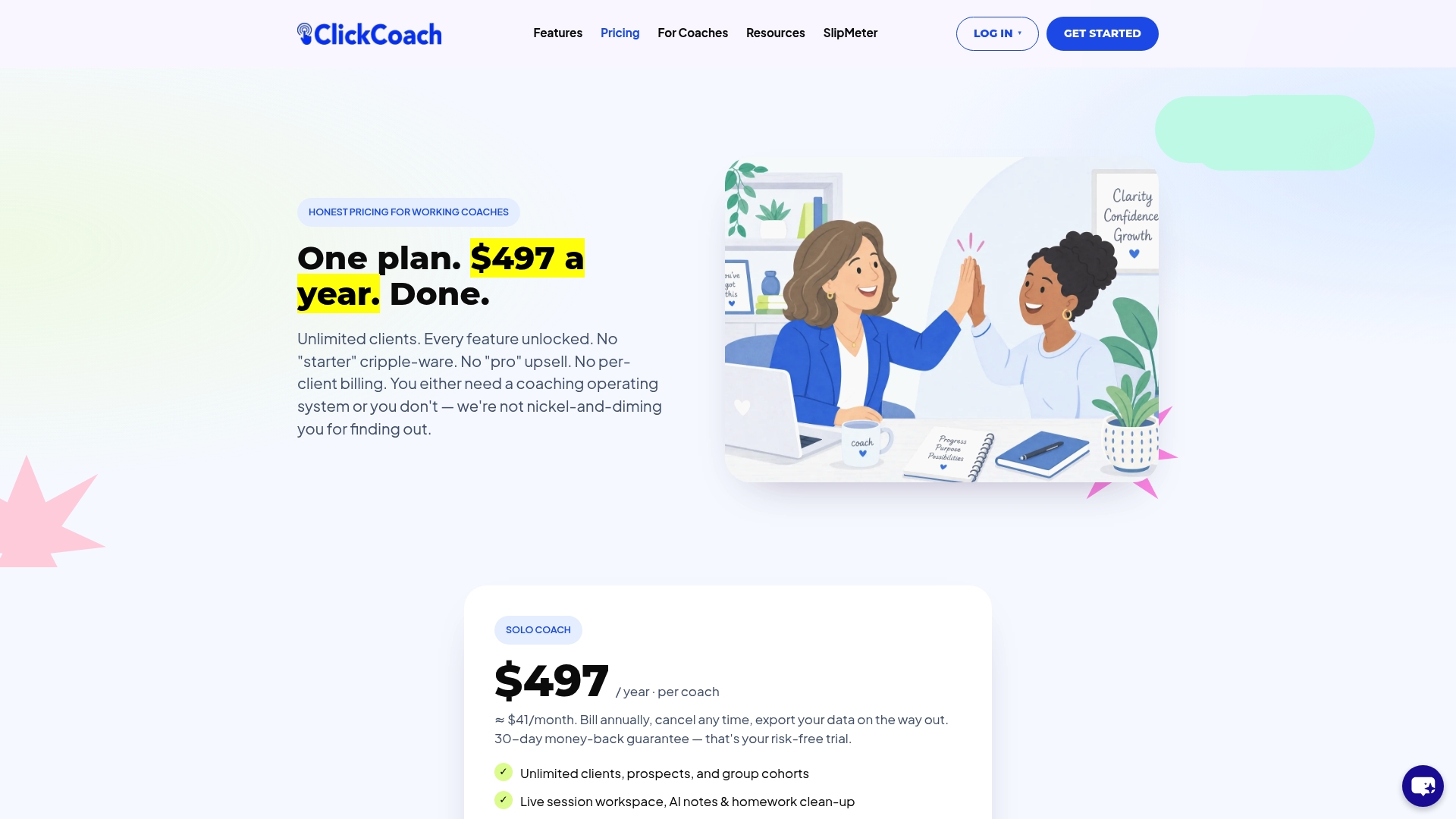
ClickCoach brings session notes, action plans, and progress tracking into one workspace built specifically for coaching practices, not a generic project management tool repurposed for the job. Every session can be documented with the previous cycle’s action items reviewed before new ones are assigned, which is the “closing the loop” step that most coaching relationships lose track of once client volume grows. Branded client portals give clients a place to see their own progress between sessions, turning your follow-up into something visible rather than something they have to take on faith. AI assists with drafting homework and follow-up actions, but you stay in control of what actually gets sent.
If you’re scaling past a handful of clients or adding coaches to your practice, this is the point where informal tracking breaks down and a dedicated system starts paying for itself in saved time and demonstrable results. Take a look at ClickCoach’s progress tracking software to see how a structured loop looks when it’s built into your daily workflow, or start with the full coaching business management platform to see everything in one place.
Sources
- Fast feedback fuels performance — Gallup
- Performance feedback: evidence review — CIPD
- Structured feedback and learning effectiveness — MDPI (Sustainability)
- Closing the customer feedback loop — Harvard Business Review
FAQ
Why are feedback loops so important?
Feedback loops matter because they turn one-time comments into a documented, repeatable cycle that drives measurable change; without a defined cadence, owner, and follow-up, feedback tends to evaporate before it produces any real improvement.
What is the purpose of a feedback loop?
The purpose is to collect input, convert it into a specific action, implement the change, and report the result back to whoever gave the input, a process known as closing the loop that sustains trust and participation.
What are the benefits of positive feedback loops?
Positive, growth-oriented feedback increases how often people seek out more feedback on their own, while research shows it also builds trust and drives higher engagement than negative feedback delivered without careful framing.
How often should a feedback loop run?
Cadence should match the stakes of the relationship. High-stakes contexts like coaching or weekly one-on-ones benefit from session-to-session follow-up, while lower-stakes product feedback can run on a sprint or monthly cycle.
Can a tool like ClickCoach help coaches manage feedback loops?
Yes. ClickCoach centralizes session notes, action plans, and progress tracking so coaches can document input and follow-up consistently, which is especially useful once a practice grows beyond a single coach managing everything from memory.