

Referrals are the fastest, lowest-cost way to convert high-trust clients when you’re building a new coaching practice. A referred prospect already believes in your work before the first conversation, which means shorter sales cycles, better client fit, and higher retention. Start here: ask for a referral right after a client breakthrough, add one referral line to your offboarding email, and log every referral source in your CRM from day one.
Three immediate actions to take this week:
- Ask at peak enthusiasm. When a client hits a clear milestone, say: “If you know someone who’d benefit from this kind of work, I’d love an introduction.”
- Add one line to your offboarding email. Something like: “If this experience was valuable, the best compliment is an introduction to someone you think I could help.”
- Log the referral source in ClickCoach or your CRM for every new client, starting now. That data will tell you which clients refer most and when.
Key Takeaways
Referrals are high-trust, low-cost, and compounding — treat them as a channel with a repeatable workflow, not a happy accident.
| Point | Details |
|---|---|
| Ask at peak enthusiasm | Time your referral ask to a client milestone or breakthrough for the highest intro rate. |
| Log every source | Record referral source, ask date, and conversion outcome in ClickCoach or your CRM from day one. |
| Keep incentives simple | A discounted first session for the friend or a bonus session for the referrer outperforms complex commissions. |
| Use story-driven prompts | Ask clients “What was your biggest breakthrough?” to get testimonials that function like referrals. |
| ClickCoach centralizes the system | Client records, templated messaging, and analytics keep the full referral loop in one place. |
Table of Contents
- Why referrals and word-of-mouth outperform paid channels for coaching
- How to turn referrals from a one-off into a repeatable system
- Exact scripts and timing: how to ask without damaging the relationship
- When to use incentives and what feels authentic for coaching
- How to measure referral performance
- How to gather testimonials that function like referrals
- Copy-and-paste templates and a launch checklist
- Common mistakes new coaches make when asking for referrals
- How ClickCoach supports your referral system
- What I’ve seen work in early-stage coaching practices
- ClickCoach makes your referral system practical from day one
- Sources
Why referrals and word-of-mouth outperform paid channels for coaching
Referrals convert faster because they carry social proof and lower perceived risk. When a trusted friend recommends a coach, the prospective client skips the skepticism phase entirely. Personal recommendations transfer trust in a way that no ad or social post can replicate, and for coaching, where the service is deeply personal, that trust transfer is decisive.
The mechanics work like this: the referrer lends their credibility to you, frames your work through their own transformation story, and pre-qualifies the fit. The referred prospect arrives already believing the outcome is possible for them. That’s a fundamentally different starting point than a cold lead who found you through a Google ad.
Downstream, referred clients tend to stay longer, spend more, and refer others themselves. Aggregated figures in coaching resources consistently cite studies showing that people trust recommendations from friends and family more than any other information source. For a new coach with a limited marketing budget, that compounding effect is the most efficient growth lever available.
The core advantage: Referrals reduce the cost of client acquisition while increasing the quality of the client relationship from the very first session.
How to turn referrals from a one-off into a repeatable system
Top coaches treat referrals as a deliberate, measurable channel, not a lucky byproduct of good work. The shift from hope-based to system-based referrals comes down to three components: touchpoints, tracking, and follow-up.
Build a referral touchpoint calendar with these four moments:
- Onboarding mention. Plant the seed early: “As we work together, if you know someone who could benefit, I’d love a warm introduction.”
- Milestone ask. At a clear win, ask directly and capture the moment as a case study asset.
- Offboarding. Include a referral line in your final email and a shareable link.
- 90-day follow-up. Re-engage past clients with a check-in and a gentle referral nudge.
What to log for every referral:
- Ask date and method (in-session, email, text)
- Referrer name and client segment
- Channel (direct intro, shared link, social mention)
- Conversion outcome and time-to-close
A well-designed referral program gives each client a unique referral link, automates tracking, and makes it easy to see which clients refer most. That data moves you from guessing to forecasting.
Pro Tip: Ask at the moment of peak enthusiasm, then immediately document the client’s result as a short case study. You now have a referral ask and a conversion asset in the same conversation.
Exact scripts and timing: how to ask without damaging the relationship
Short, dignified invitations work best. The goal is to center the friend’s benefit, not your need for clients. Here are scripts you can use immediately.
In-session (at a milestone): “You’ve made real progress here. If you know someone who’s been dealing with something similar, I’d be glad to have a conversation with them. Would you be open to making an introduction?”
Offboarding email line: “Working with you has been genuinely rewarding. If someone in your network could benefit from this kind of support, I’d welcome an introduction — no pressure at all.”
Short referral follow-up email: “Hi [Name], I hope things are going well since we wrapped up. If anyone in your circle has been thinking about coaching, I’d love to connect with them. A quick intro email works perfectly.”
Milestone text or message: “That breakthrough you had last week was real. If you know someone who needs this, I’m here.”
Timing rules:
- Ask during or right after a win, never during a crisis or stressful phase.
- Renewal conversations are a natural second ask.
- Always get consent before sharing anyone’s contact information.
When to use incentives and what feels authentic for coaching
Incentives are optional. Genuine client satisfaction drives most referrals, and keeping incentives simple and low-friction preserves the dignity of the relationship. When you do offer something, frame it as a gift to the friend, not a transaction.
Incentive options that work well:
- A discounted first session for the referred friend
- One bonus session for the referrer
- A resource bundle (workbook, guide) for the new client
- A dual-sided offer: both parties get something small and useful
Avoid complex commission structures. When referrals feel like a sales arrangement, clients hesitate to participate because they worry about their reputation. Framing referrals as a gift to a friend reduces that risk and keeps the ask relational rather than transactional.
Pro Tip: Lead with the friend’s benefit: “I’d love to offer your friend a discounted first session” lands better than “I’ll give you credit if they sign up.”
How to measure referral performance
Track a small, focused set of KPIs. More data than this creates overhead without insight.
| KPI | Definition | How to calculate |
|---|---|---|
| Intro rate | Share of asks that result in an introduction | Introductions ÷ asks |
| Conversion rate | Share of introductions that become clients | New referred clients ÷ introductions |
| Time-to-close | Days from introduction to signed agreement | Average across referred clients |
| Referral LTV | Lifetime value of referred clients vs. non-referred | Revenue per referred client |
Expect 90–180 days before patterns emerge clearly. In that window, run simple A/B tests: try two different ask scripts or two incentive framings and compare intro rates. Log everything in ClickCoach’s client records or your CRM so the data is searchable and tied to individual client histories.
Tracking referral sources and building a repeatable ask process is what separates coaches who grow predictably from those stuck in feast-or-famine cycles.
How to gather testimonials that function like referrals
Story-driven testimonials do the same job as a referral: they transfer trust and lower perceived risk for a prospective client. Ask for the transformation arc, not generic praise.
Six prompts that generate usable testimonial content:
- “What was your biggest breakthrough during our work together?”
- “What changed for you in the first 30 days?”
- “What would you tell a friend who was considering working with me?”
- “What problem were you trying to solve when you first reached out?”
- “What result surprised you most?”
- “How would you describe this experience to someone who’s never worked with a coach?”
Short quotes work on landing pages. Longer written responses work in sales conversations. Audio or video testimonials build the highest trust in personal-brand niches. For social proof strategies that increase engagement, place testimonials close to your referral call-to-action so the two reinforce each other.
Pro Tip: At the end of a testimonial conversation, ask: “Would you be comfortable forwarding a one-line version of that to a friend who might benefit?” You’ve just turned a testimonial into a referral asset.
Copy-and-paste templates and a launch checklist
Email Template 1 — In-session follow-up: “Hi [Name], it was great to see your progress today. If someone in your network is navigating something similar, I’d genuinely welcome an introduction. A quick email connecting us is all it takes.”
Email Template 2 — Milestone referral request: “Hi [Name], I’ve been reflecting on the work you’ve done over the past [X weeks]. The results speak for themselves. If you know someone who could benefit from this kind of focused support, I’d love to connect with them.”
Email Template 3 — Gentle reminder for passive referrers: “Hi [Name], just checking in. I hope things are going well. I’m currently opening a few spots for new clients — if anyone comes to mind, I’d be grateful for an introduction.”
Referral page copy (short): “Know someone who could use focused, results-driven coaching? Send them here. [Your Name] works with [niche] to [specific outcome]. [Link to book a free call].”
Launch checklist:
- Add a referral line to your onboarding welcome email.
- Add a referral line to your offboarding email.
- Create a shareable referral link or simple intake form.
- Add a referral source field in ClickCoach or your CRM.
- Schedule a 90-day follow-up sequence for past clients.
- Draft your milestone ask script and save it somewhere accessible.
Common mistakes new coaches make when asking for referrals
Most referral systems fail not because the coach lacks clients, but because the ask is mistimed, undocumented, or never followed up.
- Asking too early. Asking before a client has experienced a real result feels presumptuous. Wait for a tangible win.
- Sounding transactional. Framing the ask around your need (“I’m trying to grow my business”) shifts focus away from the friend’s benefit.
- Not documenting sources. If you don’t log where clients come from, you can’t identify your best referrers or replicate what’s working.
- Forgetting to thank referrers. A sincere, personal thank-you after an introduction converts is one of the highest-ROI actions in your practice.
- Relying on a single channel. Referrals from clients are powerful, but connecting with connectors — people who know many others in your niche — multiplies reach significantly.
- Asking during a crisis. If a client is struggling, asking for a referral damages trust. Read the room.
The fix for most of these is a referral trigger calendar: a simple schedule that maps ask moments to client milestones so the timing is never improvised.
How ClickCoach supports your referral system
ClickCoach centralizes referral capture and tracking so you can log sources, close the loop quickly, and spend less time on administration. The platform’s client records support referral source fields, so every new client intake includes where they came from. Templated email broadcasts let you send milestone follow-ups and referral nudges without rebuilding messages from scratch each time.
Specific features that support the referral workflow:
- Client records with custom fields for referral source and ask date
- Branded client portals that clients can share as a referral landing point
- Templated messaging for milestone asks and follow-up sequences
- Analytics to track conversion rates across client segments
Coaches using ClickCoach report saving up to 20 minutes per session by keeping session notes, homework, progress tracking, and client communications in one place. That time compounds: less administrative drag means more energy for the client relationships that generate referrals.
A simple workflow: log the referral source on intake → send an automated thank-you to the referrer → apply a bonus session credit or schedule a follow-up gift. The whole loop runs inside one platform.
What I’ve seen work in early-stage coaching practices
The coaches who grow fastest from referrals share one habit: they ask at the right moment and they follow up. Not once, not occasionally. Every time.
Early in a coaching practice, the temptation is to wait until you have more clients, more testimonials, more credibility. But the first referral almost always comes from the first client who had a real breakthrough. That moment is the system. Ask then, document the result, send a thank-you, and repeat. The pipeline builds from that single, well-timed ask more reliably than from any ad campaign.
The other thing that matters: building trust online and maintaining relationships with past clients between engagements. A check-in email three months after offboarding has generated more referrals for early-stage coaches than any formal program. Keep the relationship warm and the referrals follow.
ClickCoach makes your referral system practical from day one
Running a referral system manually across email, spreadsheets, and notes is where most coaches lose momentum. ClickCoach gives you one login for client records with referral source fields, templated email broadcasts for milestone asks, branded client portals your clients can share, and analytics that show which segments convert. The AI-assisted homework and progress tracking keep clients engaged between sessions, which is what generates the breakthroughs worth referring.
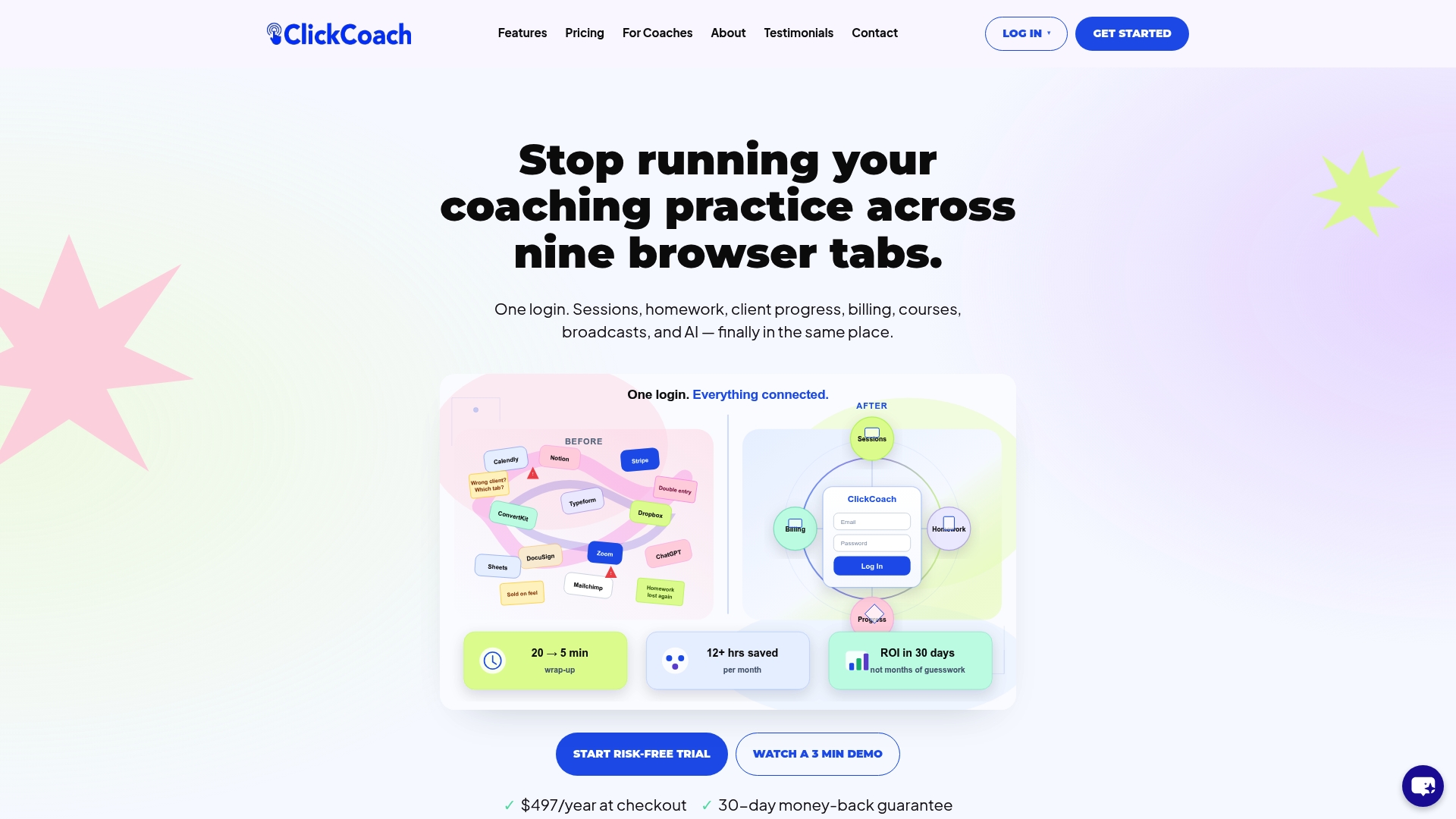
Every feature is included in a single annual subscription with a 30-day money-back guarantee. No tiers to compare, no integrations to stitch together. Start your ClickCoach practice today and have your referral tracking system live before your next session.