

A short, structured discovery call is the most reliable way a coach assesses fit, starts trust, and produces a clear next step before any money changes hands. According to LinkedIn Sales Solutions, discovery calls are designed to start relationships, gather qualifying information, and move conversations toward a decision or a clean disqualification. That dual purpose — to serve the prospect and protect your practice — is exactly why skipping this step costs coaches more than the 30 minutes they think they’re saving.
Keep the call to 15–30 minutes. Open with a one-line agenda: “Today I want to understand your situation, share how I work, and decide together whether this is a good fit.” Close with a concrete next step: either a proposal, a follow-up call, or a clear no. That structure alone separates coaches who convert consistently from those who give away hours of free advice and wonder why prospects go quiet.
Key Takeaways
A structured, 30-minute discovery call with a clear 4-stage agenda is the most reliable way to assess fit, build early trust, and convert prospects into committed coaching clients.
| Point | Details |
|---|---|
| Use a 4-stage structure | Open, Discover, Reflect, and Offer in 30 minutes produces a clear decision every time. |
| Target a 30/70 talk ratio | Aim for the client to talk ~70% of the call; use the 3-second pause to get there. |
| Log one diagnostic sentence | After every call, record goal, readiness signal, one concern, and next step in your CRM. |
| Send follow-up within 2 hours | A short email with a one-sentence summary and a concrete next step closes the loop fast. |
| ClickCoach centralizes the workflow | Intake templates, session notes, CRM, and follow-up emails in one workspace reduce admin and keep client context intact. |
Table of Contents
- What a coaching discovery call actually is
- Why discovery calls are important to your coaching business
- How to structure a 30-minute discovery call
- Sample questions to ask on a discovery call
- What to listen for: fit signals and red flags
- How to prepare before the discovery call
- How to handle pricing, offers, and next steps
- Copy-ready discovery-call script and intake template
- Applying the Five C’s framework and talk-ratio evidence
- The discovery call habit that protects your results
- ClickCoach makes every discovery call repeatable
- Sources
- FAQ
What a coaching discovery call actually is
A coaching discovery call is a 15–30 minute, bidirectional fit-and-clarity conversation. The coach is assessing whether the prospect is coachable and aligned with the coach’s method. The prospect is deciding whether this coach understands their situation and is worth the investment. As the Co-Active Training Institute frames it, the call is a two-way assessment that lays the foundation for a coaching relationship — not a substitute for paid sessions.
Primary use cases:
- Qualifying a new lead before investing in a full proposal
- Assessing coaching fit (values, communication style, readiness)
- Aligning on scope, goals, and realistic outcomes
- Setting expectations about the coaching process and commitment
- Creating early momentum so the prospect feels progress before signing
One distinction worth making explicit: a discovery call is not a free coaching session, not an intake form, and not a full session compressed into 30 minutes. An intake form captures data. A full session delivers coaching. A discovery call does neither — it creates enough clarity for both parties to make a confident decision.
Why discovery calls are important to your coaching business
The importance of discovery calls shows up on two levels: business returns and coaching outcomes. Both matter, and coaches who treat the call as purely a sales step miss half the value.
Business-side benefits:
- Faster qualification means you spend time only on prospects who are genuinely ready
- Higher conversion rates because the prospect already trusts you before the proposal arrives
- Fewer bad-fit clients, which reduces scope creep, refund requests, and early terminations
- More predictable client load because you can forecast pipeline from call volume
Coaching-outcome benefits:
- Earlier goal alignment shortens the ramp-up phase of the engagement
- Stronger early rapport carries into the first paid session
- Clients who articulate their goals on a discovery call tend to hold themselves more accountable from day one
- You surface mismatched expectations before they become mid-engagement conflicts
FoundersBestFriend recommends structuring the call so prospects leave with useful insights and clear next steps — a principle that increases trust and referral rates even when the prospect doesn’t buy immediately.
Pro Tip: In the first 10 minutes, offer one specific observation about the prospect’s situation — not advice, just a reflection. Something like: “What I’m hearing is that the goal is clear but the path feels uncertain — is that right?” That single moment of being seen builds more trust than five minutes of explaining your credentials.
How to structure a 30-minute discovery call
A reproducible structure is what separates a productive discovery call from a rambling conversation. The four-stage model below gives you timing, a purpose for each block, and a checklist you can paste into your booking confirmation or session notes.
| Time block | Stage | Coach’s job | Output |
|---|---|---|---|
| 0–5 min | Open and contract | State the agenda, confirm time, ask permission to take notes | Shared expectations |
| 5–20 min | Discover | Ask 3–4 open questions; listen more than you talk | Clear picture of goals, constraints, and readiness |
| 20–25 min | Reflect and summarize | Mirror back what you heard; name the gap or opportunity | Prospect feels understood |
| 25–30 min | Offer and decide | Present your approach neutrally; invite a decision or next step | Clear yes, no, or follow-up date |
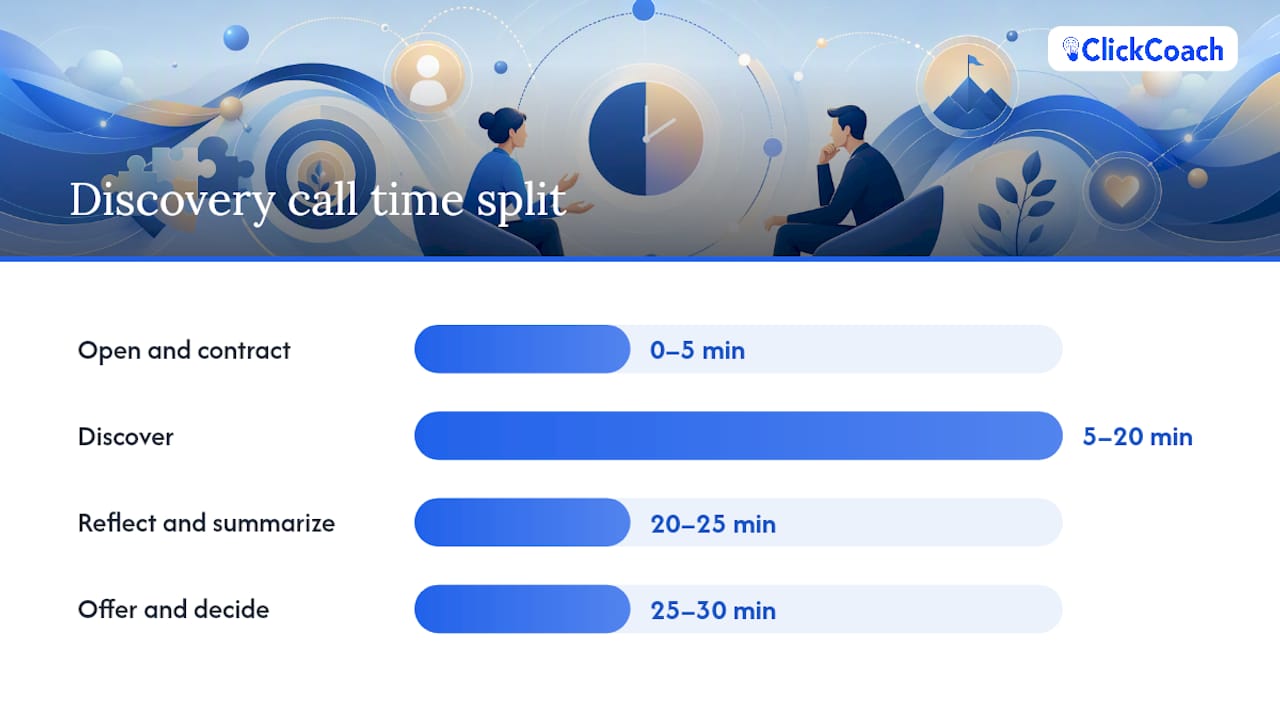
This 4-stage structure — Understand, Reflect, Offer, Decide — is consistent with guidance from Transformation Academy, which cautions coaches to frame the call as a service conversation, not a pitch, and to use neutral language when presenting their offer.
Pre-call checklist (copy into your booking confirmation):
- [ ] Confirm date, time, and video/phone link
- [ ] Send one pre-call intake question (see Section 9 for the full template)
- [ ] Review intake response before the call
- [ ] Set your own session goal: what decision should this call produce?
- [ ] Prepare 3 prioritized diagnostic questions
Sample questions to ask on a discovery call
Organized by purpose, these questions are designed for live use or as intake form prompts. Open-ended and future-focused questions encourage self-discovery and accountability, which is why every question below avoids yes/no framing.
Diagnostic questions (current problem and impact):
- “What’s the one thing that, if it changed, would make the biggest difference in your work right now?”
- “How long has this been a challenge, and what has it cost you — in time, revenue, or energy?”
- “What does success look like to you 6 months from now, in concrete terms?”
- “What have you already tried, and what happened?”
Clarifying questions (root causes and past attempts):
- “When you say [X], what do you mean specifically?”
- “What’s getting in the way that you haven’t been able to solve on your own?”
- “If you knew the answer, what would it be?”
- “What would need to be true for this to feel solved?”
Decision-oriented questions (readiness, budget framing, timeline):
- “What’s your timeline for making a change — is this urgent or exploratory?”
- “Have you worked with a coach before? What did or didn’t work?”
- “What would need to happen on this call for you to feel confident moving forward?”
The last question is particularly useful: it hands the decision criteria back to the prospect and tells you exactly what you need to address before the call ends.
What to listen for: fit signals and red flags
Asking good questions is only half the skill. What you hear — and how you log it — determines whether your qualification process actually improves over time.
Signals of strong fit:
- Specific, measurable goals (“I want to close 20% more deals by Q3”)
- A committed timeline (“I need to make a decision this week”)
- Prior investment in development (previous coaching, courses, therapy for personal growth)
- Ability to describe what change looks like, not just what they want to escape
- Ownership language (“I need to change how I respond”) rather than blame language
Red flags that predict poor fit:
- Vague outcomes (“I just want to feel better” with no further specificity)
- Expectations that blur coaching and therapy (“I need someone to help me process my childhood”)
- Dependency signals (“I’ll need you to tell me what to do each week”)
- Unwillingness to commit time (“I’m really busy — can we do 20 minutes a month?”)
- Fee resistance framed as principle (“I don’t think I should have to pay for this”)
How to log what you hear: After the call, write one sentence in your CRM or notes: “[Name] — [goal in their words] — [readiness signal] — [one concern] — [next step].” That single line is enough to re-orient yourself before a follow-up call and to spot patterns across your pipeline. For coaches building a consistent coaching client onboarding process, this note discipline is what turns a good call into a repeatable system.
How to prepare before the discovery call
Preparation takes less than 10 minutes when you have a system. The goal is to start focused, not to over-research the prospect.
Client-facing prep:
- Send a booking confirmation with the one-line agenda and the video/phone link
- Include one pre-call intake question: “In 2–3 sentences, describe the main outcome you’re hoping coaching will help you achieve.”
- Confirm the appointment 24 hours in advance with a simple reminder
Coach-facing prep:
- Read the intake response and note 1–2 diagnostic hypotheses (what you think the real issue might be)
- Choose your 3 prioritized questions from the diagnostic and clarifying sets above
- Set a clear session goal: “By the end of this call, we will both know whether to move forward.”
- Test your tech — audio, video, and note-taking tool — 5 minutes before the call
For scheduling, a low-friction booking page reduces no-shows and removes the back-and-forth email chain. Tools like Calendly illustrate how a simple 30-minute booking page with a built-in intake question can cut pre-call admin to near zero. ClickCoach’s session templates and CRM fields serve the same function inside a single practice workspace, so intake responses, notes, and follow-up actions stay connected to the client record from day one.
How to handle pricing, offers, and next steps
The offer conversation is where most coaches lose momentum — either by over-explaining, under-pricing, or leaving the decision open-ended. Keep it short and neutral.
Three ways to present your fee:
- Transparent: “My standard engagement is [X] per month for [Y sessions]. Does that fit what you had in mind?”
- Tiered: “I offer two options: [Option A] for clients focused on [outcome], and [Option B] for deeper work. Based on what you’ve shared, [Option A] seems like the right fit — want me to send the details?”
- Referral-friendly: “If this isn’t the right fit for your budget right now, I’m happy to point you toward someone who works at a different level. No pressure either way.”
Avoid discounting on the call. If a prospect pushes back on price, the right response is curiosity, not a reduced fee: “What would make this feel like a clear yes for you?”
Follow-up email template (send within 2 hours of the call):
Subject: Next steps from our call today
Hi [Name],
It was great connecting. Based on our conversation, [one-sentence summary of their goal]. I’ve attached [proposal / program overview] for your review. The next step is [specific action — e.g., “reply to confirm” or “schedule a 15-minute follow-up by Friday”].
Looking forward to working together.
In your CRM or practice tool, log: decision (yes/no/follow-up), next step, timeline, and who owns the action. That four-field note closes the loop and keeps your pipeline accurate.
Copy-ready discovery-call script and intake template
Copy this script into your session notes, booking confirmation, or ClickCoach template. Adapt the bracketed sections to your niche.
Opening (0–2 min): “Thanks for making time today. I have us down for 30 minutes. My plan is to spend most of it understanding your situation, then share a bit about how I work, and we’ll decide together whether it makes sense to go further. Does that work for you?”
Transition into discovery (2–3 min): “Great. Tell me — what’s going on for you right now that made you reach out?” [Listen. Don’t interrupt. Use the 3-second pause before responding.]
Reflective summary (20–22 min): “Let me make sure I’ve got this right. You’re dealing with [X], it’s been happening for [Y], and the impact is [Z]. The outcome you’re after is [goal]. Does that capture it?”
Offer language (25–28 min): “Based on what you’ve shared, here’s how I’d approach this with you: [one-sentence description of your method]. My [program/engagement] is designed for exactly this kind of work. Would you like me to send you the details?”
Closing (28–30 min): “What’s your timeline for making a decision? I’ll follow up by [date] — does that work?”
Pre-call intake template (send with booking confirmation):
| Field | Prompt |
|---|---|
| Name and contact | [Name, email, phone] |
| Main outcome | “In 2–3 sentences, what outcome are you hoping coaching will help you achieve?” |
| Prior attempts | “What have you already tried to address this?” |
| Timeline | “How soon are you looking to make a change?” |
| Budget frame | “Have you invested in coaching or professional development before?” |
Niche adaptations: For executive coaching, add “What does your organization expect to change as a result of this engagement?” For wellness coaching, replace the budget-frame question with “What does your current self-care or health routine look like?” For life coaching, add “What would your life look like if this were fully resolved?”
Applying the Five C’s framework and talk-ratio evidence
Two research-backed tools can measurably improve your discovery calls: the Five C’s coaching frameworks and talk-ratio data from large-scale conversation analysis.
The Five C’s mapped to discovery-call behaviors
Professional coaching frameworks describe two common Five C’s variants. Here’s how each maps to a specific discovery-call behavior:
| C | Variant 1 | Variant 2 | Discovery-call behavior |
|---|---|---|---|
| 1 | Clarity | Clarity | Ask the goal question early; confirm you both mean the same thing |
| 2 | Compassion | Confidence | Acknowledge the prospect’s challenge before moving to solutions |
| 3 | Curiosity | Competence | Use open questions; resist the urge to advise |
| 4 | Confirmation | Commitment | Reflect back what you heard; get explicit agreement |
| 5 | Commitment | Consistency | Close with a concrete next step; don’t leave the call open-ended |
Talk-ratio evidence and how to hit the 30/70 target
PulseRevOps, summarizing Gong’s large-call analysis, recommends a 30% coach / 70% client talk ratio on first discovery calls. Higher client talk time correlates with better disclosure and stronger conversion. Two tactics make this achievable:
- The 3-second pause: After the prospect finishes speaking, wait 3 seconds before responding. Most people fill silence with more information — often the most important information.
- The 90-second monologue rule: If you’ve been talking for 90 seconds without a question or a pause, stop and ask: “What’s your reaction to that?”
Two-metric dashboard to track across your next 10 calls:
| Metric | Target | How to measure |
|---|---|---|
| Client talk percentage | ~70% | Estimate at call end or use a transcription tool |
| Number of open “why” questions asked | 3–5 per call | Tally in your notes immediately after |
Run this across 10 calls and you’ll have a baseline. Coaches who track these two numbers consistently report clearer calls and faster decisions — not because the questions are magic, but because the discipline of tracking forces better listening.
The discovery call habit that protects your results
Most coaches I’ve worked with underestimate one thing: the discovery call is not just a sales filter. It’s the first moment of accountability in the coaching relationship. When a prospect articulates their goal out loud, in their own words, to another person, they’ve made a small commitment. That commitment carries forward.
The habit I recommend is this: at the end of every discovery call, log one diagnostic sentence and set the first month’s milestone before you close the booking. Something like: “[Name] — goal: double revenue in 12 months — readiness: high — first milestone: close 3 new clients by end of month 1.” That note takes 30 seconds and becomes the anchor for your first paid session. Without it, you’re starting from scratch every time.

The coaches who skip this step often find themselves re-diagnosing in session two or three — which wastes paid time and erodes client confidence. The discovery call, done well, eliminates that ramp-up entirely.
ClickCoach makes every discovery call repeatable
Running a consistent discovery call process is straightforward when your intake fields, session templates, CRM notes, and follow-up emails live in one place. ClickCoach brings all of that into a single workspace built specifically for professional coaches.
With ClickCoach, you can store your intake template and call script as reusable session templates, log prospect notes directly into the CRM pipeline, and send a follow-up email from the same platform where you track client progress. When a prospect converts, their discovery-call notes carry forward into the client record automatically — no copy-pasting between tools, no lost context. The AI-assisted homework and follow-up drafting keeps you in control while cutting the time you spend on post-call admin.
Coaches using an all-in-one practice manager spend less time on logistics and more time on the work that actually moves clients forward. If you’re ready to make your discovery calls consistent and your onboarding process professional, start with ClickCoach or join the platform today.
Sources
- How to handle coaching discovery calls? (FoundersBestFriend)
- Coaching Discovery Call Guide - Co-Active Training Institute
- How to Run a Coaching Discovery Call That Converts - Transformation Academy
- Discovery Call Guide | LinkedIn Sales Solutions
FAQ
What is a discovery call in coaching?
A coaching discovery call is a 15–30 minute, bidirectional conversation that assesses whether the coach and prospect are a good fit before any paid engagement begins. It is not a free coaching session — it is a structured fit-and-clarity conversation that ends with a clear next step.
Why are discovery calls important for coaches?
Discovery calls help coaches qualify prospects faster, avoid bad-fit clients, and set clear expectations before the engagement starts. They also create early accountability momentum: prospects who articulate their goals on a discovery call tend to enter the paid engagement more committed.
What is the 70/30 rule in coaching discovery calls?
Conversation-intelligence analysis from large call datasets supports this ratio as a signal of better disclosure and stronger conversion on first discovery calls.
What are the Five C’s of coaching?
Two common versions exist. One lists Clarity, Compassion, Curiosity, Confirmation, and Commitment; another uses Clarity, Confidence, Competence, Commitment, and Consistency. Both map directly to discovery-call behaviors — from asking clear goal questions early to closing with a concrete next step.
Should a coaching discovery call be free?
Most coaches offer discovery calls at no charge, keeping them to 15–30 minutes. The call is a qualification and fit conversation, not a paid session, so charging for it typically reduces booking rates without adding proportional value to either party.