

A coaching practice is the structured set of methods, systems, and client management routines that a coach uses to deliver effective, results-driven services. The term “coaching practice” functions as an everyday shorthand, but the recognized industry term is professional coaching practice, defined by the International Coaching Federation (ICF) as a collaborative coaching partnership that inspires clients to maximize their potential through guided self-reflection. That definition matters because it separates coaching from mentoring, therapy, and consulting. A well-built practice is not just about coaching skill. It is the entire operating system behind how you find clients, run sessions, track progress, and grow sustainably.
What is a coaching practice and what does it include?
A coaching practice is the full framework a coach operates within, covering methodology, session structure, client management, and administrative systems. Think of it as the difference between knowing how to cook and running a restaurant. The skill is necessary, but the systems make it repeatable and scalable.
Every coaching practice rests on three pillars: a defined coaching approach, a structured session model, and a client engagement system. Without all three, even talented coaches lose clients to disorganization, inconsistency, or burnout.

Coaching approaches vary widely. One-on-one coaching is the most common format, offering personalized attention and deep client relationships. Group coaching serves multiple clients simultaneously, reducing cost per client while building peer accountability. Peer coaching, used heavily within training programs like those at the Co-Active Training Institute, bridges theory and real practice by letting coaches rehearse skills in a safe environment. Executive coaching and life coaching represent two of the most commercially established specializations.
Session structure typically follows three phases:
- Planning: Review client goals, prior session notes, and agreed homework before the session starts.
- Delivery: Use your chosen coaching modality, whether Co-Active Coaching, solution-focused coaching, or cognitive behavioral coaching, to guide the conversation.
- Follow-up: Send session summaries, assign next steps, and document progress immediately after the session ends.
Pro Tip: Write your session notes within 30 minutes of ending a call. Memory degrades fast, and delayed notes create gaps that erode client trust over time.
The essential skills that define a strong coaching practice include active listening, powerful questioning, goal-setting frameworks, accountability structures, and the ability to track measurable client progress across multiple engagements.
How does client management impact coaching practice success?
Client management is the operational backbone of any coaching practice. Poor management does not just create administrative headaches. It directly damages client outcomes, because missed notes, forgotten commitments, and inconsistent follow-up break the continuity that coaching depends on.
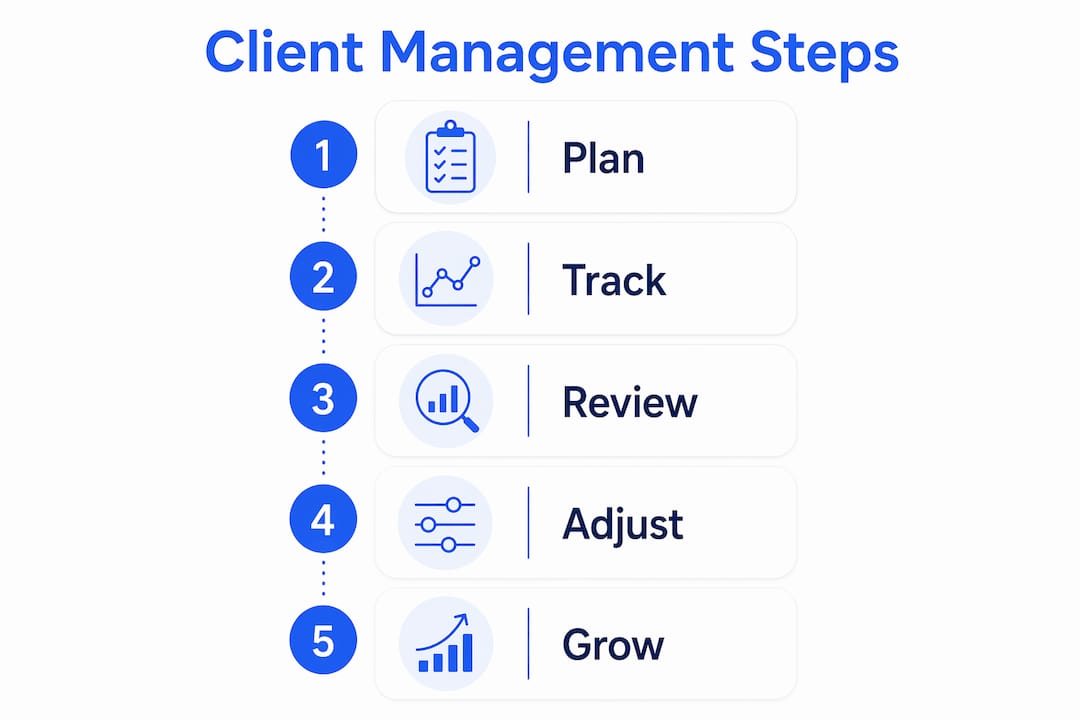
The right management system depends on client volume. Spreadsheets work well for coaches managing fewer than 15 clients before switching to a specialized CRM becomes cost-effective. Coaches managing 12–15 clients typically reach the break-even point where investing in a dedicated platform saves roughly 2 hours per month at a $100 hourly rate. That math justifies the subscription cost quickly.
| Client volume | Recommended tool | Primary benefit |
|---|---|---|
| 1–5 clients | Spreadsheet or notes app | Zero cost, low complexity |
| 6–14 clients | Spreadsheet with templates | Structured without overhead |
| 15+ clients | Specialized CRM or platform | Time savings justify subscription |
| 20+ clients | All-in-one coaching platform | Centralized data, automation |
The concept of a “source of truth” is central to good client management. One system holds all session notes, goals, progress data, and communications. Coaches who avoid scaling toolsets too early prevent the chaos that comes from data scattered across email, Notion, Google Sheets, and a CRM simultaneously.
Pro Tip: Pick one system and use it imperfectly rather than running three systems perfectly. A functional, slightly messy single source of truth beats a pristine multi-tool setup that nobody updates consistently.
Administrative cadences keep client management from collapsing under volume. Daily session notes, weekly client progress reports, and quarterly audits form the rhythm that prevents administrative debt from accumulating. Skipping these routines for two weeks creates a backlog that takes days to clear.
What is digital coaching and how does it differ from traditional practice?
Digital coaching is a technology-enabled model that delivers personalized development through video sessions, AI-powered tools, chat, microtasks, and automated progress tracking. Traditional one-on-one executive coaching costs between $500 and $10,000 per month, placing it out of reach for most employees and individual clients. Digital coaching cuts those costs significantly while expanding reach to international and decentralized teams.
The most important distinction is scalability. A traditional coaching practice is limited by a coach’s available hours. A digital practice uses technology to serve more clients without proportionally increasing time investment.
Digital coaching also adds a layer of measurability that traditional models lack. AI-powered roleplay scenarios let clients rehearse real business conversations before they happen, with performance data captured automatically. That data feeds back into the coaching relationship, making progress visible and concrete rather than anecdotal.
Steps to implement digital coaching in an existing practice:
- Audit your current session format and identify which elements can move to asynchronous delivery, such as homework review or goal check-ins.
- Choose a video platform for live sessions. Zoom and Google Meet are the most widely adopted options.
- Add a client portal where clients can access session recordings, homework, and progress notes between sessions.
- Introduce microtasks: short, specific assignments clients complete between sessions to reinforce coaching insights.
- Use AI tools to draft homework prompts, summarize session notes, and flag clients who have not engaged recently.
- Review engagement data monthly and adjust your delivery model based on what clients actually use.
Digital coaching works especially well for enterprise organizations with employees across multiple time zones, where scheduling traditional sessions creates logistical friction that reduces participation rates.
How do coaching practice organization systems enhance efficiency?
A coaching practice organization system is the set of Standard Operating Procedures (SOPs), administrative rhythms, and decision rules that keep a practice running consistently regardless of volume or complexity. Effective SOPs protect four things: the sales process, the client experience, the coach’s time, and decision quality. They are operational tools, not rigid policies.
The goal of an organization system is not perfection. A sustainable coaching practice focuses on a single system of truth rather than perfect organization, maintaining functionality despite imperfections through centralized data management. That mindset shift matters. Coaches who chase perfect systems spend more time organizing than coaching.
| SOP type | Frequency | Purpose |
|---|---|---|
| Session documentation | Daily | Capture notes while memory is fresh |
| Client progress report | Weekly | Maintain continuity and accountability |
| Onboarding checklist | Per new client | Standardize first impressions |
| Tool and system audit | Quarterly | Identify gaps and reduce tool sprawl |
| Revenue and capacity review | Quarterly | Align client load with business goals |
The recurring administrative rhythm of daily notes, weekly reports, and quarterly audits is the practical engine of a well-organized practice. Coaches who skip this rhythm accumulate what practitioners call “administrative debt,” a backlog of undocumented sessions and untracked client progress that erodes both quality and confidence.
Pro Tip: Build your SOP library one procedure at a time. Start with your onboarding checklist and session note template. Add a new SOP only when you notice yourself explaining the same thing twice.
Avoid the common mistake of scaling your toolset before your client volume justifies it. Adding a project management tool, a CRM, a scheduling app, and a billing platform before you have 15 clients creates complexity without benefit. One well-used spreadsheet outperforms four underused apps every time.
How can coaches build and sustain a successful coaching practice?
Building a successful coaching practice requires more than coaching skill. Coaches often confuse having a coaching practice with running a coaching business, and the distinction is real. A coaching practice is where you deliver coaching. A coaching business is where you market, package, price, and sell coaching services. Both require attention, but they demand different skills.
The entrepreneurial skills that separate thriving practices from stalled ones include:
- Marketing: Knowing how to attract and convert ideal clients, not just serve existing ones.
- Service packaging: Bundling sessions, homework, and check-ins into clear offers clients can evaluate and purchase.
- Pricing strategy: Setting rates that reflect your value and cover your costs. Financial planning resources, like those available through Kelliworks Accounting, help coaches build sustainable income models from the start.
- Peer coaching: Engaging regularly with other coaches for skill development and accountability. The Co-Active Training Institute identifies peer coaching as the critical bridge between formal training and real-world practice.
- Continuous professional development: Pursuing ICF credentials, advanced training, and supervision to deepen your methodology over time.
Practical growth happens in stages. Start with three to five clients at a reduced rate to refine your session structure and onboarding process. Document what works. Raise your rates as your system matures and your results become demonstrable. Resist the urge to automate or scale before your core process is repeatable.
The mindset shift that matters most is moving from “I need a perfect system” to “I need a functional system.” Functional beats perfect every time, because a functional system gets used and a perfect system gets postponed.
Key Takeaways
A coaching practice succeeds when structured methods, consistent client management, and disciplined administrative routines work together as one operating system.
| Point | Details |
|---|---|
| Core definition | A coaching practice is the full framework of methods, systems, and routines a coach uses to deliver results. |
| Client management threshold | Spreadsheets work well below 15 clients; specialized platforms become cost-effective above that volume. |
| Digital coaching advantage | Digital models cut traditional coaching costs and add measurable progress tracking through AI and video tools. |
| Organization system priority | One functional source of truth outperforms multiple underused tools at every stage of practice growth. |
| Business vs. practice | Running a coaching business requires marketing, packaging, and pricing skills beyond coaching proficiency alone. |
Why most coaching practices stall before they scale
The coaches I see struggle most are not the ones who lack skill. They are the ones who mistake activity for systems. They run great sessions, get strong client feedback, and then lose track of who owes homework, which client is in week four, and what they promised to send last Tuesday. That is not a coaching problem. It is an operations problem.
The uncomfortable truth is that most coaches underinvest in their organization system until the pain becomes unbearable. By then, they are already losing clients to disorganization, not to a competitor with better coaching skills. I have watched coaches with genuinely transformative methods lose clients simply because the follow-up experience felt chaotic.
The fix is not a new app. It is committing to one system, however imperfect, and using it every single day. The coaches who build practices that last are the ones who treat their administrative rhythm with the same discipline they bring to their coaching methodology. Incremental progress in your systems compounds just like incremental progress in your clients’ goals. Start with one SOP. Use it consistently for 30 days. Then add the next one.
— Mitch
ClickCoach: one platform for your entire coaching practice
Managing a coaching practice across multiple apps wastes time that belongs to your clients.
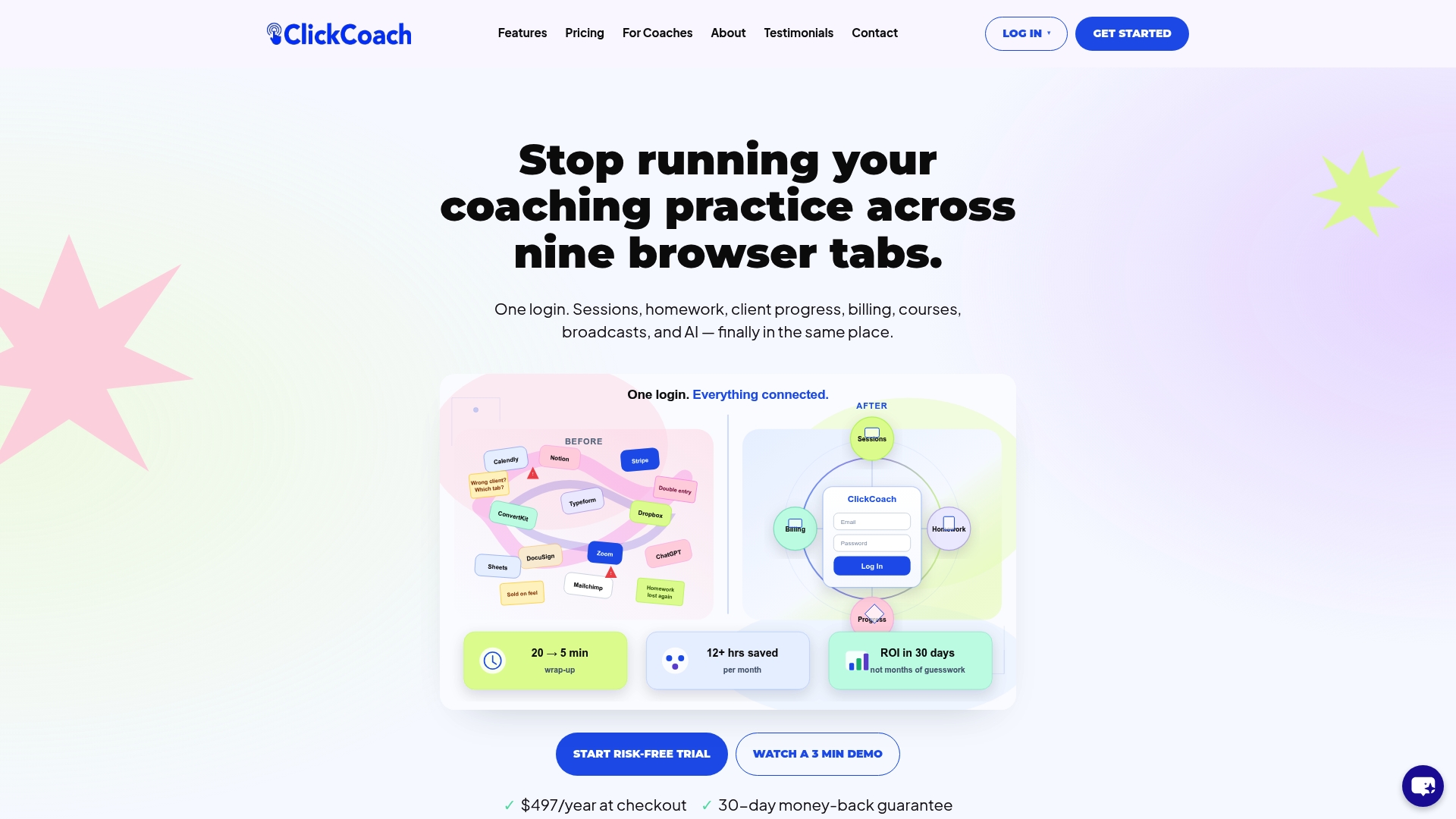
ClickCoach brings session management, billing, client progress tracking, and homework assignments under one login. The platform’s AI drafts homework prompts and tracks client engagement automatically, so you spend less time on administration and more time coaching. Coaches report saving up to 20 minutes per session by replacing their disconnected tool stack with ClickCoach’s unified workspace. Clients get a branded portal that keeps them engaged between sessions. If you are ready to replace the chaos with a system that actually works, explore ClickCoach and see what a purpose-built coaching platform looks like.
FAQ
What is the coaching practice definition?
A coaching practice is the structured set of methods, client management systems, and administrative routines a coach uses to deliver professional coaching services. The ICF defines professional coaching as a collaborative partnership focused on maximizing client potential through guided self-reflection.
How many clients do I need before switching from spreadsheets to a CRM?
Coaches managing 12–15 clients typically reach the point where a specialized platform saves enough time to justify its cost. Below that threshold, a well-organized spreadsheet is the more practical choice.
What is a digital coaching practice?
A digital coaching practice delivers coaching through video sessions, AI tools, chat, and automated progress tracking rather than in-person meetings. It reduces costs compared to traditional executive coaching and scales more effectively across large or geographically distributed client groups.
What does a coach do in a typical session?
A coach reviews client goals and prior notes before the session, uses a defined coaching modality to guide the conversation during the session, and sends a summary with assigned homework immediately after. That three-phase structure is the foundation of effective session delivery.
How do SOPs help a coaching practice?
Standard Operating Procedures protect the sales process, client experience, coach time, and decision quality by turning repeatable tasks into documented routines. They become most valuable once coaching volume grows and ad hoc explanations start consuming significant time.