

Client transformation data is the collection of measurable indicators that show a coaching client’s progress toward their goals and the behaviors driving that progress. In practice, that means pairing an outcome metric, like a body-composition trend or a leadership 360 score, with a process metric, like weekly habit adherence or session completion rate. Together, those two data points tell you whether the client is moving in the right direction and whether they are doing the work that produces the movement.
ACE Fitness notes that clients often arrive with vague goals like “improve my health.” Your job is to translate that into something measurable, and client transformation data is the structured record of that translation in action.
Key Takeaways
Client transformation data, tracked consistently across outcome and process metrics, is the foundation of evidence-based coaching and a practice that retains and grows its client base.
| Point | Details |
|---|---|
| Definition | Client transformation data is the measurable record of a client’s progress toward goals and the behaviors producing that progress. |
| Metric balance | Pair one to two outcome metrics with three to five process metrics per client for clear, coachable data. |
| Collection cadence | A five- to eight-question weekly check-in plus a monthly four-week review balances completeness with client compliance. |
| Interpretation rule | Trend lines over three or more weeks are signals; single data points are noise. Adjust your program based on patterns, not outliers. |
| ClickCoach | ClickCoach centralizes recurring assessments, session notes, dashboards, and client portals under one login, making systematic tracking practical for solo and multi-coach practices. |
Table of Contents
- Why tracking client transformation data matters for your practice
- What counts as client transformation data?
- Why outcome and process metrics both belong in your plan
- How to choose the right metrics with any client
- Practical methods to collect transformation data reliably
- How to interpret change and present progress so clients stay motivated
- Realistic timelines for measurable change
- Privacy, consent, and record-keeping best practices
- Common challenges in tracking transformation data and how to overcome them
- How data shapes your coaching decisions
- The case for making data a daily coaching habit
- ClickCoach puts your tracking system in one place
- Sources
Why tracking client transformation data matters for your practice
Measurement does two things at once: it sharpens your coaching and it grows your business.
For coaching effectiveness:
- Objective data creates short feedback loops that increase client adherence and make your decisions more precise. When a client sees their sleep consistency trending upward, their self-efficacy rises with it.
- Tracking inputs alongside outputs tells you whether a plateau is a program problem or a behavior problem, so you adjust the right variable.
For your practice:
- Consistent progress records give you the evidence to diagnose retention dips and identify which program elements produce real breakthroughs.
- Anonymized client outcomes become proof points for marketing and sales conversations, replacing vague testimonials with credible results.
A structured progress system with baselines, measurable goals, and regular check-ins makes coaching more evidence-based and repeatable, which matters whether you run a solo practice or a multi-coach firm.
What counts as client transformation data?
Client transformation data falls into five categories. Each one captures a different layer of the client’s experience.
| Category | What it measures | Concrete examples |
|---|---|---|
| Performance | Objective output metrics | Lift numbers, running pace, revenue generated |
| Physiological | Body and health markers | Resting heart rate, body measurements, sleep hours |
| Behavioral/Process | Habit and action adherence | Habit completion rate, session attendance, daily steps |
| Subjective/Qualitative | Client’s felt experience | Energy rating, confidence scale, journal entries |
| Administrative/Engagement | Practice-level signals | Session completion rate, homework submission rate |
No single category tells the full story. A client’s weight might stall while their energy rating climbs and their habit adherence holds at 90 percent. Without the full picture, you would misread that as failure.
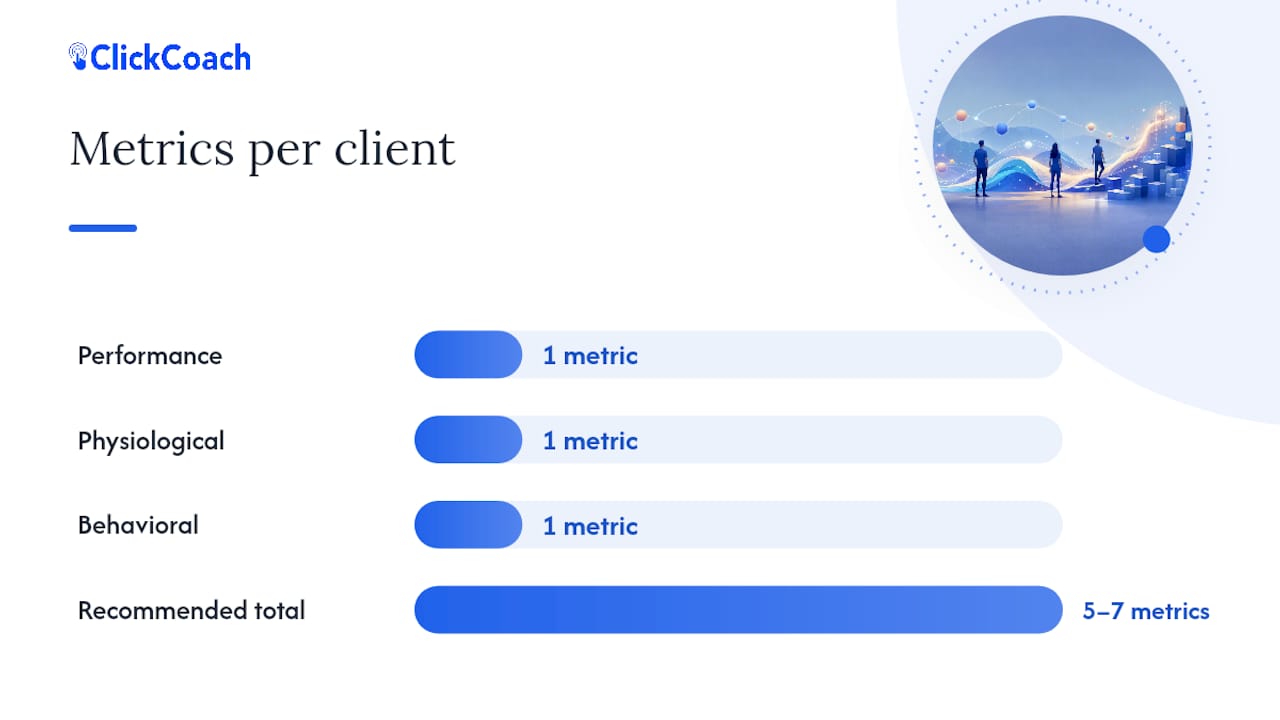
Pro Tip: Start with one metric from each of the first three categories per client. Five to seven data points is enough to coach from. More than that and both you and your client lose focus.
Why outcome and process metrics both belong in your plan
Outcome metrics are lagging indicators. They show what happened. Process metrics are leading indicators. They show what the client is actually doing right now, which predicts what will happen next.
A client’s body-composition result at week twelve is an outcome. Their daily step count and meal-logging rate during those twelve weeks are process metrics. When inputs are strong but outputs stall, that signals a need for program adaptation, not client blame.
A practical split for most clients: one or two outcome metrics (the destination) plus three to five process metrics (the daily behaviors). That ratio keeps sessions focused on what the client controls while keeping the end goal visible.
Pro Tip: Celebrate process wins explicitly in every session. A client who hit their habit target five days out of seven deserves recognition before you discuss the scale. That acknowledgment keeps motivation high during the slow weeks when outcomes have not yet shifted.
How to choose the right metrics with any client
Use this sequence in your first one to two sessions.
- Ask intake questions that surface measurable outcomes. Try: “What would success look like in 90 days, and how would you know you had achieved it?” and “What behaviors do you think are most connected to that result?”
- Establish a baseline. Measure the current state of every metric you plan to track before the program starts. No baseline means no meaningful comparison later.
- Select one to two outcome metrics and three to five process metrics that are within the client’s direct control. ACE Fitness recommends pairing clarified outcome goals with process goals the client can actually influence.
- Set a tracking cadence. Decide together how often each metric is recorded and who is responsible for logging it.
- Agree on review triggers. Define in advance what would prompt a mid-cycle metric adjustment, such as two consecutive weeks of missed targets or a significant life change.
Keep the measurement burden low. If tracking feels like homework, adherence drops. Three to five data points collected consistently beats fifteen collected sporadically.
Practical methods to collect transformation data reliably
| Frequency | What to collect | Method |
|---|---|---|
| Baseline (session 1) | All selected metrics, photos, subjective ratings | Coach-led intake form, photos, wearable sync |
| Weekly | Habit adherence, energy rating, step count, sleep hours | five- to eight-question self-report check-in |
| Monthly | Body measurements, performance benchmarks, 4-week trend review | Coach review session, updated photos |

A five- to eight-question weekly check-in plus a monthly four-week review is a practical, scalable cadence that balances completeness with client compliance. Keep the weekly form short enough to complete in under three minutes.
For reliability, standardize the conditions: same time of day for weigh-ins, same lighting for photos, same phrasing on rating scales every week. Inconsistent conditions introduce noise that makes trends harder to read.
How to interpret change and present progress so clients stay motivated
Trend lines matter more than individual data points. One bad week is noise. Three consecutive weeks in the same direction is a signal worth acting on.
Three visual formats that work well in client reporting:
- Line charts for continuous metrics like weight, step count, or energy rating. They make trends immediately visible.
- Rolling averages (a 4-week moving average) to smooth out week-to-week variability and show the underlying direction.
- Progress rings or radar charts for multi-dimensional clients who are tracking across performance, behavioral, and subjective categories simultaneously.
When a client hits a plateau, try this framing: “Your process numbers are solid. What we’re seeing is your body or your system catching up to the work. Let’s look at what we can adjust to create a new stimulus.” That language, drawn from TriageMethod’s guidance on framing data as clues rather than judgments, keeps clients engaged instead of defensive.
Report weekly on process metrics and monthly on outcome trends. That cadence matches the pace at which each type of data actually changes.
Realistic timelines for measurable change
Set expectations early. Clients who understand the timeline stay in the program.
Weeks 1–4 (short window): Expect behavioral shifts, not outcome changes. Habit adherence improves, energy ratings often rise, and sleep quality may stabilize. These are the signals to celebrate and report.
Weeks 4–12 (medium window): Process metrics consolidate. Performance benchmarks typically begin moving. Body-composition changes may become visible, though the pace varies significantly by individual.
Months 3–12+ (long window): Measurable outcome shifts become clear and defensible. This is when before-and-after comparisons carry real weight and when anonymized data becomes usable for practice marketing.
At each window, report what is actually available. Showing a client their habit adherence trend at week three is more motivating than apologizing for the fact that the scale has not moved yet.
Privacy, consent, and record-keeping best practices
Handling client data responsibly is not optional. Here is a practical checklist for your onboarding process.
- Obtain written informed consent before collecting any personal data. Specify what you collect, why, how it is stored, and who can access it.
- Collect only what you need. Every data field you do not use is a liability you do not need.
- Use secure, encrypted storage. Cloud platforms with access controls are preferable to spreadsheets shared over email.
- Define a retention policy. Decide how long you keep client records after a program ends and communicate that to clients upfront.
- Anonymize before sharing. Any aggregated or case-study data used in marketing must be stripped of identifying information.
- Control access. In a multi-coach practice, limit data access to the coaches directly working with each client.
Pro Tip: If your coaching involves health information, such as medical history, diagnoses, or prescription details, HIPAA may apply to your practice. This article is general guidance, not legal advice. Consult a healthcare attorney or compliance specialist to confirm your obligations before collecting that category of data.
Common challenges in tracking transformation data and how to overcome them
The most common problem is metric overload. Coaches design a thorough intake, collect twelve data points per client, and then struggle to synthesize any of it. The fix is to cut before you start: five to seven metrics per client, chosen collaboratively.
The second challenge is inconsistent self-reporting. Clients forget, round numbers, or report what they think you want to hear. Standardized check-in forms with specific, closed questions reduce this. Framing data collection as “collecting clues so I can coach you better” rather than as performance evaluation increases honesty.
Tracking fatigue is real, especially around weeks four to six when the novelty of a new program fades. A brief mid-program check-in on the tracking process itself, asking whether the current format still feels manageable, catches this before clients go silent.
Finally, coaches sometimes track without interpreting. Data that never influences a coaching decision is just administrative overhead. Build a monthly review into your calendar specifically to ask: “What does this data tell me about what to change?”
How data shapes your coaching decisions
Client transformation data becomes useful the moment it changes what you do in a session. If a client’s habit adherence drops from 85 percent to 40 percent over three weeks, that is not a willpower conversation. It is a logistics or environment conversation. The data tells you which one to have.
Consistent progress tracking also surfaces patterns across your client base. If multiple clients plateau at the same program week, that is a program design signal, not a client behavior signal. Practice-level data analysis turns individual coaching into a repeatable, improvable system.
When outcome metrics stall but process metrics hold strong, the right response is program adaptation, not pressure. When process metrics drop and outcomes follow, the conversation shifts to accountability and environment design. The data tells you which lever to pull.
The case for making data a daily coaching habit
Most coaches I speak with track inconsistently because tracking feels separate from coaching. The shift happens when you treat the weekly check-in as part of the coaching relationship, not as administrative overhead.
The coaches who get the most from their data are the ones who review it before every session, not after. Three minutes of pre-session review changes the quality of the conversation that follows. You walk in knowing what happened, and the client feels seen.
Here are three actions you can take in your practice this week:
- Pick one client and define their baseline across three categories: one performance metric, one behavioral metric, and one subjective rating.
- Create a five-question weekly check-in form and send it before your next session.
- Set a monthly calendar block to review four-week trends for every active client.
ClickCoach puts your tracking system in one place
Tracking client transformation data manually across spreadsheets, forms, and email threads costs you time you could spend coaching. ClickCoach gives you one login for the entire workflow.
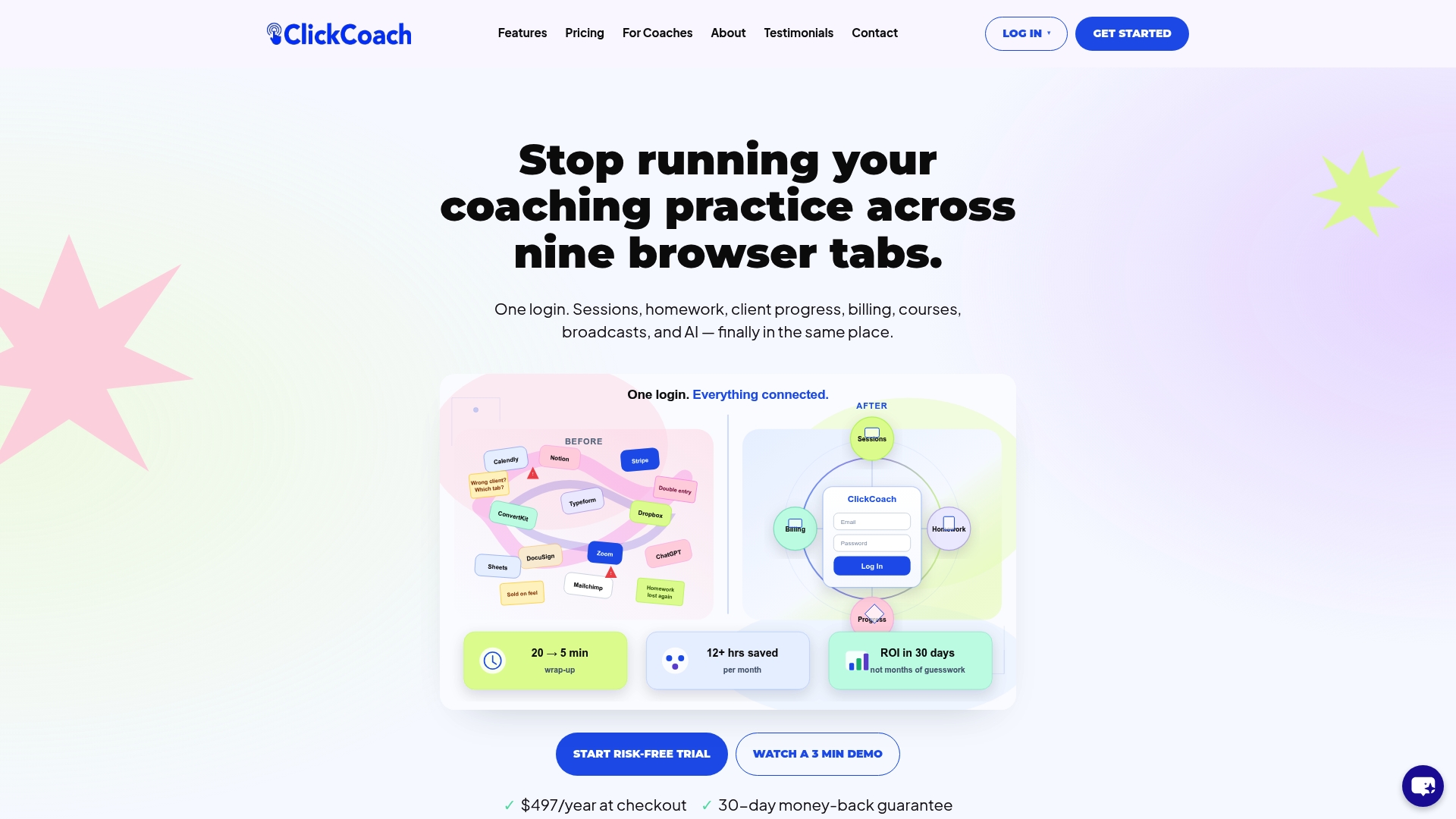
The platform’s recurring assessments let you send standardized check-ins automatically, so weekly data arrives without you chasing it. Session templates keep your baseline and progress notes in the same place as your client’s goals and homework. The built-in dashboard shows trend data at a glance, and AI-assisted homework creation means you can assign follow-up actions in seconds. Branded client portals give your clients a professional, organized view of their own progress, which strengthens engagement between sessions.
If you are ready to replace the spreadsheet juggle with a system that actually scales, explore ClickCoach and see how it fits your practice.