

Practice management in coaching is defined as the systematic coordination of people, processes, and tools, including scheduling, billing, and progress tracking, that replaces memory-based work with repeatable workflows. The role of practice management in starting a coaching practice is not optional infrastructure. It is the foundation that determines whether your practice grows or stalls. Without it, coaches hit a capacity ceiling fast, client results suffer, and burnout follows. This article explains what practice management means for coaches operationally, which tools and systems matter most, and how structured approaches directly improve client engagement and business sustainability.
How does effective practice management enhance client engagement?
Structured documentation is the single biggest driver of faster client results. Coaches who maintained structured progress documentation helped clients achieve their goals 40% faster than those relying on memory alone. That gap exists because documented progress gives both coach and client a shared, objective view of what is working and what needs to change.
Referrals follow the same pattern. Coaches with formalized client management systems receive 2.4x more referrals than those without, per EMCC data. Clients refer others when they feel the experience is consistent, professional, and results-driven. A coach who tracks homework, follows up between sessions, and documents milestones delivers exactly that experience.
Session preparation also matters more than most coaches realize. When you arrive at a session with notes from the last three meetings, the client does not need to recap. You can spend the full hour on progress. Coaching-focused platforms like ClickCoach and GreetNow make this possible by centralizing session notes, homework assignments, and client history in one place.
Pro Tip: Never rely on memory to manage client progress. Even the best coaches lose critical context between sessions. A written record is not a crutch. It is a professional standard.
- Documented goals give clients a clear target to work toward each week.
- Homework tracking creates accountability between sessions, not just during them.
- Progress notes allow coaches to spot patterns across multiple sessions.
- Consistent follow-up signals to clients that their growth matters beyond the call.
What does practice management mean for coaches operationally?
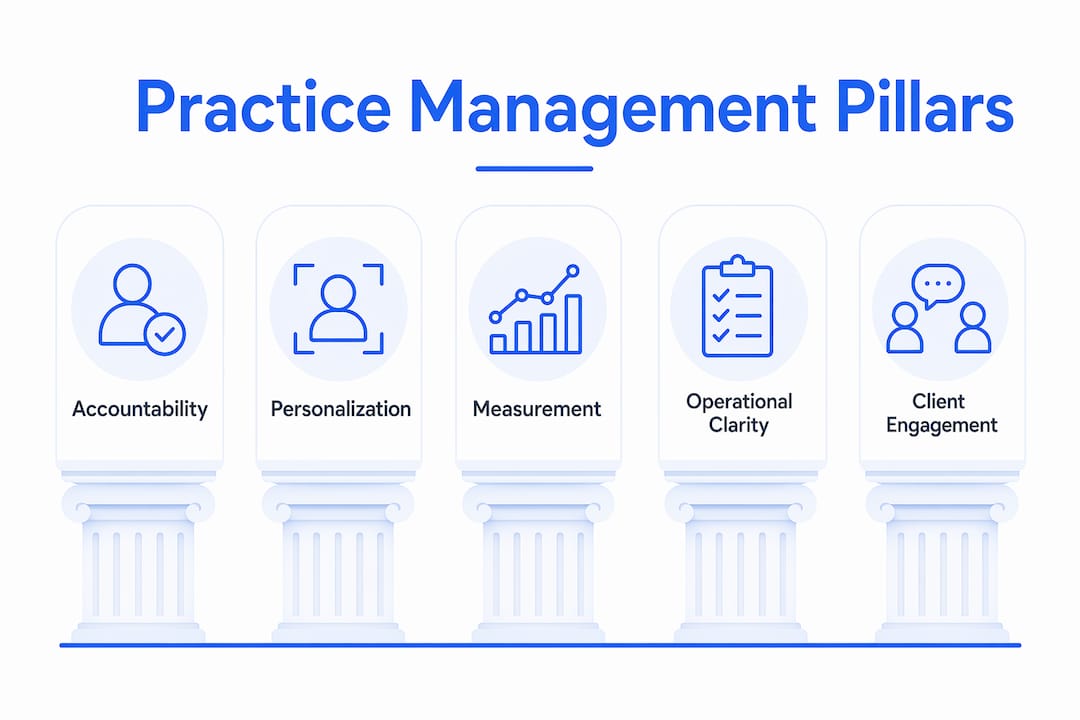
Practice management coaching emphasizes three core pillars: accountability, personalization, and measurement. Each pillar serves a distinct function. Accountability keeps clients on track between sessions. Personalization ensures the coaching approach fits the individual, not a template. Measurement provides the data that proves results and justifies continued investment.
The operational shift this creates is significant. Most coaches start their practice as doers. They handle every client interaction, every invoice, every scheduling conflict personally. That model works at five clients. It breaks at fifteen. A private practice business coach helps redefine the coach’s role by establishing decision-making structures that delegate responsibility, freeing the owner from constant intervention.
Operational clarity also changes how leadership energy gets used. When systems are predictable, leadership energy shifts from fixing daily problems to driving growth. That is not a philosophical point. It is a practical one. Coaches who spend two hours a week on administrative firefighting lose two hours they could spend on client acquisition, program development, or professional development.
| Approach | Characteristics | Outcome |
|---|---|---|
| Memory-based management | No documentation, reactive scheduling, verbal agreements | Client ceiling at 12–15, high burnout risk |
| Structured practice management | Documented workflows, automated billing, tracked progress | Scales to 25–30+ clients with consistent quality |
Pro Tip: Build your management system before you need it. Waiting until you have 12 clients to create a scheduling process means you will build it under pressure, and it will show.
Which tools should coaches prioritize when starting their practice management system?
Client onboarding is the first process to formalize. The moment a prospect says yes, your system should take over. That means a signed agreement, a welcome packet, a scheduled first session, and a completed intake form, all handled without back-and-forth emails. Coaches who automate this step from day one set a professional tone that clients notice immediately.
- Scheduling and calendar management. Use a dedicated booking tool that syncs with your calendar and sends automatic reminders. Manual scheduling is a time drain that compounds as your client list grows.
- Billing and invoicing. Automate recurring invoices and payment collection. Chasing payments manually damages the coach-client relationship and wastes time you cannot recover.
- Session notes and progress tracking. Document every session with a structured template. Note the client’s stated goal for the session, what was discussed, what was assigned, and what the follow-up action is.
- Homework and accountability tools. Assign homework through a platform the client can access between sessions. ClickCoach, for example, uses AI to assist coaches in drafting homework and tracking whether clients complete it.
- Client communication records. Keep all client messages in one place. Fragmented communication across email, text, and voice notes creates confusion and missed follow-ups.
Investing early in specialized CRM for coaching practice management saves time, prevents burnout, and increases client retention. A platform that saves meaningful time per session justifies its subscription cost quickly, especially when you factor in the value of your hourly rate.
Delegation is the next step most coaches delay too long. Hiring a virtual assistant or a practice manager to handle scheduling, invoicing, and client communications frees the coach to focus on what only the coach can do: the actual coaching. This is not a luxury for large practices. It is a growth strategy for any practice beyond ten clients.

What common challenges do coaches face without practice management?
The capacity ceiling is the most documented challenge. Without management infrastructure, quality degrades when exceeding 12–15 active clients. That ceiling is not about skill. It is about cognitive load. A coach tracking 15 clients in their head is one missed follow-up away from a client feeling neglected.
Burnout follows the same root cause. Administrative overhead that is unmanaged does not stay flat. It grows with every new client. Coaches who handle billing, scheduling, session prep, and follow-up manually find that the non-coaching work eventually crowds out the coaching itself.
The “chaos tax” is a less obvious but equally damaging problem. Unclear accountability and fragmented communication act as friction that reduces the perceived value of coaching. When a client is not sure what their homework was, or when the coach cannot recall what was discussed two sessions ago, the client’s confidence in the process erodes. That erosion shows up in cancellations and non-renewals.
- Missed follow-ups signal to clients that their progress is not being tracked.
- Inconsistent session quality makes it hard for clients to trust the process.
- Manual billing errors create awkward conversations that damage the relationship.
- No documentation means no proof of progress, which weakens renewal conversations.
- Reactive scheduling wastes time and creates unnecessary friction for both parties.
The path out of these challenges is not working harder. It is building systems that handle the predictable work automatically, so the coach can focus on the work that requires human judgment. Practice management systems support a shift from reactive management to proactive leadership. That shift is what separates practices that plateau from practices that scale.
Key Takeaways
Effective practice management is the core infrastructure that determines whether a coaching practice scales with quality or stalls under its own administrative weight.
| Point | Details |
|---|---|
| Define systems before you need them | Build scheduling, billing, and onboarding workflows before your client list grows. |
| Documentation drives results | Structured progress tracking helps clients reach goals faster and generates more referrals. |
| Capacity ceiling is a systems problem | Memory-based management limits coaches to 12–15 clients; formal infrastructure enables 25–30+. |
| Automate the predictable work | Use tools like ClickCoach to handle billing, homework, and session notes automatically. |
| Leadership energy is finite | Systems that run without intervention free coaches to focus on growth, not firefighting. |
The part of practice management most coaches get wrong
Most coaches I talk to treat practice management as an administrative chore. They see it as the paperwork side of coaching, something to tolerate rather than build deliberately. That framing is the problem.
Practice management is not the opposite of coaching. It is what makes good coaching repeatable. The coaches who deliver the most consistent client results are not necessarily the most talented in the room. They are the ones who show up to every session with context, track every commitment, and follow up without being asked. That is a systems outcome, not a talent outcome.
The shift I find most coaches resist is the move from doing everything themselves to building structures that run without them. A private practice business coach will tell you this is the defining transition for any practice owner who wants to scale. It feels like losing control. It is actually gaining it.
Data also matters more than most coaches admit. Coaches who track client progress across sessions can see patterns that are invisible in the moment. Which clients plateau at week six? Which homework formats actually get completed? Which session structures produce the most breakthroughs? Without records, you are guessing. With records, you are leading.
My honest advice: treat your practice management system as a client-facing product, not a back-office function. When your clients experience a professional onboarding, timely follow-ups, and clear progress documentation, they feel the quality of your practice before they can articulate it. That feeling is what drives referrals and renewals.
— Mitch
How ClickCoach supports your practice management from day one
Building a practice management system from scratch takes time most coaches do not have. ClickCoach brings session management, billing, client progress tracking, and homework assignments under one login, so coaches stop juggling multiple apps and start focusing on clients.
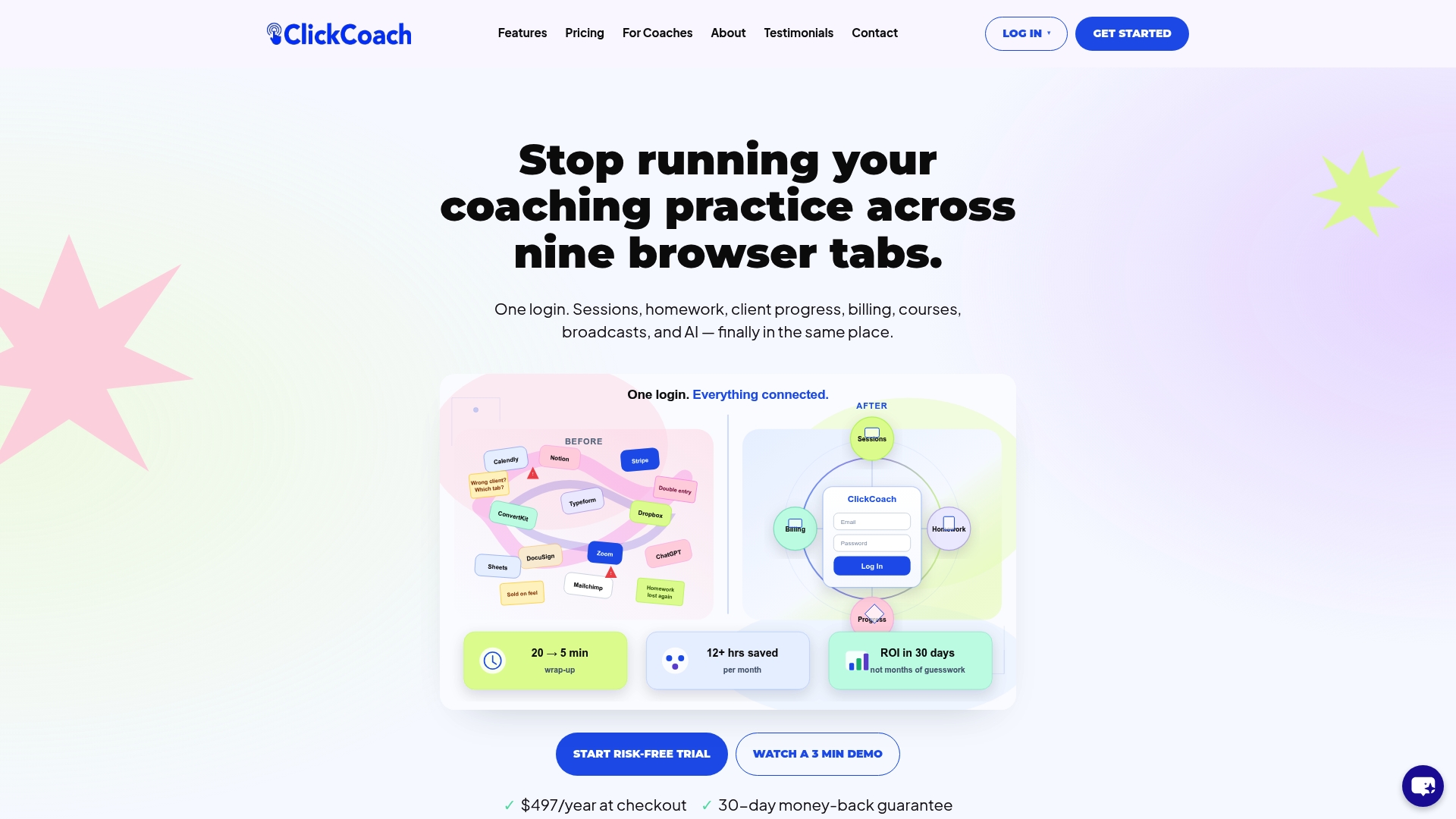
ClickCoach reports saving coaches up to 20 minutes per session by centralizing the administrative work that typically happens across email, spreadsheets, and separate billing tools. Its AI assists in drafting homework and tracking whether clients complete it, which directly supports the accountability pillar that drives faster client results. Coaches who want to manage their practice without the overhead of stitching together multiple platforms will find ClickCoach built for exactly that need. Clients get branded, easy-to-use portals. Coaches get their time back.
FAQ
What does practice management mean for coaches?
Practice management means the systematic coordination of scheduling, billing, client progress tracking, and communication workflows. It replaces memory-based approaches with repeatable systems that maintain quality as client volume grows.
Why is practice management important when starting a coaching practice?
Starting with structured systems prevents the capacity ceiling that limits memory-dependent coaches to 12–15 clients. Early infrastructure also sets a professional standard that improves client retention and referral rates from the start.
How does practice management coaching differ from regular coaching?
Practice management coaching focuses on accountability, personalization, and measurement rather than general advice. It is ongoing and implementation-focused, designed to accelerate behavior change and produce predictable outcomes.
What tools do coaches need for effective practice management?
Coaches need a scheduling tool, automated billing, a session notes system, a homework tracking platform, and centralized client communication. Platforms like ClickCoach combine all of these under one login to reduce administrative overhead.
How does practice management affect client referrals?
Coaches with formalized client management systems receive 2.4x more referrals than those without, per EMCC data. Consistent, documented client experiences create the professional impression that motivates clients to recommend their coach.