

Real-time collaboration coaching is defined as live, in-session guidance that delivers instant feedback and context-sensitive prompts to clients during active work. Unlike post-session reviews, this approach corrects behavior and reinforces skills at the exact moment they matter. AI-driven tools, live video integration, and structured prompt libraries now make this possible at scale. The role of real-time collaboration coaching has shifted from a nice-to-have technique to a core method for coaches who want measurable client outcomes. Platforms like Otter.ai and research from Balto confirm that immediate feedback produces faster skill gains and stronger engagement than delayed review alone.
What are the core benefits of real-time collaboration coaching?
AI-driven real-time coaching reduces average handle time by 20–30% and enables clients to reach full proficiency twice as fast. That speed advantage compounds over time. Clients who receive feedback mid-session correct errors before they become habits, which cuts the total coaching hours needed to hit a performance target.
The benefits of coaching in teams extend well beyond speed. Research from a survey of 168 distance-learning university students found that synchronous live coaching boosts ethical awareness and confidence while encouraging higher-order thinking. Clients do not just perform better. They think more critically about what they are doing and why.

Real-time feedback also changes group dynamics. When teams receive live prompts during collaborative exercises, participation rates rise, creative problem-solving increases, and trust builds faster. Psychological safety, the belief that speaking up carries no penalty, grows when clients see that feedback is immediate, specific, and non-punitive.
Key benefits at a glance:
- Faster proficiency: Clients reach competency benchmarks in roughly half the time compared to post-session feedback models.
- Higher ethical awareness: Live dialogic reflection strengthens moral reasoning during complex, AI-supported tasks.
- Stronger team trust: Immediate, precise feedback signals that the coach is present and invested, which deepens the working relationship.
- Greater participation: Real-time prompts reduce hesitation by giving clients a clear next step in the moment.
- Reduced error reinforcement: Correcting behavior during the session stops bad habits from forming between sessions.
Pro Tip: Limit simultaneous prompts to one at a time. Stacking multiple nudges during a single interaction overloads the client and causes them to disengage from all of them.
How does real-time collaboration coaching differ from traditional coaching?
The clearest distinction is timing. Traditional coaching delivers feedback after the session ends, through written notes, recordings, or a follow-up call. Real-time coaching delivers it during the session, anchored to the exact conversational moment it applies to.
| Factor | Real-time coaching | Traditional coaching |
|---|---|---|
| Feedback timing | During the session | After the session |
| Cognitive load | Requires brief, focused prompts | Can handle longer, reflective feedback |
| Behavior correction | Immediate, in context | Delayed, relies on memory |
| Technology dependency | High (AI prompts, live transcription) | Low |
| Best use case | Skill building, live calls, team sessions | Deep reflection, strategic planning |
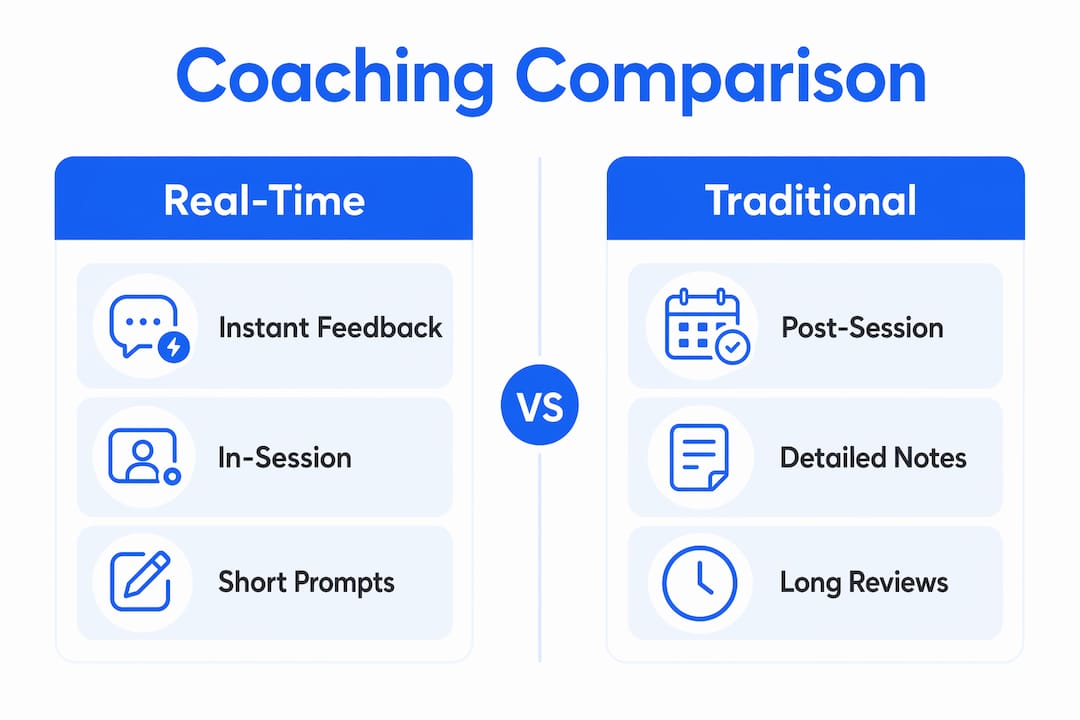
Practitioners draw a sharp line between in-call prompts and post-call reviews. Mixing long-form feedback into live sessions creates cognitive overload and disrupts the client’s focus. The rule is simple: keep live prompts short and save reflective conversation for after the session ends.
Cognitive load is the central design constraint for real-time coaching techniques. Effective prompts stay under 10 words and must be dismissible without breaking the client’s flow. A prompt that requires the client to stop, read, and interpret a paragraph defeats the purpose of real-time delivery.
AI systems that use multiple signals to trigger prompts, such as tone, keyword detection, and pacing, outperform single-trigger systems. Multi-signal detection reduces false alerts and builds client trust in the coaching system over time.
Pro Tip: Run a 60-to-90-day pilot with a defined client group before rolling out real-time coaching tools to your full practice. The data you collect during the pilot will sharpen your prompt library and reveal which triggers actually change behavior.
What are the best practices for implementing real-time coaching?
A structured 6-step rollout over 60–90 days produces the strongest adoption rates and the clearest performance data. Skipping steps or rushing the timeline produces inconsistent results and erodes client confidence in the process.
- Document your current coaching workflow. Map every touchpoint in a typical session before adding any new technology. You cannot measure improvement without a clear baseline.
- Build your prompt library. Write objection prompts, transition prompts, and reinforcement prompts separately. Mixing types in a single library makes it harder to test what works.
- Select your pilot group. Mid-performers are the best candidates for a pilot because their performance data shows meaningful movement. Top performers have less room to improve, and struggling clients need more foundational support first.
- Integrate with your CRM or session management tool. Prompts that connect to client history and session notes produce more relevant guidance than generic triggers.
- Run the pilot and track outcomes. Measure session length, client response rate to prompts, and performance metrics before and after. Sixty days gives you enough data to spot trends without committing to a full rollout prematurely.
- Refine and expand. Use pilot data to cut prompts that clients ignore and strengthen the ones that drive behavior change. Then roll out to your full client base.
Embedding coaching into daily leadership rituals accelerates this process. When clients encounter coaching cues in their regular workflow, not just during scheduled sessions, the behavior change becomes self-sustaining. Coaching integrated with leadership creates clarity, ownership, and sustained team capability under pressure.
Pro Tip: Anchor every prompt to the current moment in the session. A prompt that references something from five minutes ago pulls the client out of the present conversation and reduces the impact of the feedback.
What challenges do coaches face with real-time collaboration coaching?
Prompt fatigue is the most common failure point. Vague, late, or overly frequent prompts cause clients to disengage from the coaching system entirely. Once a client starts dismissing prompts reflexively, the tool loses its effect and rebuilding trust in it takes significant time.
Common challenges and how to address them:
- Prompt overload: Deliver one prompt at a time and set a minimum interval between nudges. Clients need space to act on feedback before receiving the next cue.
- Poor timing: A prompt that fires after the relevant moment has passed is worse than no prompt at all. Audit your trigger logic regularly to catch timing drift.
- Transcription lag: AI transcription tools occasionally misread tone or miss keywords, which causes incorrect prompts to fire. Use multi-signal triggers rather than single-keyword detection to reduce this error rate.
- Mixing feedback types: Reflective, long-form feedback delivered during a live session disrupts the client’s focus. Reserve that content for post-session review.
- Lack of client trust: Clients who do not understand why a prompt appeared will ignore it. Brief onboarding on how the system works increases acceptance and response rates.
Technology issues are manageable, but the human side of real-time coaching requires equal attention. Clients must feel that prompts serve them, not surveil them. Framing prompts as support rather than correction changes how clients receive them and directly affects how much behavior change you see.
How does real-time collaboration coaching enhance team dynamics?
Individual coaching addresses one person’s skills and mindset. Team coaching addresses the collective invisible space of psychological safety and systemic interdependencies that individual work cannot reach. These are two different problems, and they require different tools.
Team coaching paired with individual executive coaching produces sustainable organizational change. Research confirms that team coaching fosters organizational transformation by targeting systemic culture issues that no amount of one-on-one work can fix alone. A team that lacks psychological safety will underperform regardless of how skilled each individual member is.
Real-time methods amplify this effect during group sessions. When a coach delivers live prompts during a team exercise, every member receives the same signal at the same moment. That shared experience builds a common reference point and reinforces collective norms faster than any post-session debrief can.
Team-referent instruments, surveys and diagnostics designed to measure group health rather than individual performance, give coaches the data they need to target the right dynamics. Measuring trust, communication clarity, and decision-making speed at the team level reveals patterns that individual assessments miss entirely.
| Team coaching focus | Real-time method | Expected outcome |
|---|---|---|
| Psychological safety | Live prompts during group exercises | Faster trust building |
| Communication clarity | In-session feedback on language and tone | Reduced misunderstanding |
| Decision-making speed | Real-time cues during problem-solving tasks | Shorter resolution time |
| Accountability culture | Shared prompts visible to the full team | Collective ownership of outcomes |
Embedding coaching into daily leadership rituals transforms culture from instruction-based to coaching-oriented. That shift produces psychological safety and organizational adaptability, two outcomes that no single coaching session can deliver on its own.
Key Takeaways
Real-time collaboration coaching produces the strongest results when short, precisely timed prompts are paired with a structured rollout, clear separation of feedback types, and team-level diagnostics alongside individual work.
| Point | Details |
|---|---|
| Speed of proficiency | Real-time feedback cuts time to competency roughly in half compared to post-session review. |
| Prompt design matters | Keep live prompts under 10 words and dismissible to prevent cognitive overload. |
| Pilot before scaling | Run a 60-to-90-day pilot with mid-performers to build a reliable, data-backed prompt library. |
| Team coaching is distinct | Individual coaching cannot fix systemic team culture issues; team-level methods are required. |
| Embed coaching in daily practice | Integrating coaching into leadership rituals sustains behavior change between formal sessions. |
What I have learned from watching real-time coaching go wrong
Most coaches who struggle with real-time methods make the same mistake: they treat the technology as the coach. They build a prompt library, connect it to a session tool, and then step back. The prompts fire. The client ignores them. Nothing changes.
Real-time coaching works when the coach stays in the driver’s seat. The AI surfaces the moment. The coach decides what to do with it. That distinction matters more than any feature set.
I have also seen coaches resist the team dimension entirely. They are comfortable with one-on-one work and assume that scaling up means running the same process with more people in the room. It does not. A group session without team-referent diagnostics is just individual coaching with an audience. The real leverage comes from addressing what happens between people, not just within them.
The coaches who get the best results treat real-time feedback as a discipline, not a shortcut. They refine their prompt libraries every month. They review which cues clients acted on and which ones they skipped. They adjust. That continuous refinement is what separates a coaching practice that grows from one that plateaus.
If you take one thing from this: start with fewer prompts than you think you need. You can always add more. You cannot easily rebuild a client’s trust once they have learned to ignore your cues.
— Mitch
How ClickCoach supports your real-time coaching practice
ClickCoach brings session management, client progress tracking, billing, and homework assignments under one login, so you spend less time switching between tools and more time coaching.
The platform’s AI assists with drafting session prompts and tracking client progress across sessions, which makes it easier to build and refine the kind of prompt library this article describes. Coaches report saving up to 20 minutes per session by consolidating their workflow in one place. Clients get branded, easy-to-use portals that keep them engaged between sessions. If you want to put the effective collaboration strategies covered here into practice without adding more software to your stack, explore ClickCoach and see how it fits your current workflow.
FAQ
What is real-time collaboration coaching?
Real-time collaboration coaching is live, in-session guidance that delivers instant prompts and feedback during active coaching or work sessions. It differs from traditional coaching by correcting behavior at the moment it occurs rather than after the session ends.
How much faster do clients improve with real-time coaching?
AI-driven real-time coaching reduces average handle time by 20–30% and enables clients to reach full proficiency roughly twice as fast as post-session feedback methods alone.
How long should a real-time coaching pilot run?
A 60-to-90-day pilot with a defined group of mid-performing clients gives you enough data to evaluate prompt effectiveness and refine your library before a full rollout.
What is the biggest risk of real-time coaching prompts?
Prompt fatigue is the primary risk. Vague, late, or overly frequent prompts cause clients to disengage from the system. Keeping prompts under 10 words and spacing them appropriately prevents this.
Does real-time coaching work for remote teams?
Real-time coaching for remote teams is effective when prompts are delivered through video or messaging platforms during live sessions. The key is anchoring each prompt to the current conversational moment so remote clients stay present and responsive.