

To attract paying clients from social media, choose one primary platform that matches your niche, build a repeatable content system around three coaching-focused pillars, and route every post to an email capture or DM conversation. That single sentence is the whole strategy. Everything below is the execution.
Here is your 72-hour starting plan:
- Pick your primary platform today. Match it to where your ideal client already spends time (see the platform guide below). Commit for four weeks before evaluating.
- Define three content pillars and post three times this week. One teaching post, one client-result post, one personal/process post. That mix covers discovery, trust, and relationship in a single week.
- Add one conversion path to every post. A lead magnet link in bio, a “DM me the word X” CTA, or a direct calendar link. The single metric to watch first: DM-to-discovery-call conversion rate.
If that rate climbs week over week, the rest of your numbers will follow.
Key Takeaways
Social media marketing for coaches works when every post has a clear conversion path from discovery to a booked call, and when client relationships are managed in a system that preserves outcomes and makes renewals easy.
| Point | Details |
|---|---|
| Choose one primary platform | Match your platform to your niche’s demographic; commit for 60 days before evaluating results. |
| Use a 50/30/20 content mix | 50% teach/diagnose, 30% proof/process, 20% human/relationship posts drive both discovery and trust. |
| Email is the conversion engine | Route every post to a lead magnet or DM; social is discovery, email and calls are where clients sign. |
| Track DM-to-call rate first | A DM-to-call conversion rate below 20% signals a script or offer problem, not a content volume problem. |
| ClickCoach centralizes client ops | Use ClickCoach to manage leads, sessions, homework, and billing under one login as your practice scales. |
Table of Contents
- Which social media platforms work best for your coaching niche?
- A conversion-first social media strategy for coaches
- What content types and post ideas actually work for coaches?
- How to build a weekly posting plan without burning out
- How to turn followers into booked discovery calls
- Common social media mistakes coaches make and how to fix them
- Which metrics actually matter for your coaching business?
- How to turn social leads into repeatable coaching clients
- What I’ve learned testing these tactics as a working coach
- ClickCoach helps you manage every lead your social content generates
- Sources
Which social media platforms work best for your coaching niche?
Choosing a platform is not a branding decision. It is a client-location decision. Pew Research Center data shows that platform adoption varies significantly by age, education, and income, which means the platform your ideal client uses is predictable if you know their demographic profile.
Platform-by-niche breakdown
Instagram reaches a broad 18–44 audience and rewards visual storytelling. Reels drive discovery; carousels build trust; Stories maintain daily presence. Executive and wellness coaches who can show process and transformation visually tend to perform well here. Posting four to five times per week is realistic, and the conversion path runs from Reel to bio link to lead magnet. CoachBusinessPro notes that booking-enabled CTAs in Reels and carousels are among the highest-converting formats for coaches in 2026.
LinkedIn is the clearest fit for executive, leadership, and business coaches. The audience skews toward professionals with purchasing authority, and long-form posts, thought-leadership articles, and case studies perform well. Three posts per week is a sustainable cadence. The conversion path moves from post to connection request to DM to discovery call, which ScaleGrowth’s coaching guide identifies as particularly effective for coaches targeting corporate clients.
TikTok reaches a younger, broader audience. Pew Research’s 2024 TikTok data shows strong engagement among adults under 30, making it a natural fit for life coaches, career coaches targeting early-career professionals, and fitness coaches. Short educational videos (60–90 seconds) drive discovery fast, but conversion requires a pinned video with a clear lead magnet CTA.
Facebook still commands a large, diverse adult audience. Its group functionality makes it the strongest platform for community-based coaching, parent coaching, and wellness niches. Statista’s social buyer data by age group supports the case that older millennial and Gen X buyers, who are active on Facebook, represent a high-value coaching demographic. The conversion path runs from group post to comment to DM to call.
YouTube is the long-game platform. A 10–15 minute coaching tutorial builds more trust than almost any other format, and search-driven discovery means videos keep working for months. The effort is higher (one video per week is a realistic floor), but the conversion path from video to email opt-in to discovery call is well-documented. Short-form YouTube Shorts can also feed discovery alongside longer content.
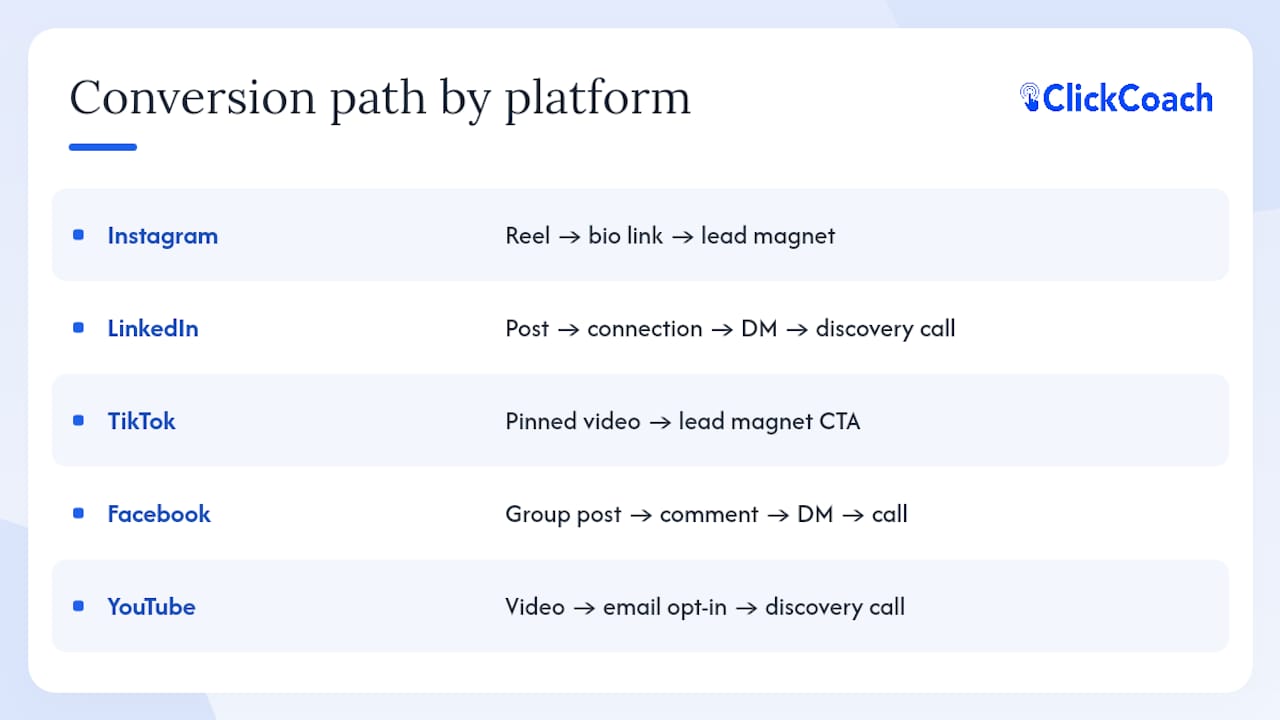
How to validate your platform in four weeks
Post six pieces of content on your chosen platform over four weeks. Track one KPI: how many DMs or lead magnet opt-ins did each post generate? If you see even two to three qualified conversations per week, you have found your platform. If you see none, test a second platform for four more weeks before drawing conclusions.
| Platform | Best for (niche/demo) | Content-format strengths | Posting frequency | Audience behavior | Conversion path |
|---|---|---|---|---|---|
| Wellness, executive, life coaches (18–44) | Reels, carousels, Stories | 4–5x/week | Discovers via Reels, saves carousels | Reel → bio link → lead magnet → call | |
| Executive, business, leadership coaches | Long-form posts, articles, case studies | 3x/week | Reads, comments, connects | Post → DM → discovery call | |
| TikTok | Life, career, fitness coaches (younger adults) | Short educational video (60–90 sec) | 5–7x/week | Watches, shares, follows | Pinned video → bio link → lead magnet |
| Parent, community, wellness coaches (middle-aged adults) | Group posts, Lives, short videos | 3–4x/week | Engages in groups, comments | Group post → DM → call | |
| YouTube | All niches, trust-building focus | Long tutorials, Shorts | 1–2x/week | Searches, subscribes, watches | Video → email opt-in → call |
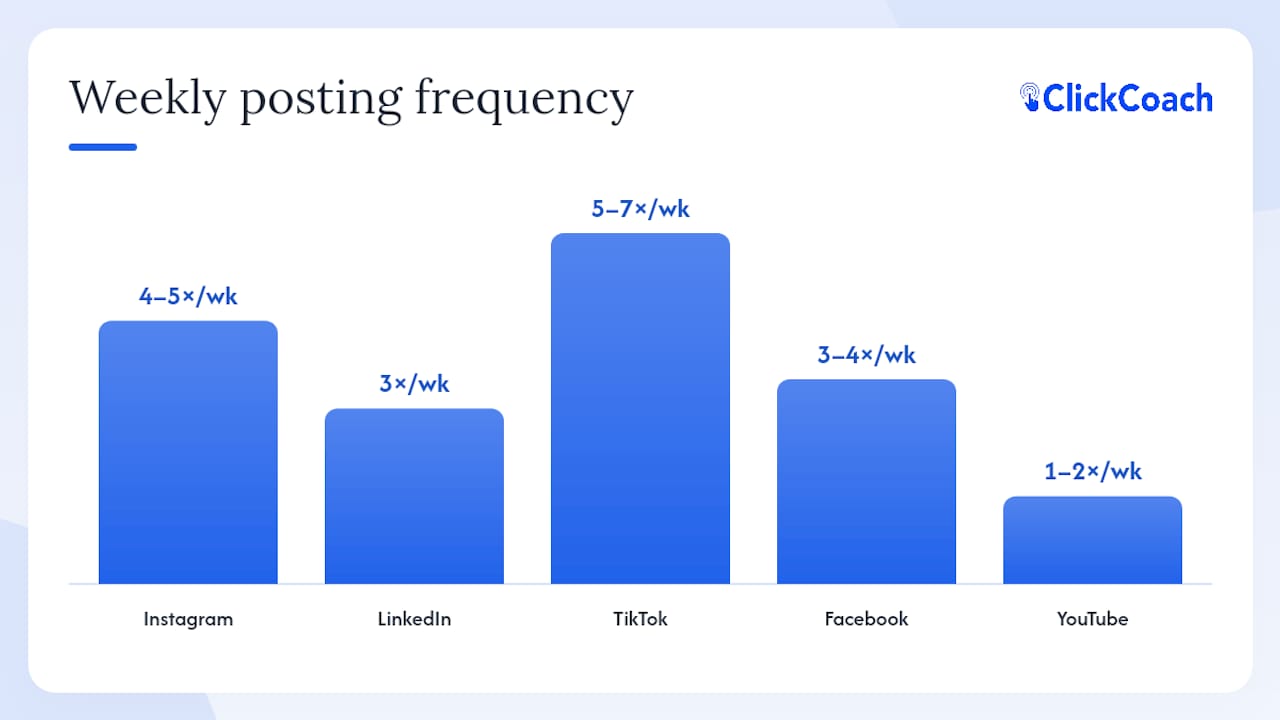
A conversion-first social media strategy for coaches
Most coaches post content. Fewer coaches run a funnel. The difference between the two is whether your social activity has a next step built in at every stage.
Start with a one-line audience and offer statement: “I help [specific client] achieve [specific outcome] in [timeframe or context].” That sentence should appear in your bio, your pinned post, and the first five seconds of every video. It is the filter that attracts qualified prospects and repels everyone else.
The one-page funnel
Social media is discovery. Email is conversion. Keedia’s 2026 analysis makes this point clearly: the coaches who consistently sign clients use social to drive traffic to an email list or a DM conversation, not to sell directly from a post. The funnel architecture looks like this:
Social discovery → Lead magnet or DM → Email nurture (3–5 messages) → Discovery call → Paid engagement
Every post you publish should push the viewer one step forward in that sequence.
Content pillars mapped to funnel stages
Three pillars cover the full funnel without overcomplicating your planning:
- Teach and diagnose (discovery stage): micro-lessons, myth-busts, frameworks, and “what most people get wrong about X” posts. These attract cold audiences who do not know you yet.
- Proof and process (trust stage): client wins, behind-the-scenes session prep, your methodology explained, and before/after outcomes. These convert warm followers into leads. Referencing the ICF core competencies in your process posts signals professional credibility to discerning buyers.
- Human and relationship (retention and referral stage): your story, your values, your honest takes on coaching industry norms. These build the emotional connection that makes someone book a call rather than just follow you.
Offer ladder positioning on social
A simple offer ladder gives you something to mention at every funnel stage without feeling pushy:
- Free lead magnet (assessment, checklist, 5-day challenge): mentioned in every post CTA
- Low-entry session ($97–$197 single session or audit): promoted once per week
- Core package (3- or 6-month engagement): featured in testimonial and case study posts
- Group program (cohort or community): promoted during launch windows with Lives or webinars
What content types and post ideas actually work for coaches?
Short-form educational video is the highest-ROI format for discovery in 2026, but conversion typically happens off-platform via email or a discovery call. That means your content mix needs both: formats that attract new eyes and formats that deepen trust with people already following you.
The adapted content ratio for coaches
The 5:3:2 rule offers a useful starting framework: out of every 10 posts, five share curated or educational content, three share original insights, and two are personal or humanizing. For coaches, the ratio shifts toward more original content. A practical adaptation: 50% teach/diagnose, 30% proof/process, 20% human/relationship. Business confirms that audience-first content consistently outperforms promotional content in engagement, which is why the teaching pillar anchors the mix.
Format guidance by platform
- Reels and TikTok videos: 30–90 seconds, hook in the first two seconds (“The reason your clients don’t follow through isn’t motivation”), one teaching point, CTA at the end. Captions under 150 characters.
- Carousels (Instagram/LinkedIn): 5–8 slides, first slide is the hook/promise, last slide is the CTA. Best for frameworks, step-by-step guides, and myth-busts.
- LinkedIn long-form posts: 800–1,200 words, personal story opening, one clear insight, a question to drive comments.
- YouTube long-form: 10–20 minutes, structured like a coaching session (problem, insight, tool, action step). Include an email opt-in CTA at the 30% mark.
- Facebook group posts: conversational, question-led, or poll-based. Lives work well for Q&A and community building.
Pro Tip: Pin your best-performing lead magnet post to the top of your profile on every platform. That pinned post does more conversion work than any other piece of content on your page.
30 ready-to-use post ideas for coaches
Teach/diagnose (15 ideas):
- “The three questions I ask every new client in session one”
- “Why most goal-setting advice fails (and what to do instead)”
- “A 5-minute morning habit my clients use to stay on track”
- “The difference between a coach and a consultant (most people get this wrong)”
- “What accountability actually looks like in a coaching relationship”
- “How to know if you’re ready for a coach”
- “The framework I use to help clients clarify their values”
- “Why you keep setting the same goal and not hitting it”
- “One question that changes how clients think about their career”
- “The myth of work-life balance (and what high performers do instead)”
- “How to have a hard conversation at work without burning the relationship”
- “What ‘being stuck’ actually means (and how to get unstuck)”
- “Three signs your stress is a signal, not a problem”
- “How I help clients build confidence without faking it”
- “The one mindset shift that changes everything for new leaders”
Proof/process (9 ideas): 16. “A client came to me unable to delegate. Here’s what changed in 90 days.” 17. “Behind the scenes: how I prep for a coaching session” 18. “My methodology explained in 60 seconds” 19. “What a breakthrough session actually looks like” 20. “The homework I give clients after session one (and why)” 21. “A client’s words after completing our program [with permission]” 22. “How I track client progress between sessions” 23. “What my clients say surprised them most about coaching” 24. “The moment I knew this client was ready to lead”
Human/relationship (6 ideas): 25. “Why I became a coach (the honest version)” 26. “A mistake I made early in my practice and what I learned” 27. “What I wish someone had told me when I started my coaching business” 28. “The part of coaching nobody talks about” 29. “My honest take on [trending coaching topic]” 30. “What a typical week looks like running a coaching practice”
Using social proof strategies like client wins and specific outcome posts consistently outperforms generic motivational content in driving DMs and inquiries.
How to build a weekly posting plan without burning out
Sustainability beats intensity every time. A coach who posts three times per week for six months will outperform one who posts daily for three weeks and then disappears.
Sample weekly content calendar
| Day | Primary platform | Content type | Secondary platform (cross-post) |
|---|---|---|---|
| Monday | Teaching post (carousel or video) | Teach/diagnose pillar | LinkedIn text version |
| Wednesday | Proof/process post (client win or behind-the-scenes) | Proof pillar | Facebook group |
| Friday | Human/relationship post (story or honest take) | Human pillar | Optional Stories/TikTok |
Three posts per week on your primary platform, with selective cross-posting to one secondary platform, is a realistic and repeatable cadence for a solo coach.
Repurposing one idea across formats
One YouTube video or podcast segment can generate a full week of content:
- Record a 10–12 minute YouTube video on one coaching topic.
- Pull the best 60-second clip for a Reel or TikTok.
- Turn the three main points into a carousel for Instagram or LinkedIn.
- Write the key insight as a LinkedIn long-form post.
- Send the video link to your email list with a two-paragraph intro.
That is five pieces of content from one recording session. Batching two or three topics in a single two-hour block each week keeps your pipeline full without daily content pressure.
How to turn followers into booked discovery calls
Social attention is only valuable if it moves somewhere. The tactics below create a clear path from a post to a paid engagement.
Lead magnets that convert for coaches
The highest-converting lead magnets for coaching niches are specific and diagnostic:
- A self-assessment (“Score your leadership readiness in 5 minutes”)
- A 5-day email challenge (“5 days to a clearer career direction”)
- A one-page framework or checklist (“The 7-step framework I use with every new client”)
Place the lead magnet link in your bio, in the caption of every teaching post, and as the CTA on your pinned post.
DM and comment follow-up sequence
When someone comments on your post or sends a DM, respond within two hours. A simple script:
- Public reply: “Great question, [name]. The short answer is [one sentence]. I just sent you a DM with more detail.”
- DM opener: “Hey [name], thanks for engaging with that post. Are you dealing with [specific problem the post addressed]?”
- Value exchange: Share one specific tip or resource relevant to their situation.
- Call invitation: “I do a free 20-minute discovery call for coaches in your situation. Want me to send you the link?”
Live and webinar formats that generate calls
A 45-minute live session structured as: 10 minutes of teaching, 20 minutes of coaching a volunteer live, 10 minutes of Q&A, and 5 minutes explaining your offer and booking link. This format demonstrates your method in real time, which is more persuasive than any testimonial.
After the live, send a follow-up DM to everyone who commented: “Thanks for joining. Did you get what you needed, or would a quick call help?”
Booking flow
Use a calendar tool (Calendly, Acuity, or similar) with a short pre-call form (three to four questions) that qualifies fit before the call. Ask: What is your biggest challenge right now? What have you already tried? What would success look like in 90 days? Coaches who use a pre-call form report fewer no-shows and better-qualified conversations.
Common social media mistakes coaches make and how to fix them
Most coaches do not have a content problem. They have a conversion problem. These are the errors that cost the most clients.
- Posting without a CTA. Every post needs one next step. Fix: add “DM me the word [X]” or “link in bio for the free [resource]” to every caption this week.
- Chasing viral content. A viral post that attracts the wrong audience wastes your time. Fix: measure DMs and opt-ins, not likes.
- A weak bio. If your bio does not state who you help and what outcome you deliver, qualified prospects scroll past. Fix: rewrite your bio today using the formula: “I help [specific client] achieve [specific outcome]. [Lead magnet CTA].”
- Ignoring DMs. Unread DMs are unbooked clients. Fix: set a daily 10-minute DM response block.
- No email capture. Social platforms can change their algorithms or suspend accounts. Fix: every post should drive traffic to an email list you own. As Keedia’s analysis confirms, email is the conversion engine, not social.
- Scattered platform approach. Being mediocre on four platforms beats being excellent on none. Fix: commit to one primary platform for 60 days.
- Sharing client stories without consent. Posting a client outcome without explicit written permission is an ethical breach and a trust risk. Fix: use a simple consent form before sharing any client story, and anonymize details unless the client has agreed to be named.
Which metrics actually matter for your coaching business?
Follower count and likes are not business metrics. The numbers that predict revenue are different.
Core metrics to track:
- Email list growth rate (new subscribers per week from social)
- DM-to-call conversion rate (what percentage of DM conversations become booked calls)
- Discovery call-to-paid conversion rate (what percentage of calls become paying clients)
- Booked sessions per 1,000 engaged followers (a proxy for content quality and CTA effectiveness)
- Lead cost (if running paid ads: total ad spend divided by number of discovery calls booked)
A useful benchmark: if your DM-to-call conversion rate is below 20%, the bottleneck is usually your DM script or your lead magnet offer, not your content volume.
4-week test template
| Week | What to change | What to measure | Target signal |
|---|---|---|---|
| Week 1 | Post 3x, add CTA to every post | DMs received, opt-ins | At least 2–3 DM conversations |
| Week 2 | Test a new lead magnet or CTA wording | Opt-in rate, DM quality | Opt-in rate above 20% on bio link |
| Week 3 | Add one Live or video post | Comments, shares, DMs from video | At least 1 discovery call booked |
| Week 4 | Review full funnel: post → DM → call → close | DM-to-call rate, call-to-close rate | One paid client from social |
Run this test for four weeks before changing your platform or content strategy. Most coaches abandon their approach too early.
How to turn social leads into repeatable coaching clients
A lead that does not enter a system is a lead that disappears. Here is the operational workflow that converts social interest into long-term client relationships.
- Capture: Lead fills out your lead magnet form or sends a DM. Record their name, contact, and the problem they mentioned in a CRM or client pipeline tool.
- Qualify: Within 24 hours, send a two-question reply or pre-call form to confirm fit (budget, timeline, specific challenge).
- Schedule: Send your calendar link immediately after qualification. Include a short pre-call form (three questions). Confirm the appointment with an automated reminder 24 hours and one hour before.
- Onboard: After a client signs and pays, send a welcome email with your client portal link, session prep instructions, and their first homework assignment. A platform like ClickCoach centralizes this entire sequence, from the signed contract to session notes to homework tracking, under one login.
- Nurture no-shows: If a prospect misses a call, send a DM within two hours: “Hey [name], I had us down for [time]. Want to reschedule? Here’s my link.” Follow up by email 48 hours later. Most no-shows rebook if you follow up twice.
- Track outcomes: After each session, log the client’s stated goal, the action step agreed on, and the result at the next session. This data makes renewal conversations easy and gives you real outcome language for future content.
Pro Tip: Batch your admin tasks. Spend 20 minutes at the end of each coaching day updating client notes, sending homework, and logging session outcomes. Coaches who do this consistently report fewer dropped clients and stronger renewal rates, because the record of progress is always current when renewal conversations come up.
What I’ve learned testing these tactics as a working coach
The coaches I see grow fastest on social share one habit: they treat their content like a product, not a diary. They plan it, test it, and measure it the same way they would measure a client’s progress toward a goal.
The mistake I see most often is spending 80% of effort on content creation and 20% on conversion. The ratio should be closer to 50/50. A beautifully produced Reel with no CTA is a missed opportunity. A simple, direct post with a clear “DM me” instruction often outperforms it.
On ethics: before you share any client story, get written consent. Specify exactly what you plan to share, on which platform, and for how long. Anonymize outcomes unless the client explicitly agrees to be named. The ICF core competencies include confidentiality as a foundational standard, and your social content should reflect that standard visibly.
ClickCoach helps you manage every lead your social content generates
Growing your social presence creates a new operational challenge: more leads, more conversations, more clients to track. Stitching together a calendar tool, a spreadsheet, a document folder, and an email platform to manage that volume costs you time you could spend coaching.
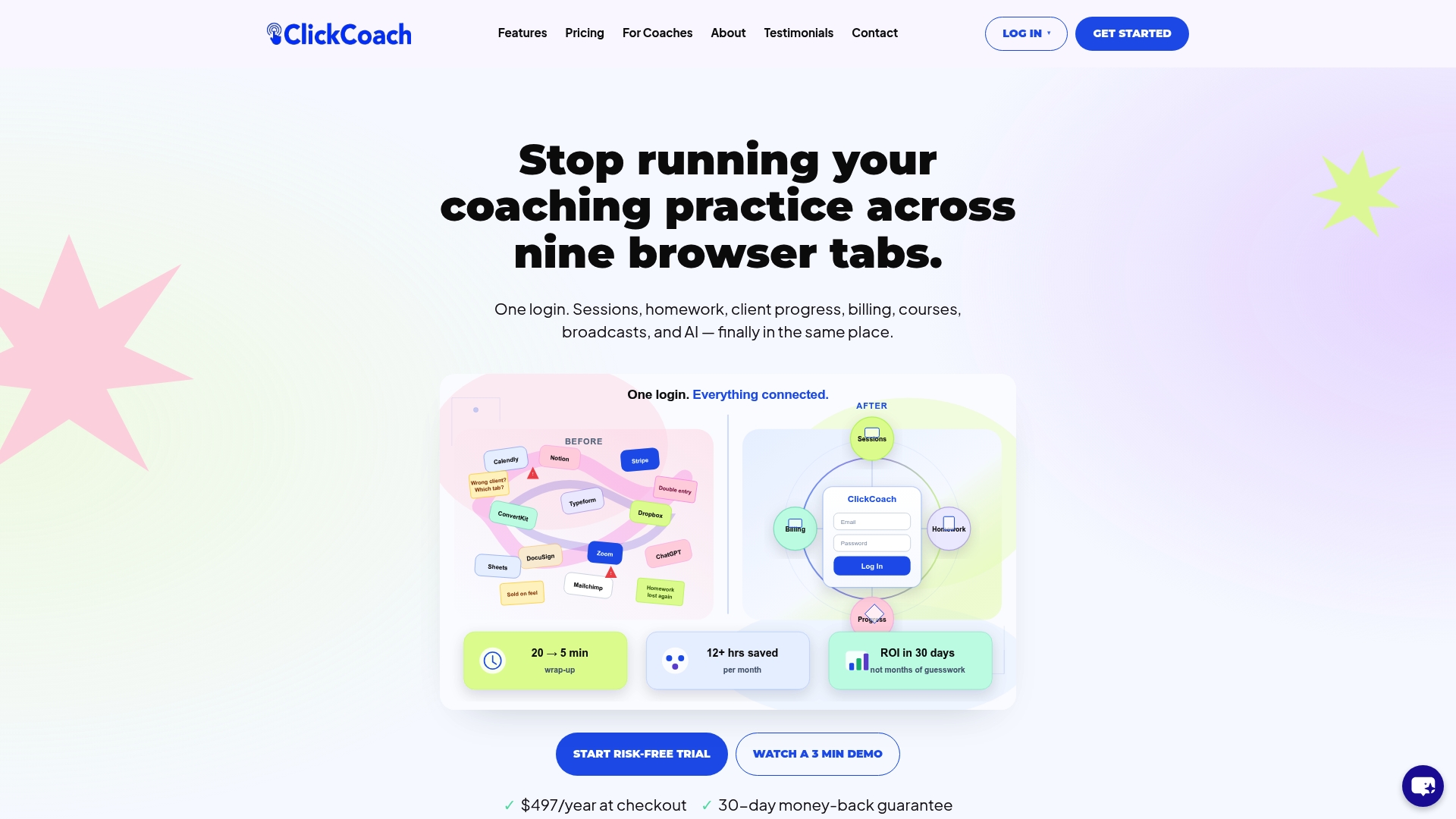
ClickCoach gives you one place to manage the full client relationship from the moment a social lead books a call. Session notes, homework assignments, progress tracking, billing, e-sign contracts, and a branded client portal all live under one login. Coaches using ClickCoach report saving up to 20 minutes per session on administrative tasks, which adds up to hours each week as your practice grows. When a discovery call converts to a paid client, onboarding takes minutes, not an afternoon.
If you are managing more than five active clients and still juggling multiple tools, it is time to consolidate. Start with ClickCoach and run your entire practice from a single platform.
Sources
- Social Media Use in 2021
- Share of social buyers by age group worldwide
- How to Use The 5:3:2 Rule For Social Sharing
- Explained: The 5:3:2 rule for social media
- Coachbusinesspro
- Social Media for Coach Client Acquisition: What Actually Works (2026)
- Social Media for Coaches: Build a Client Pipeline - Scale Growth Digital