

Set two to four co-created, behaviorally anchored goals tied to one objective business KPI, then run a timeboxed measurement plan with a named data owner tracking baseline, midline, and endline results. That’s the whole system in one sentence. The rest is execution.
Before your next intake session, build this one-row template for each goal: goal statement, observable behavior, audience who will notice it, objective business KPI, baseline score, midline check date, and a named owner for the data. Layer in a PDCA cycle (Plan, Do, Check, Act) for the review rhythm and a short 360-degree feedback pass at baseline and midline. A platform like ClickCoach can hold this template inside the client record so it doesn’t live in a separate spreadsheet you forget to update.
- Goal: behaviorally specific, tied to one KPI
- Baseline: self-rating plus 6 to 10 stakeholder inputs
- Owner: named person responsible for pulling the KPI data
- Checkpoint: 30/60/90 day midline review
Pro Tip: Write the goal as a hypothesis, not a wish. “If I run structured one-on-ones weekly, my directs will report feeling more heard within 90 days” is testable. “Improve communication” is not.
Key Takeaways
Measurable executive coaching goals work when they name one behavior, one KPI, one data owner, and a fixed review window, not when they describe aspirations.
| Point | Details |
|---|---|
| Cap goals at two to four | More than four goals dilutes attention and weakens the evidence for each one. |
| Co-create with the sponsor | Coach, executive, and HR sponsor should jointly agree on success criteria before work starts. |
| Baseline before session two | Collect self-rating and 360 feedback from 6 to 10 stakeholders in the first two weeks. |
| Match attribution to design | Use single-cohort signals for one executive; matched peers or staggered rollouts for larger programs. |
| Centralize tracking in one workspace | ClickCoach holds the goal worksheet, session notes, and progress data in one client record for faster sponsor reporting. |
Table of Contents
- Why Measurable Executive Coaching Goals Change Outcomes
- How Do You Align Coach, Executive, and Sponsor on Goals?
- A Copy-and-Paste Framework for Measuring Executive Goals
- Leading vs. Lagging: Choosing the Right Measures
- What Should a Tracking Cadence and Dashboard Look Like?
- Templates You Can Use Today
- How Do You Report Impact Without Overclaiming?
- Common Pitfalls That Sink Executive Coaching Measurement
- What I Do Differently With Executive Clients
- Put the Framework Into One Workspace
- Sources
- FAQ
Why Measurable Executive Coaching Goals Change Outcomes
Sponsors don’t fund vague improvement. They fund evidence. A goal that names the observable behavior and the business KPI it feeds gives HR and finance something concrete to evaluate at renewal time, rather than a subjective impression of whether the engagement “felt good.”
Behavioral change is the most defensible signal of coaching impact you can produce, because it’s observable by multiple stakeholders before any downstream business result shows up. Business outcomes matter too, but they need real attribution design behind them.
An exploratory study of 12 matched coach-coachee pairs found business impact varies with role complexity and organizational context, which is exactly why a single testimonial or self-report rating won’t hold up under scrutiny from a skeptical CFO.
How Do You Align Coach, Executive, and Sponsor on Goals?
Co-creation means the coach, the executive, and the HR sponsor all own the goal, not just the executive. That three-way ownership is what makes coaching defensible and significantly more effective, because nobody can later claim the goal was invented after the fact to justify a result.
Build these into your measurement agreement before the first real session:
- One business KPI mapped to each behavioral goal, not a vague cluster of ambitions
- Named data owner with access to the KPI source (usually someone in the executive’s org, not you)
- Agreed review cadence, typically 30, 60, and 90 days
- Written consent for any stakeholder survey or operational data pull
Ask these questions directly in the intake meeting:
- “What observable behaviors would your stakeholders notice if progress occurred?”
- “Who currently owns the data for the business metric this behavior should move?”
- “What would count as evidence this isn’t working, and by when would we know?”
Add a short consent line whenever you request stakeholder feedback or internal KPI data: state who sees the raw responses, how long you retain them, and that aggregated results, not individual quotes, go to the sponsor.
A Copy-and-Paste Framework for Measuring Executive Goals
Six steps, in order, cover the full arc from kickoff to evaluation. Each has a purpose and a rough timeframe you can adapt to the engagement length.
| Step | Purpose | Timeframe | Example data source |
|---|---|---|---|
| Charter | Name one KPI and its owner | Week 1 | Sponsor conversation, HR |
| Baseline | Self-rating + 360 + one objective metric | Weeks 1 to 2 | Stakeholder survey, HRIS report |
| Hypothesis framing | State the behavior as a testable claim | Week 2 | Coaching intake notes |
| Timebox | Set the window for behavior evidence | 60 to 90 days | Calendar milestones |
| Midline pulse | Check progress, adjust if needed | Day 30, 60, 90 | Short stakeholder survey |
| Endline evaluation | Compare to baseline, assess attribution | End of window | Full 360, KPI trend |
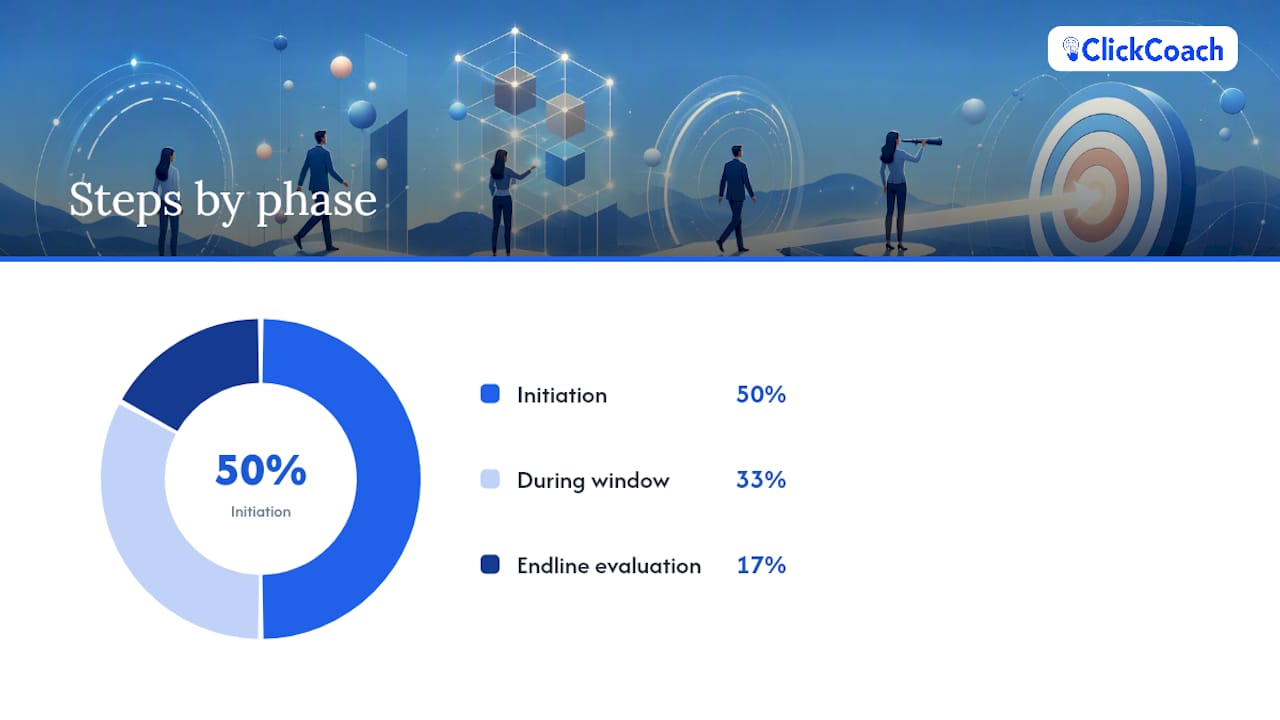
A defensible plan sets two to four behaviorally anchored goals, collects 360 feedback from 6 to 10 stakeholders at baseline, and repeats a lighter version at midline. Here’s an example row you can adapt: “If [executive] runs structured decision reviews weekly, direct reports will report clearer priorities within 90 days, tracked against project cycle time as the objective KPI.”
Pro Tip: Store the charter and baseline in the client file the day you collect them. Retroactively reconstructing a baseline three months in is the single fastest way to lose sponsor credibility.
Leading vs. Lagging: Choosing the Right Measures
A leading indicator moves fast and tells you whether the behavior is happening at all, things like meeting facilitation quality or experiment completion rate. A lagging indicator, like retention or revenue, moves slowly and gets influenced by dozens of other factors you don’t control. Use leading indicators for midline checks and lagging indicators for the endline business case.
Pair one objective KPI with one or two intermediate indicators and one or two qualitative signals, such as a short stakeholder micro-survey or a session-level self-rating.
| Behavior | Intermediate indicator | Objective KPI |
|---|---|---|
| Structured one-on-ones | Direct report survey score | Team retention rate |
| Delegation practice | Manager’s calendar audit | Project cycle time |
| Cross-functional visibility | Peer feedback rating | Cross-team project completion rate |
Combining a SMART goal with this kind of behavioral mapping, sometimes framed as a BE-DO-HAVE structure, keeps the identity-level ambition tied to something you can actually count.
What Should a Tracking Cadence and Dashboard Look Like?
Most engagements need less tracking infrastructure than coaches assume, but they need the right fields captured consistently. Set a rhythm of session follow-ups after every meeting, a brief weekly log from the executive, and a formal 30/60/90 day midline check that feeds a sponsor report.

A minimum viable dashboard per goal needs seven fields: goal statement, target behavior, baseline score, midline score, trend direction, data owner, and any supporting attachments like survey exports.
When picking a tracking tool, check for:
- Clear data ownership, so it’s obvious whose responsibility a metric is
- A dashboard simple enough to update in under two minutes per session
- Built-in stakeholder survey capability, not a bolt-on
- Exportable, sponsor-ready reports without manual reformatting
Pro Tip: Keep data collection low-friction for the executive, one or two questions logged weekly, but escalate to an ops contact early if the objective KPI lives in a system you can’t access directly.
This is exactly the gap a practice-management platform like ClickCoach is built to close. It centralizes goal records, session notes, and progress data in one workspace instead of scattering them across spreadsheets and email threads, which matters most when a sponsor asks for a midline update on short notice.
Templates You Can Use Today
Three templates cover the full cycle from intake to sponsor update.
Goal worksheet fields: hypothesis goal, observable behaviors, audience who notices change, objective KPI, baseline score, midline check date, named data owner, evidence sources.
Session micro-measures, logged weekly:
- What behavior did you practice this week, and how many times?
- What’s one piece of feedback you received, direct or observed?
- What’s your confidence rating on this goal today (1 to 5)?
- What will you adjust before the next check-in?
Sponsor report structure, one page:
- Goal and behavioral hypothesis, restated in plain language
- Trend summary: baseline vs. midline score
- Fidelity indicator: is the executive actually practicing the behavior
- Recommended next step: continue, adjust, or close out
Keep the sponsor report to one page. A dense report signals uncertainty more than a confident, focused one does.
How Do You Report Impact Without Overclaiming?
Attribution gets stronger as your design gets more rigorous, and you should pick the level your engagement actually supports. A single cohort paired with one behavior and one operational KPI is a reasonable signal for a one-executive engagement. Staggered rollouts or matched peer comparisons strengthen the claim for team-level work. Interrupted time series analysis fits larger, multi-cohort programs where the budget supports it.
Structure the one-page impact brief around four questions: what changed, by how much, who confirmed the data, and what the change plausibly means given other factors in play.
When results are mixed, say so plainly rather than reaching for stronger language than the data supports: “The behavior shows consistent midline movement; the KPI trend is directionally positive but within normal variance, so we recommend continuing through the full 90-day window before drawing a business conclusion.” That phrasing protects your credibility more than a confident overstatement ever will.
Common Pitfalls That Sink Executive Coaching Measurement
Five failure modes show up again and again, and each has a fast fix.
- Vague goals (“be a better leader”) rewrite as a behavioral hypothesis with a named audience and timeline.
- Missing baseline means agree on the data source before session two, not after session six.
- No named KPI owner stalls data access for weeks. Name the owner in the charter meeting.
- Overloaded goal lists (six or more goals) dilute attention. Cap at two to four.
- Self-report only invites skepticism. Add at least one 360 or operational data point.
Pause and recalibrate a goal when midline data is ambiguous but the behavior is clearly present. Close a goal out only when the evidence, not the calendar, says it’s done.
What I Do Differently With Executive Clients
I insist on one objective KPI per goal, a named data owner outside the coaching relationship, and a signed measurement commitment before real work starts. It feels like extra friction in week one. It saves hours of scrambling later when a sponsor asks for evidence mid-engagement, and it produces a midline signal you can actually stand behind instead of a vague progress narrative.
Put the Framework Into One Workspace
Running this framework across spreadsheets, email threads, and survey tools works for one client. It falls apart at five or six, when session notes live in one place, KPI trackers in another, and the sponsor report gets rebuilt from scratch every month. ClickCoach centralizes the goal worksheet, session notes, and progress tracking in one client record, so the one-row measurement template and the midline snapshot both live where you actually work.
Two fields from the framework map directly to what a practice platform should handle: the one-row measurement template (goal, behavior, KPI, baseline, owner) belongs in the client’s permanent record, and the midline snapshot needs to be pullable in minutes, not rebuilt from memory. ClickCoach’s progress tracking tools hold both, and its SlipMeter feature supports the weekly micro-measure logging your executive clients do between sessions.
If you’re managing this by hand right now, take a look at ClickCoach’s practice management platform and see whether it fits the way you already run engagements. You can also just get started and set up your first client goal worksheet today.
Sources
- How to Measure the Impact of Executive Coaching: Set Defined Goals | Challenger, Gray & Christmas, Inc.
- Track Personal Growth in Executive Coaching
- DOI 10.1037/a0015438
FAQ
How Many Goals Should You Set With an Executive Client?
Two to four behaviorally anchored goals, each tied to one objective business KPI, gives enough coverage without diluting attention or data collection effort.
What’s the Difference Between a Leading and Lagging Indicator?
A leading indicator, like meeting facilitation quality, moves quickly and shows whether the behavior is happening; a lagging indicator, like retention or revenue, moves slowly and reflects many combined factors.
How Long Should a Measurement Window Run?
Plan for roughly 60 to 90 days to see clear behavioral evidence, with fuller business impact often taking six to 12 months to surface in pilot cohorts.
Who Should Own the KPI Data in a Coaching Engagement?
Someone inside the executive’s organization, named at the charter meeting, should own KPI access, not the coach, since the coach rarely has direct visibility into internal systems.
Can a Practice Management Platform Replace a Measurement Framework?
No. A platform like ClickCoach centralizes the goals, notes, and tracking data the framework produces, but the coach still designs the goals, baselines, and attribution approach.