

Proactive client communication coaching is the deliberate practice of training coaches to initiate consistent, anticipatory outreach before clients raise concerns. This approach shifts the coach’s role from reactive problem-solver to trusted partner who sets the pace of every interaction. Coaches who master this skill reduce client anxiety, cut down on repetitive “where are we?” messages, and build the kind of trust that drives long-term retention. Tools like ClickCoach and frameworks from professional services consultants at Kelliworks show that structured communication systems are the real engine behind strong client relationships.
What is proactive client communication coaching and why does it matter?
Proactive client communication coaching is a structured discipline that teaches coaches to anticipate client needs and deliver timely updates before silence creates doubt. The core idea is simple: clients who receive consistent, predictable communication feel supported. Clients who don’t hear from their coach fill that silence with worry.
The mindset shift here is significant. Most coaches default to reactive communication, responding when clients reach out rather than setting the rhythm themselves. Proactive communication builds trust through consistency, not through dramatic gestures or lengthy check-in calls. A brief, scheduled update carries more weight than a long conversation that only happens when something goes wrong.
The importance of proactive communication extends beyond client satisfaction. Coaches who implement anticipatory outreach report fewer inbound “status check” messages. That reduction frees up mental bandwidth for the complex coaching work that actually moves clients forward. The operational benefit is real: less time managing anxiety, more time delivering results.
“Anticipating client needs fosters a culture of trust where clients feel supported, which is crucial for long-term coaching success.” — Proactive communication in customer relationships
Coaching for effective client interaction starts with recognizing that communication is not just a soft skill. It is infrastructure. Build it deliberately, and everything else in your practice runs more smoothly.
Key components of proactive communication coaching

Proactive communication coaching breaks down into four concrete components: communication windows, intake protocols, between-session check-ins, and urgency definitions. Each one addresses a specific failure point in reactive coaching practices.
Communication windows
A communication window is a defined time block when clients can expect responses from their coach. Clear communication windows reduce cognitive load for both coach and client by removing the guesswork around response timing. For example, a coach might specify: “I respond to messages Monday through Thursday, 9 a.m. to 5 p.m., within 24 hours.” That single sentence eliminates dozens of anxious follow-up messages per month.
Intake forms and expectation-setting
Standardized intake forms do more than collect client information. They set the terms of the entire coaching relationship. Experts recommend a 15–20 minute intake process that covers communication channels, response times, and how clients should flag urgent issues. Coaches who skip this step spend the rest of the engagement managing mismatched expectations.
Between-session check-ins
Brief, templated check-in messages keep clients connected between sessions without opening the door to open-ended conversations. A well-designed check-in email asks two or three focused questions: Did you complete your homework? What is your top priority for our next session? What obstacles came up this week? Standardized check-in templates prompt client reflection without extending dialogue unnecessarily.
Urgency definitions
Coaches who distinguish between urgent and non-urgent messages protect their time and their clients’ clarity. An urgent message might be a crisis that affects the client’s ability to function. A non-urgent message is a question that can wait for the next session. Communicating this distinction upfront prevents clients from treating every thought as an emergency.
- Define your communication window and post it in your client portal.
- Build a standardized intake form that covers channels, timing, and urgency criteria.
- Create two or three check-in templates for different points in the coaching cycle.
- Write a one-paragraph urgency policy and share it during onboarding.
- Review your communication protocols quarterly and adjust based on client feedback.
Pro Tip: Set your communication window as a fixed block, not a range. “I respond within 48 hours on weekdays” is clearer than “I try to respond quickly.” Precision reduces anxiety on both sides.
Proactive vs. reactive communication: a real-world comparison
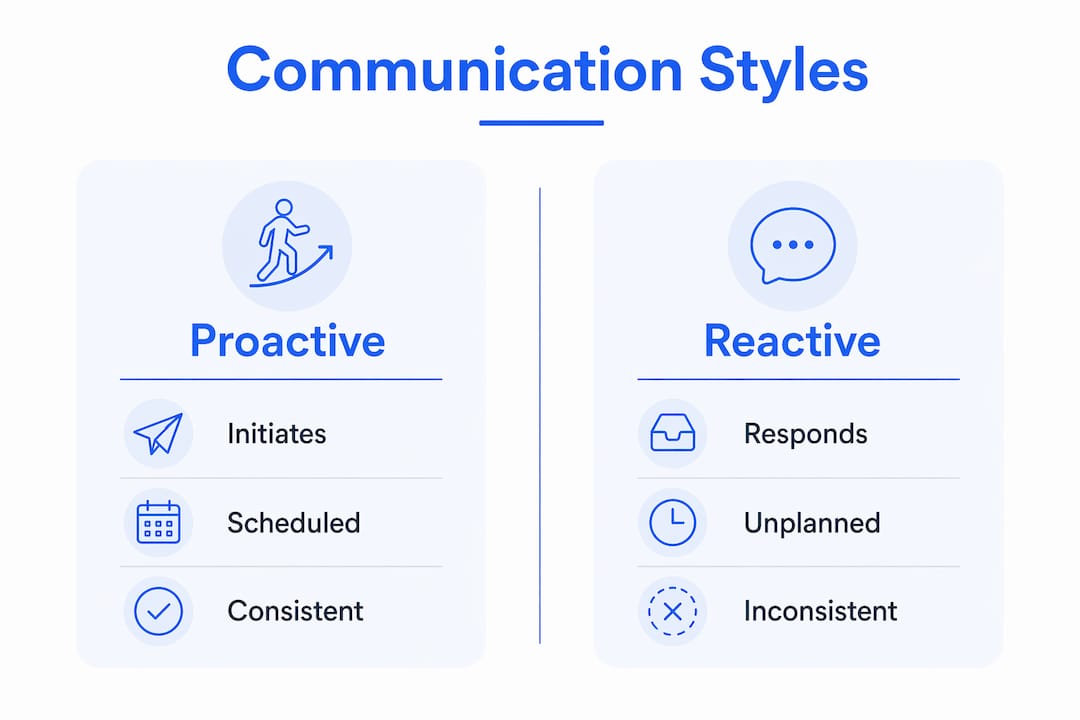
The difference between proactive and reactive coaching communication shows up most clearly in client behavior. Reactive coaches wait for clients to reach out. Proactive coaches schedule touchpoints before clients feel the need to ask.
| Factor | Proactive communication | Reactive communication |
|---|---|---|
| Update timing | Coach initiates on a set schedule | Coach responds when client asks |
| Client anxiety | Low, because silence is expected and explained | High, because silence feels like neglect |
| Coach workload | Predictable and manageable | Unpredictable, often urgent |
| Client perception | Coach as strategic partner | Coach as service provider |
| Retention impact | Higher, due to consistent trust-building | Lower, due to perceived disengagement |
| Referral likelihood | Stronger, clients feel genuinely supported | Weaker, clients feel transactional |
Consider a realistic scenario. A client completes a difficult homework assignment and hears nothing for five days. A reactive coach waits for the next session. A proactive coach sends a brief check-in on day two: “How did the assignment go? Anything you want to flag before we meet?” The second approach costs the coach three minutes. It saves the client five days of uncertainty.
Proactive outreach schedules map key coaching moments to specific communication touchpoints, assigning both the channel and the timing. This turns good intentions into consistent practice. Reactive communication, by contrast, relies on the client to signal when something is wrong. That is a flawed system because clients often disengage quietly before they ever say they are struggling.
The risk of purely reactive communication is client churn. Clients who feel unsupported between sessions are far more likely to cancel or not renew. Proactive communication coaching addresses this directly by making support feel continuous, not episodic.
Best practices for implementing proactive communication coaching
Coaches who successfully shift to proactive communication do not overhaul everything at once. They build the system in layers, starting with the highest-impact changes first.
- Audit your current communication. Write down every touchpoint you currently have with clients: session reminders, follow-up emails, check-ins, and ad-hoc messages. Identify the gaps where clients go silent or send anxious follow-ups.
- Create a proactive outreach matrix. List every key moment in your coaching cycle (onboarding, mid-program, pre-session, post-session, program close) and assign a communication action to each one. Include the channel, timing, and message template.
- Onboard clients with a communication brief. During your first session or intake call, walk clients through your communication window, response time, and urgency policy. This single conversation prevents the majority of between-session friction.
- Use technology to manage cadence. Platforms like ClickCoach centralize session management, homework tracking, and client messaging under one login. That structure makes it far easier to maintain a consistent communication rhythm without relying on memory or scattered apps.
- Document every communication touchpoint. Keep a record of when you sent check-ins, what you asked, and how clients responded. This data helps you spot patterns, like clients who go quiet before dropping out, and adjust your approach early.
- Measure and adjust. Track inbound message volume from clients over time. Organizations using proactive messaging see a measurable drop in “where is my update” inquiries. If your inbound volume stays high, your proactive system needs refinement.
Pro Tip: Schedule your check-in messages the same way you schedule sessions. Block time on your calendar for outreach, and treat it as a non-negotiable appointment. Consistency is what makes the system work.
The goal is not to communicate more. It is to communicate at the right moments, through the right channels, with the right level of detail. Stable communication practices act as infrastructure that prevents client anxiety caused by unpredictable updates. Once the system is in place, it runs with minimal effort and delivers consistent results.
Key Takeaways
Proactive client communication coaching works because consistent, anticipatory outreach builds trust, reduces client anxiety, and frees coaches to focus on high-value work.
| Point | Details |
|---|---|
| Define communication windows | Set fixed response times so clients know exactly when to expect updates. |
| Standardize intake protocols | Use a 15–20 minute intake process to align on channels, timing, and urgency criteria. |
| Use templated check-ins | Brief, focused messages between sessions maintain connection without creating open-ended dialogue. |
| Shift from reactive to proactive | Coaches who initiate outreach see lower client anxiety and stronger retention rates. |
| Build with technology | Platforms like ClickCoach centralize communication, scheduling, and progress tracking in one place. |
Why I think most coaches underestimate communication infrastructure
Most coaches treat communication as a byproduct of good coaching. They focus on their methodology, their frameworks, their session structure. Then they wonder why clients disengage between sessions or cancel without warning.
The real issue is almost never the quality of the coaching. It is the silence between sessions. Clients interpret silence as indifference, even when the coach is working hard on their behalf. I have seen this pattern repeat across dozens of coaching practices: excellent coaches losing clients not because of poor results, but because of poor communication rhythm.
The shift to proactive communication is not complicated, but it does require a deliberate decision to treat communication as a system, not an afterthought. Coaches who build that system, even a simple one with a clear communication window and two or three check-in templates, report a noticeable change in client behavior. Clients become more engaged, more prepared for sessions, and more likely to complete homework.
The hardest part is not the execution. It is the mindset change. Reactive communication feels natural because it is responsive. Proactive communication requires you to act before the client signals a need. That feels counterintuitive at first. Over time, it becomes the foundation of every strong coaching relationship you build.
One more thing: consistency matters more than frequency. A weekly check-in that arrives every Tuesday is more powerful than three check-ins in one week followed by two weeks of silence. Clients calibrate their trust to your rhythm. Make the rhythm reliable.
— Mitch
How ClickCoach supports proactive client communication
Coaches who want to put these communication strategies into practice need a system that keeps everything in one place.
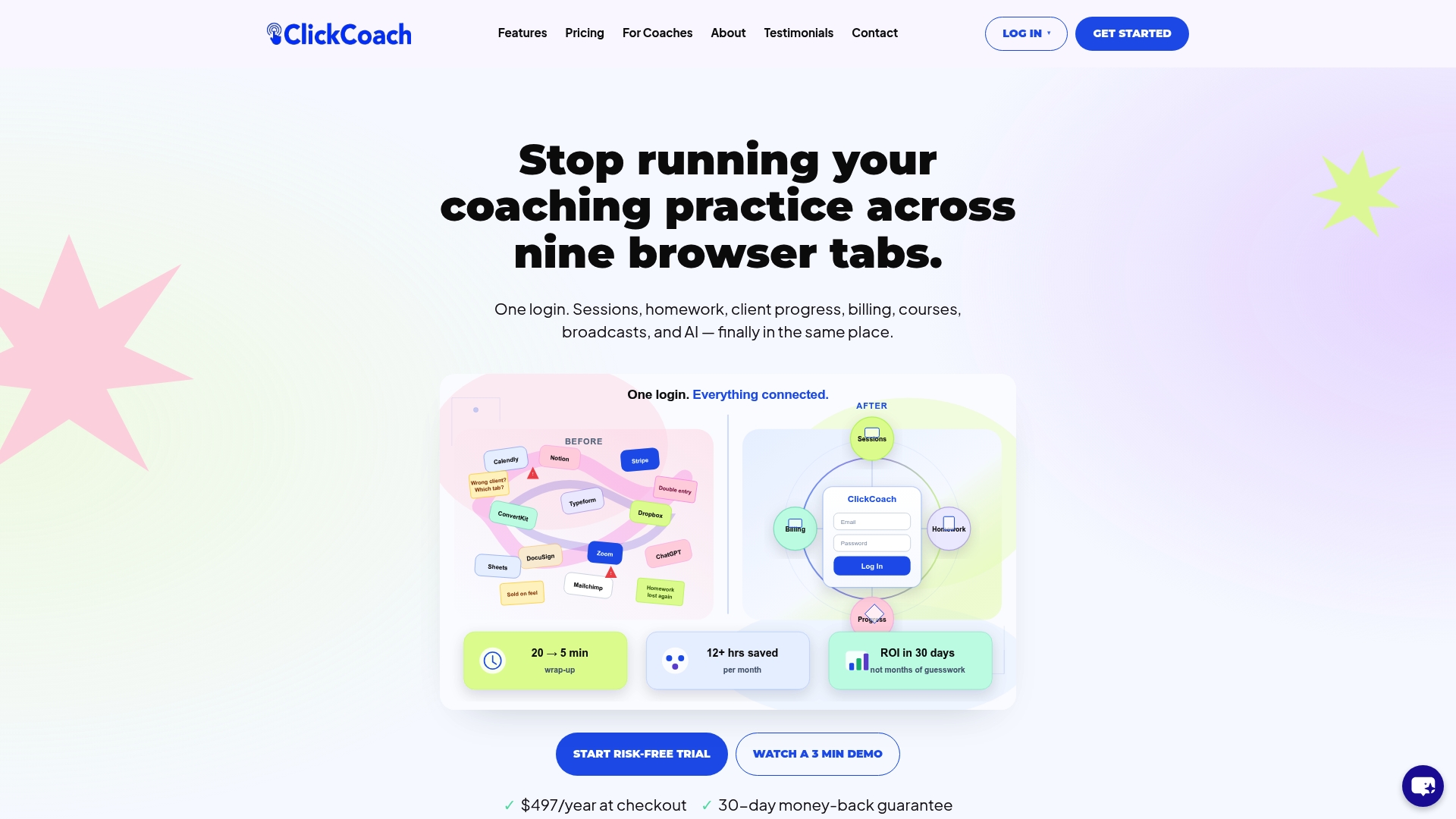
ClickCoach brings session management, client progress tracking, homework assignments, and billing under a single login. That structure makes it straightforward to maintain a consistent communication cadence without juggling multiple apps or losing track of where each client stands. The platform’s AI assists with drafting homework and tracking progress, so coaches spend less time on admin and more time on the work that matters. Coaches report saving up to 20 minutes per session by using ClickCoach. Explore ClickCoach to see how it fits your practice.
FAQ
What is proactive client communication coaching?
Proactive client communication coaching is the practice of training coaches to initiate consistent, anticipatory outreach before clients raise concerns. It builds trust through predictable updates and reduces client anxiety between sessions.
How does proactive communication differ from reactive communication?
Reactive communication responds when clients ask. Proactive communication sets a schedule of touchpoints so clients always know when to expect an update, which reduces inbound inquiries and improves retention.
What is a communication window in coaching?
A communication window is a defined time block when clients can expect a response from their coach. Clear windows reduce miscommunication and protect the coach’s time by setting firm response-time expectations upfront.
How do I improve client communication as a coach?
Start by auditing your current touchpoints, then build a proactive outreach matrix that assigns a communication action to every key moment in your coaching cycle. Add templated check-ins and a clear urgency policy during onboarding.
Why does proactive communication reduce inbound client messages?
When clients know exactly when they will hear from their coach, they stop sending anxious follow-ups. Proactive messaging removes the uncertainty that drives most between-session contact.