

Invoice before coaching begins, not after: require a deposit or card on file for any package, and never let a session start without a signed agreement covering payment terms. Every invoice needs the standard elements (business details, invoice number, due date, itemized services, payment instructions), and recurring billing should run on autopilot. When you automate invoices and reminders, billing stops competing with coaching for your attention.
TL;DR:
- Most coaching invoices should include clear business details, a unique invoice number, client information, itemized services, and payment instructions to ensure quick payment.
- Upfront deposits of 20 to 30 percent are recommended for high-ticket programs to secure commitment and reduce cancellation risk before work begins.
- Automated invoicing, payment links, and card-on-file billing significantly reduce collections time and free up coach’s attention for client work.
- Enforcing no-show and late cancellation policies immediately prevents boundary erosion and calendar disruptions.
- Maintaining detailed records of invoices, receipts, and compliance with sales tax rules helps avoid tax issues and speeds up year-end tax filings.
Table of Contents
- What Belongs on a Coaching Invoice
- How to Invoice Coaching Packages: Upfront, Split, or Monthly
- Session-Based Billing Best Practices
- Handling No-Shows and Late Cancellations
- Payment Plans for High-Ticket Coaching Programs
- The Money Conversation: Reminders to Escalation
- Receipts, Recordkeeping, and Tax Basics for Coaches
- Build the System Once: Templates and Automation
- Why Clear Invoicing Strengthens Coaching
- Automate Billing Without Losing the Personal Touch
- Sources
- FAQ
What Belongs on a Coaching Invoice
An invoice that gets paid fast looks nothing like a note scribbled after a session. According to Xero’s guide for small businesses, a properly built invoice needs 10 core elements, and skipping even one is often what stalls payment inside a corporate accounts payable queue.
Here’s the checklist worth pinning above your desk:
- Your business name, address, and contact information
- A unique, sequential invoice number
- The issue date and a clear due date
- The client’s (or sponsor’s) name and billing address
- An itemized list of services, with dates and session counts
- Subtotal, applicable sales tax, and total amount due
- Accepted payment methods (card, ACH, check)
- Payment terms (net 15, due on receipt, etc.)
- Late fee policy, if one applies
- Notes field for program name or purchase order number
Pro Tip: When a company sponsors an employee’s coaching, list the sponsor’s billing contact and PO number at the top of the invoice, and note the coachee’s name separately in the line items. That single formatting choice is often the difference between a same-week payment and a three-week delay while the payer tries to match the charge to the right budget line.
There’s no federal invoice template mandated for U.S. small businesses, according to Aviy’s overview of invoice requirements, which means the standard elements above function as your de facto compliance checklist. Miss the itemized detail and a corporate AP department will bounce it back, according to LegalClarity’s sales invoice guidance, costing you a payment cycle over something as small as a vague line item.
How to Invoice Coaching Packages: Upfront, Split, or Monthly
Three billing structures cover most coaching packages, and all shifts risk differently between you and the client.
- Full payment upfront. You get paid before the work starts, which protects your cash flow completely, but some clients hesitate at a large one-time charge.
- Two-payment split. Half at signing, half at the midpoint. This lowers the entry barrier while still front-loading your risk protection.
- Monthly installments. Easier for clients to budget, but it ties your revenue to ongoing collections and requires firmer enforcement if a payment is missed.
Whichever structure you choose, write it into the coaching agreement first. The ICF Code of Ethics treats the agreement as the foundation for financial interactions between coach and client, meaning payment terms, not the invoice, are where the real commitment gets made. The invoice should simply restate what the agreement already promised.
For line items, be specific: “Executive Leadership Program, Sessions 1 through 6, January 15 to March 15, 2026” clears corporate accounting far faster than “Coaching Services.”
Session-Based Billing Best Practices
If you bill per session rather than by package, timing is what separates a smooth billing cycle from an awkward one.
- Invoice the same day, or auto-charge. Never let unpaid sessions pile up. A delay of even a week makes the eventual bill feel like a surprise.
- Keep a card on file. Auto-charging immediately after each session removes the need for a manual invoice entirely, and automated receipts confirm the charge without extra work on your end.
- Send a monthly statement anyway. Clients using employer reimbursement or tracking a coaching budget need a consolidated record, even if each session was already paid individually.
Practice-management guidance consistently points to card-on-file billing as the single biggest lever for protecting session time. When payment is automatic, you spend zero minutes on collections and every minute on the client in front of you.
Handling No-Shows and Late Cancellations
A cancellation policy only works if it’s written down before anyone needs it. Most coaches set a 24 to 48 hour notice window, with the standard consequence being a forfeited session or a flat late-cancellation fee.
- State the policy in the coaching agreement, repeat it in the welcome email, and print it in the invoice footer.
- Charge the fee the first time it’s earned. Waiving it “just this once” quietly resets client expectations for good.
- Use a three-step enforcement sequence: automated reminder, personal check-in if it’s ignored, then a hold on future sessions if the balance stays unpaid.
Pro Tip: Enforcing the policy at the first violation, even for a great client, prevents the boundary erosion that eventually turns your whole calendar into a suggestion rather than a schedule.
Payment Plans for High-Ticket Coaching Programs
High-ticket programs, anything running several thousand dollars, need a payment structure that protects your cash flow while still feeling achievable to the client signing up; learn more from Profit Network Coaches Share Their Success Stories - The Dog Gurus for practical examples.
- Collect a deposit of 20 to 30 percent at signing. It signals real commitment and reduces the odds of a client ghosting after session one.
- Design a fixed installment cadence (monthly is standard) and default to automatic payments rather than manual invoices you have to chase every cycle.
- Set a clear pause and refund policy in writing before the first payment, not after a client asks for one. Vague refund language is where most billing disputes start.
Auto-billing on a fixed schedule also means you’re not the one initiating an awkward monthly “just checking in about payment” message. The system does that instead.
The Money Conversation: Reminders to Escalation
Unpaid invoices need a repeatable sequence, not an improvised, case-by-case reaction every time one slips.
- Day 0: Invoice sends automatically with clear terms and a payment link.
- Day 7: Friendly automated reminder. “Just a quick note that Invoice #1042 is due. Here’s the link if it’s easier.”
- Day 14: Personal, direct message. “I wanted to check in on Invoice #1042. Is there anything blocking payment on your end?”
- Day 30: Pause future sessions and communicate it plainly. “I need this invoice settled before we schedule the next session. Happy to jump on a call if something’s come up.”
Before escalating past a friendly nudge, gather the signed agreement, the original invoice, and every prior reminder in one place. That documentation is what makes a formal demand, if it ever comes to that, straightforward rather than messy.
Receipts, Recordkeeping, and Tax Basics for Coaches
Invoices and receipts serve different jobs: an invoice requests payment, a receipt confirms it happened. Coaches who conflate the two often end up with incomplete records when tax season arrives.
- Keep every invoice and receipt for at least three years, and up to seven in certain filing situations, per IRS recordkeeping guidance.
- Check your state’s sales tax rules before assuming coaching services are exempt. Taxability of services varies by jurisdiction, and Xero’s overview of state sales tax differences makes clear that assuming your state’s rule applies everywhere is a common, costly mistake.
- Collect a W-9 from any corporate client before the first invoice, list your EIN on invoices to that client, and send a year-end payment summary so their accounting team isn’t chasing you every January.
Build the System Once: Templates and Automation
The coaches who spend the least time on billing built the system exactly once, then let it run. Standardize your invoice template with sponsor-aware fields (the payer’s PO number, cost center, and the coachee’s name listed separately), following the same line-item approach Everhour’s coaching invoice template recommends for third-party billing.
Your automation checklist should cover four things:
- Recurring invoices tied to the package or program schedule
- A payment link embedded directly in every invoice
- Auto-reminders that fire without you remembering to send them
- Card-on-file billing for session-based work
Pro Tip: The real win isn’t the invoice itself, it’s the chain behind it. When session notes, the signed agreement, and the invoice all live in one workflow, an integrated coaching business management setup catches mismatches (wrong session count, expired agreement terms) before a bad invoice ever reaches the client.
Why Clear Invoicing Strengthens Coaching
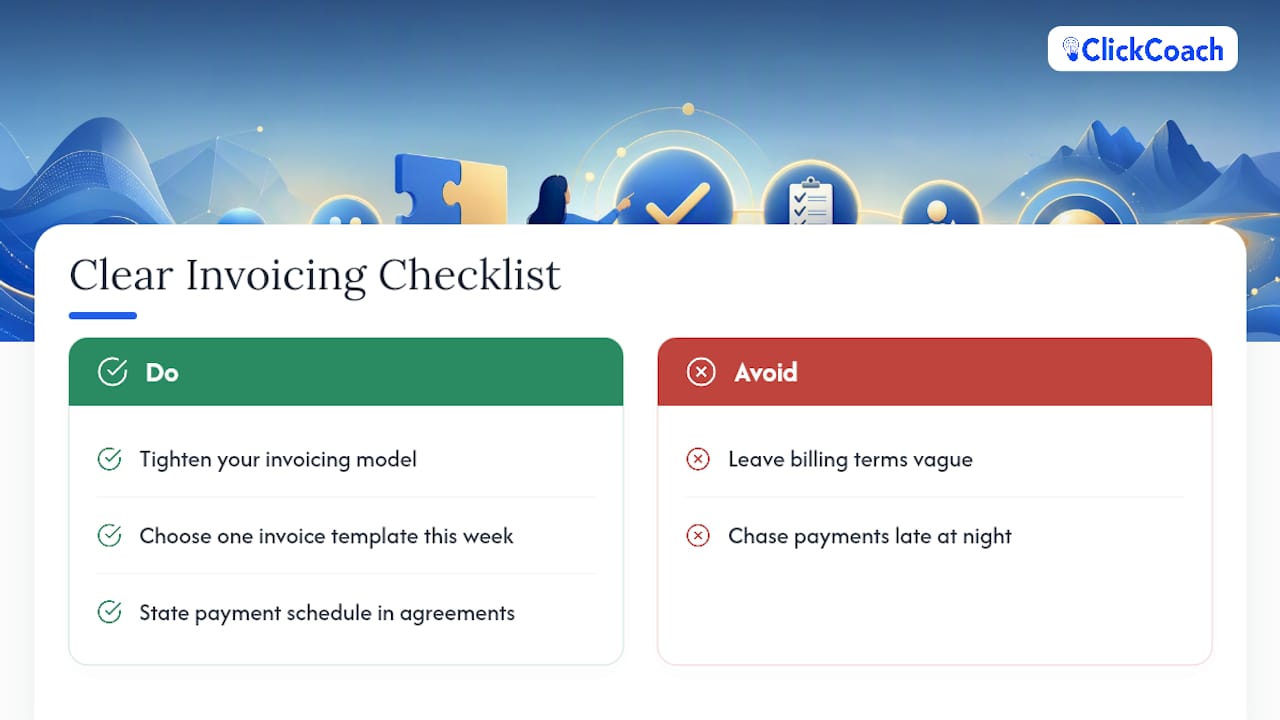
Sloppy billing doesn’t just cost you money, it costs you presence. A coach distracted by an overdue invoice at 3 a.m. is not the coach showing up fully at the next session. Professional billing models the same accountability you’re asking clients to practice: clear commitments, kept on schedule.
I’ve seen coaching practices tighten their invoicing and watch cancellations drop within a quarter, not because the policy got stricter, but because clients finally knew what to expect. Pick one template from this piece and put it into your agreement this week.
— Mitch Russo
Automate Billing Without Losing the Personal Touch
An all-in-one coaching platform can give coaches scaling past one-person admin work a way to stop treating invoicing as a second job. Instead of juggling a separate invoicing app, a separate contract tool, and a separate reminder system, such a platform ties recurring invoices, client portal receipts, payment links, and auto-reminders to the same record where you already keep session notes and agreements.
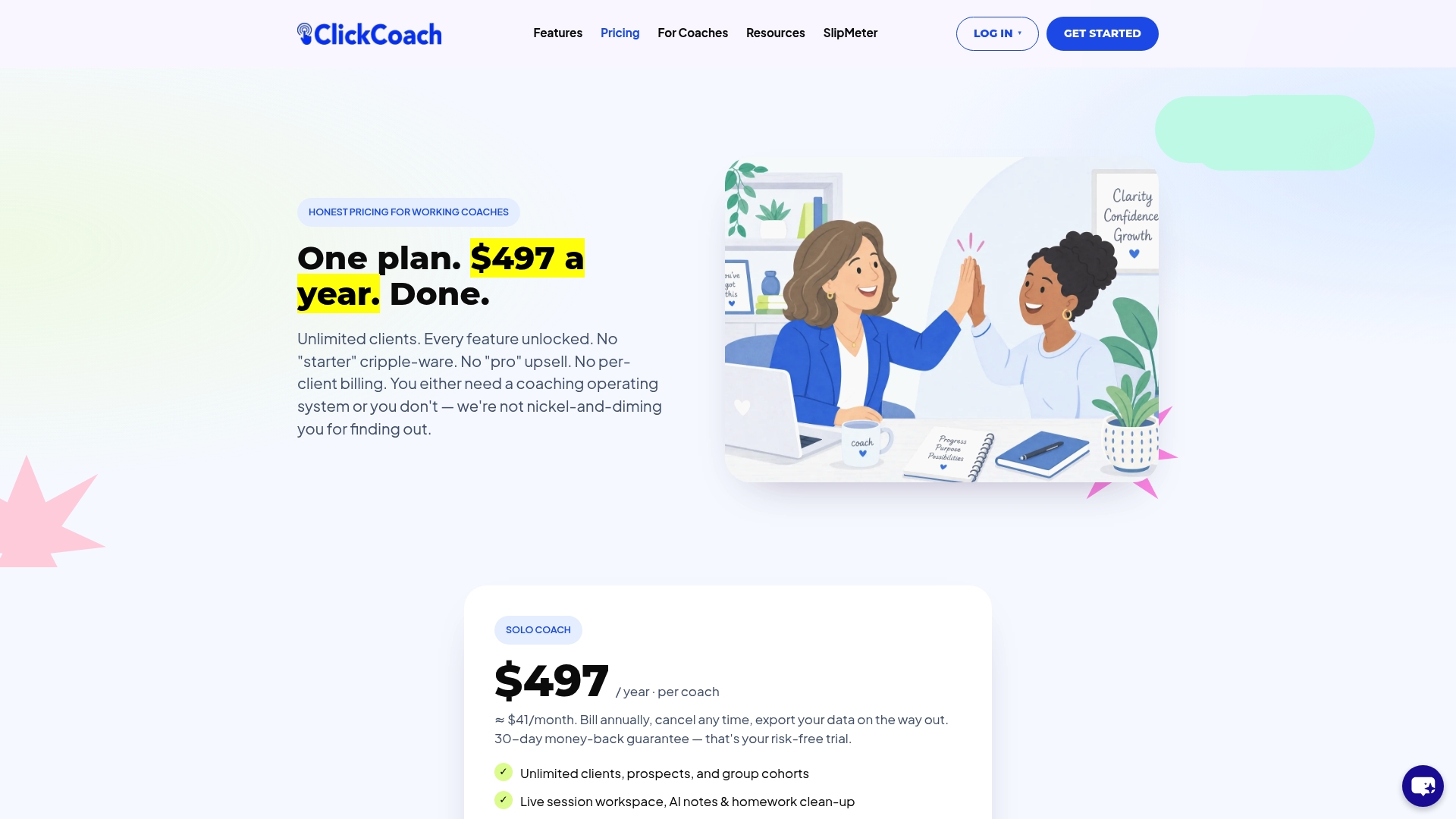
That matters most once you’re running more than a handful of clients on staggered billing cycles. Manually tracking who’s on a monthly plan, who owes a deposit, and who needs a reminder becomes its own part-time job, and it’s exactly the kind of admin that pulls your attention away from coaching. A client portal that surfaces invoices and receipts in one place also means fewer “did you get my payment?” emails landing in your inbox.
If your invoicing process still lives across three disconnected tools, take a look at ClickCoach’s coaching business management platform and see what a single, connected billing workflow looks like for your practice.
Sources
- What kind of records should I keep? | IRS
- What to include on an invoice: a complete guide for small businesses | Xero US
FAQ
How much should I charge for coaching services?
Rates vary widely by specialty and experience, and there’s no single industry-standard number. Base pricing on your niche, your track record, and what comparable coaches in your specialty charge, then build that rate into a written agreement before invoicing.
What is the 70/30 rule in coaching?
Definitions vary depending on the coaching methodology being taught, and this article’s research doesn’t establish a single agreed version. Rather than guess, check the framework your specific certification program uses.
What is the 80/20 rule in coaching?
Like some informal ratios, this term is used inconsistently across coaching schools and isn’t tied to one universal definition. Confirm the specific meaning with your training program rather than assuming a standard answer.
How do I find clients for coaching?
Consistent billing and referral-worthy client experiences tend to do more for growth than any single marketing tactic, since satisfied clients often refer other clients directly. Focus on delivering measurable progress and running professional operations, including invoicing, since a coach who bills cleanly and shows up prepared earns the kind of trust that turns into referrals.
How soon should I invoice a coaching client?
Invoice before the engagement starts for packages, and the same day for individual sessions. Delaying invoices past the work itself is one of the most common reasons coaches end up chasing overdue payments.