

A minimal effective group coaching program is a cohort lasting several weeks with a small group of participants, meeting regularly, and built around one measurable outcome. That structure gives you enough time to see behavior change without losing momentum, and a group small enough for every participant to speak in each session.
Before you build anything else, do three things this week:
- Pick one niche and one measurable outcome (not three).
- Set your pilot cohort dates and cap enrollment at 8 participants.
- Draft your first-session agenda using the template later in this guide.
Everything else — curriculum, pricing, facilitation scripts, and the checklists you’ll reuse for every future cohort — follows below.
Key Takeaways
A group coaching program succeeds when it pairs a tight 8 to 12 week structure with clear outcomes, consistent facilitation, and measurement that starts at intake rather than at graduation.
| Point | Details |
|---|---|
| Start minimal | Run an 8 to 12 week cohort of 6 to 10 participants around one measurable outcome before adding complexity. |
| Protect the 70/30 balance | Keep coach talking time under a third of each session so peer learning drives the group. |
| Homework drives outcomes | Use field experiments and structured reflection tied to weekly objectives, not passive reading. |
| Measure from day one | Set baseline scores at intake and track attendance, homework completion, and self-rated progress throughout. |
| Reduce admin with practice software | Platforms like ClickCoach centralize homework, session notes, and progress reports so coaches spend less time on manual tracking. |
Table of Contents
- What Is a Group Coaching Program?
- Why Group Coaching Delivers Real Outcomes
- How Do You Design a Group Coaching Program?
- What Does a Group Coaching Session Look Like?
- How Do You Build the Curriculum and Materials?
- How Do You Facilitate Group Dynamics Effectively?
- How Should You Price a Group Coaching Program?
- What Tools Do You Need to Run Group Coaching?
- How Do You Measure Group Coaching Outcomes?
- How Do You Recruit Your First Group Coaching Cohort?
- What Formats Work Best for Group Coaching Programs?
- Run Your Cohort Without Drowning in Admin Work
- Sources
What Is a Group Coaching Program?
A group coaching program is cohort-based coaching where a facilitator guides a small, consistent group of participants toward a shared outcome over a defined period. It blends coach-led structure with peer-to-peer learning. That combination is what separates it from a class or a support group. You’re not lecturing, and you’re not just holding space. You’re directing a process where the group itself becomes part of the intervention.
Choose group coaching over one-on-one work when:
- Participants benefit from hearing how peers solve similar problems (leadership cohorts, career transitions, new-manager training).
- You need to serve more clients without proportionally increasing your hours.
- Accountability works better with witnesses. A group that knows you skipped your homework is more motivating than a coach who knows privately.
Choose one-on-one instead when the issue is highly personal, confidential, or requires a pace no group can match.
Why Group Coaching Delivers Real Outcomes
The core benefit isn’t cost savings. It’s the learning multiplier that only happens with a group in the room: participants absorb lessons from other people’s struggles and successes, often faster than they’d absorb the same insight delivered directly to them by a coach.

Group-based interventions, when structured with clear objectives and skilled facilitation, support behavior change and professional learning in ways that one-on-one formats sometimes can’t replicate. The mechanism is straightforward: a group creates observational learning (watching a peer work through a problem clarifies your own), social accountability, and a wider pool of solutions than a single coach can offer.
Pro Tip: Track one leading indicator from week one, homework completion rate, so you can see whether the group’s engagement is holding before you reach the halfway point.
None of this works automatically. Three conditions have to be in place:
- Psychological safety, so participants risk being honest instead of performing for the group.
- A clearly stated, singular outcome the whole cohort is working toward.
- A facilitator who can read group dynamics, not just deliver content.
Skip any of those three and you get a group that meets but doesn’t transform anything.
How Do You Design a Group Coaching Program?
Program design follows a sequence. Skipping steps is the single most common reason cohorts underperform.
- Define the outcome and the audience. Write one sentence: “This program helps [specific audience] achieve [specific, measurable outcome] in [timeframe].” If you can’t write that sentence, you’re not ready to sell seats.
- Set cohort length and group size. Eight to twelve weeks and six to ten participants is the workable range for most professional coaching topics. Smaller groups feel more like one-on-one work; larger ones need co-facilitators.
- Decide cadence and format. Weekly live sessions plus asynchronous homework is the standard model. Biweekly works for executive audiences with limited calendar flexibility, but momentum drops noticeably past a two-week gap.
- Design curriculum modules. Map each session to one learning objective, one core activity, and one homework assignment (more on this in the curriculum section below).
- Set pricing and the enrollment flow. Decide this before you market anything, not after people ask.
- Build onboarding. An intake form, a welcome packet, and a kickoff call reduce first-week attrition significantly.
- Run a pilot before a full launch. Treat your first cohort as a test, not a finished product.
When picking group size, weigh airtime against diversity of perspective. Six participants means everyone speaks in most sessions. Ten means richer discussion but tighter timeboxing.
Before opening a second cohort, confirm your pilot hit three minimum bars:
- At least 70% of participants completed the majority of assigned homework.
- Attendance stayed above 80% across sessions.
- Participants can articulate, in their own words, what changed for them.
Pro Tip: Ask your pilot cohort one question in the final session: “What would you tell a friend deciding whether to join this?” Their exact phrasing often becomes your best marketing copy.
What Does a Group Coaching Session Look Like?
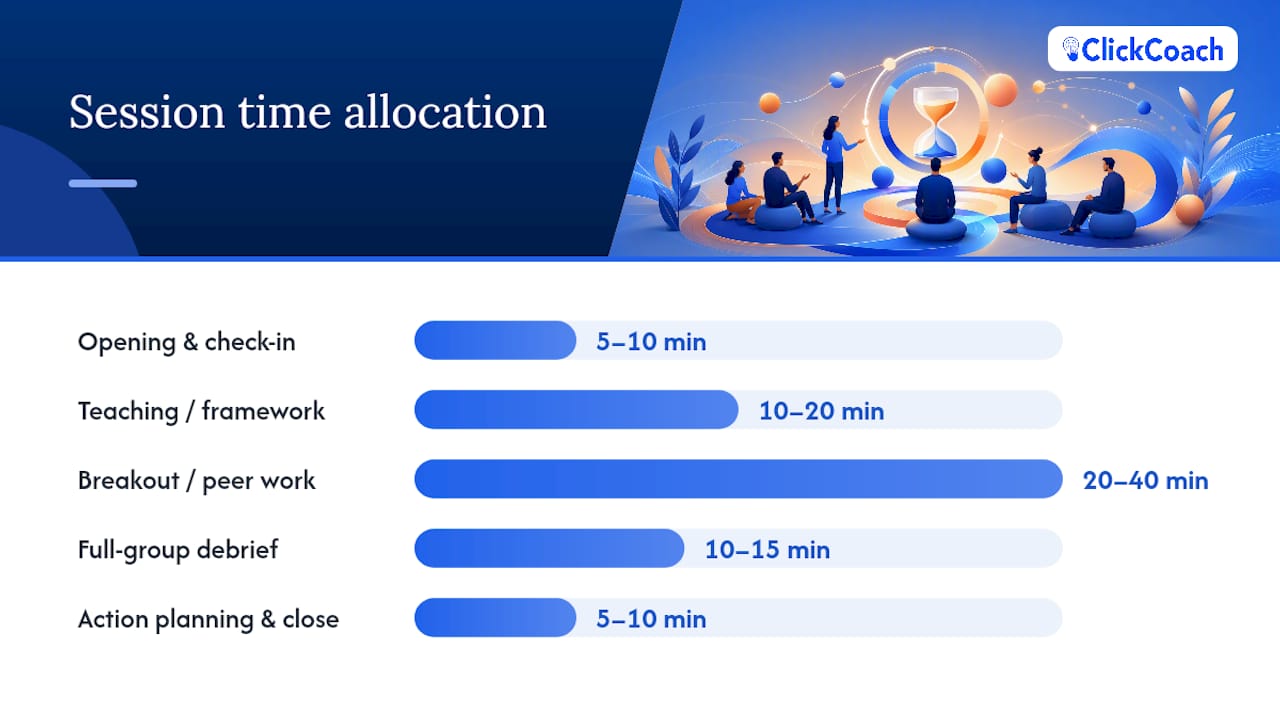
A repeatable agenda is what keeps sessions consistent even when the content changes week to week. Use this structure and adjust the time blocks to your session length.
- Opening and check-in (5 to 10 minutes). A quick round where each participant shares one word or one sentence on where they are this week.
- Focus teaching or framework (10 to 20 minutes). The coach-led portion. Keep it tight. This isn’t a lecture hall.
- Breakout or peer work (20 to 40 minutes). Small groups of two or three work through an exercise tied to the week’s objective.
- Full-group debrief (10 to 15 minutes). Breakouts report back; the coach synthesizes patterns across the group.
- Action planning and close (5 to 10 minutes). Each participant states one commitment for the coming week, out loud, to the group.
For a 60-minute session, compress the breakout to 20 minutes and tighten teaching to 10. For a 90-minute session, the structure above fits comfortably. For 120 minutes, add a second breakout round or a longer full-group case discussion.
The 70/30 rule that governs individual coaching sessions, where roughly 70% of the talking belongs to the client and 30% to the coach, applies at the group level too. If you’re talking more than a third of the session, you’ve drifted into teaching mode instead of facilitating.
Pro Tip: Write your transition lines in advance: “Let’s hear from someone who hasn’t spoken yet” or “I want to park that thread and circle back after the exercise.” Scripted transitions feel smoother than improvised ones, especially in your first few cohorts.
How Do You Build the Curriculum and Materials?
Map your curriculum before you write a single slide. Use a simple table format in your own planning doc: week number, learning objective, in-session activity, and homework assignment. That mapping keeps every session tied to the outcome you promised in your sales page, instead of drifting toward whatever feels interesting that week.
Good homework changes behavior, it doesn’t just test recall. Strong assignment types include:
- Field experiments. “Try this specific conversation technique once this week and note what happened.”
- Structured reflection. A short written prompt tied directly to the week’s framework.
- Peer accountability tasks. Pair participants to check in with each other between sessions.
One useful model comes from sales coaching, where transcript-based review and scorecards turn a recorded real-world interaction into the raw material for a coaching exercise. The same logic works outside sales: have participants bring a real recent situation, not a hypothetical, into the breakout discussion.
Build your reusable material library once and reuse it across cohorts:
- A slide deck per module, lightly branded, not text-heavy.
- A worksheet or template per homework assignment.
- A short reading or video list per module (optional, not mandatory for participants).
- A facilitator’s own run sheet noting timing and common discussion pitfalls.
Version these by cohort number (v1, v2) so you can track what you changed and why, instead of losing your edits in a single overwritten file.
How Do You Facilitate Group Dynamics Effectively?
Facilitation is a distinct skill from coaching, and it’s the one most new group coaches underestimate. The core techniques are active listening at the group level (tracking who’s spoken and who hasn’t), refocusing digressions without shutting people down, and structured turn-taking so the same two voices don’t dominate every session.
Set ground rules in your first session, out loud, and put them in writing in your onboarding packet:
- Confidentiality: what’s shared in the group stays in the group.
- Equal airtime: the coach may redirect if one person is taking more than their share.
- No fixing: peers offer questions and reflections, not unsolicited advice, unless asked.
That last rule alone prevents most of the dynamics problems that derail early cohorts.
For common issues, have a script ready before you need it:
- A dominating participant: “I want to make sure we hear a few more perspectives before we go deeper here, can we come back to you in a minute?”
- A silent participant: “I’d love to hear where you’re at on this, no pressure to have it fully formed.”
- An off-topic tangent: “That’s a real issue, let’s park it and I’ll follow up with you after the session.”
Pro Tip: Rehearse these scripts out loud before your first cohort. The words feel awkward the first time you say them in a real session if you haven’t practiced the phrasing once beforehand.
Effective coaching, at the individual or group level, depends more on goal-focused conversation and adaptability than on rigid five-step scripts. Treat every framework in this guide, including the agenda templates above, as a starting structure you’ll adapt to your specific group, not a formula to follow mechanically.
How Should You Price a Group Coaching Program?
Three pricing models dominate the market: a flat per-cohort fee, a per-participant price, and tiered access levels within the same cohort.
- Flat per-cohort fee. Best when you’re capping enrollment tightly and want predictable revenue regardless of exact headcount.
- Per-participant pricing. Scales with enrollment and is easiest to communicate on a sales page.
- Tiered packaging. Offer a base cohort price, a mid-tier with added one-on-one sessions, and a premium tier with direct access between sessions.
Price your group offer meaningfully below your one-on-one rate per participant, since the perceived value per person is lower than dedicated individual time, but the total revenue per cohort can exceed what a single one-on-one client generates.
Packaging options worth testing:
- Basic cohort: group sessions only, standard materials.
- Cohort plus one-on-one add-on: group sessions plus two or three private check-ins across the program.
- VIP tier: everything in the basic tier, plus direct messaging access to the coach between sessions.
An 80/20 blend of coaching and hands-on mentorship, roughly 80% coaching technique paired with more directive advisory input where participants need it, is a useful way to frame your VIP tier’s added value: participants aren’t just paying for more time, they’re paying for more direct guidance when they’re stuck.
What Tools Do You Need to Run Group Coaching?
You’ll need five tool categories, and most coaches already own pieces of this stack: video conferencing with breakout room support, a course or content hosting platform for materials, a community space for between-session discussion, a scheduling and billing system, and practice-management software to hold it all together.
The administrative load of running a cohort adds up fast: intake forms, homework tracking, session notes for six to ten participants, progress reports, and billing. A platform built specifically for coaching practices consolidates that work instead of spreading it across five disconnected apps. ClickCoach, for example, centralizes session notes, homework assignments, and progress tracking in one workspace, so you can onboard a new participant, assign their first homework, track completion across the cohort, and pull a progress report without switching tools for each task.
A practical integration checklist before your pilot launches:
- Calendar sync so session reminders go out automatically.
- Payment processing connected to your enrollment flow.
- A branded client portal so participants access materials and homework in one place, not a scattered mix of email attachments and shared drives.
- Automated onboarding emails triggered by enrollment, not sent manually one by one.
Pro Tip: Test your full tech stack end to end with a friend before your pilot’s first session. The moment to discover a broken integration is not five minutes before your cohort’s first live call.
How Do You Measure Group Coaching Outcomes?
Measurement has to start before session one, not after the cohort ends. Set a baseline in your intake form so you have something to compare against later.
Track these KPIs across the cohort:
- Attendance rate per session and cumulative.
- Homework completion rate, your earliest signal of engagement.
- Self-rated progress against the stated outcome, collected at intake, midpoint, and close.
- Recommendation intent, a simple “would you recommend this to a colleague” question.
- Behavior-change indicators specific to your topic (a new habit practiced, a conversation had, a skill demonstrably applied).
Structured, assessment-driven coaching processes that use baseline measurement report stronger, more credible outcomes than programs that skip measurement entirely, particularly when you’re selling to organizations that expect to see return on the investment.
For your feedback collection, keep the survey short:
- On a scale of 1 to 10, how much progress have you made toward [the stated outcome]?
- What’s the single most useful thing you’ve applied so far?
- What would make the next session more valuable to you?
Run that same pulse survey at the midpoint and at close, then compare the two data points per participant rather than looking only at the aggregate average.
How Do You Recruit Your First Group Coaching Cohort?
Your first cohort doesn’t need a marketing budget. It needs a clear offer and a short list of warm channels.
- Build a one-page landing page describing the outcome, format, dates, and price.
- Email your existing list with a direct, specific invitation, not a generic newsletter blast.
- Post on LinkedIn describing the problem the cohort solves, not a vague announcement.
- Reach out individually to your alumni or past one-on-one clients who fit the profile.
- Host a free 30-minute info session where you demonstrate your facilitation style live.
Channels that consistently work for coaches: your own email list first, LinkedIn posts second, and partnerships or referral relationships third. If you have an existing referral or joint-venture network, that’s often your fastest path to a filled pilot cohort.
- Offer your pilot at a discount in exchange for feedback, and say so explicitly.
- State clear success criteria up front: “If you attend at least 80% of sessions and complete the homework, here’s what you should expect to see change.”
- Commit to a short feedback call after the cohort, and actually schedule it before the cohort starts, not after.
What Formats Work Best for Group Coaching Programs?
Three formats cover most use cases, and picking between them comes down to how much time your audience can commit and how deep the outcome needs to go.
- Short intensive: 4 to 6 weeks, 8 to 12 participants, ideal for a narrow skill or a single transition (onboarding new managers, a specific negotiation skill).
- Medium weekly cohort: 8 to 12 weeks, 6 to 10 participants, the default model for most leadership and career-development programs.
- Long-term mastery cohort: 6 months or longer, smaller group of 5 to 8, best for deep identity-level change like an executive presence program.
Templates worth building once and reusing every cohort: an orientation email sent immediately after enrollment, an intake form capturing baseline data and scheduling preferences, the session agenda template from earlier in this guide, and a standard homework assignment format with a clear prompt and a due date.
Match format to commitment level. A busy executive audience often responds better to a shorter, more intensive format than to a long cohort they’ll struggle to attend consistently.
What Actually Works, and What Doesn’t
The most common failure I see in new group coaching programs isn’t bad content. It’s sessions that run too long without structure, outcomes that stay vague through the whole sales process, and onboarding that’s an afterthought instead of a first-week priority. Fix those three and most other problems become minor.
What reliably works is boring, in the best sense: a tight agenda you don’t deviate from, a simple accountability mechanism (peer pairs, a shared tracker, a public commitment each week), and measurement that starts on day one instead of getting bolted on at the end when a client asks for proof it worked.
If you take one thing from this guide, make it onboarding. A strong first week, clear expectations, a warm welcome, and a homework assignment that’s genuinely doable, predicts more about cohort success than almost anything you do in week six.
Run Your Cohort Without Drowning in Admin Work
Everything in this guide, the intake forms, the homework tracking, the progress reports, the billing across a cohort of ten, adds up to real administrative hours if you’re managing it across scattered spreadsheets and email threads. ClickCoach is built specifically to carry that load for coaches running cohort-based programs, not as a course platform or a marketing tool, but as the operational backbone underneath the coaching itself.
A typical cohort workflow inside ClickCoach looks like this: you onboard a new participant through a branded client portal, assign their first homework directly tied to that week’s module, watch completion status update automatically as participants submit, and generate a cohort progress report when it’s time to show results, whether that’s to the participants themselves or to the organization sponsoring the cohort. Session notes and action items stay attached to each client’s record instead of scattered across separate documents.
If you’re currently running a cohort with a mix of spreadsheets, a scheduling app, and a separate notes document, that’s exactly the friction ClickCoach’s coaching business management software is built to remove. Start by exploring the platform to see how it fits your next cohort launch.
Sources
- PMC article (group learning/coaching research)
- What Are the 5 C’s and 5 Steps of Coaching? (And Why That Might Be the Wrong Question)
- Executive Coaching: Costs, 70 30 Rule, Certification and Training
- Leadership Coaching: The Inside-Out Approach That Drives Results
- How does Mento’s 80/20 Methodology of Coaching and Mentorship work? | Mento
FAQ
What Is a Group Coaching Program?
A group coaching program is cohort-based coaching where a facilitator guides a consistent small group toward a shared, measurable outcome over a defined period, typically 8 to 12 weeks, combining coach-led structure with peer learning.
What Is the 70/30 Rule in Coaching?
The 70/30 rule holds that roughly 70% of talking time in a session should belong to the client (or the group, in a cohort setting) and 30% to the coach, preserving client-centered inquiry instead of turning sessions into lectures.
What Are the Five C’s of Coaching?
Definitions vary across sources, but one common version frames the five C’s as Clarity, Confidence, Competence, Commitment, and Consistency, a lightweight structure for module design rather than a strict formula.
What Is the 80/20 Rule in Coaching?
The 80/20 approach blends roughly 80% coaching technique with 20% direct, hands-on mentorship, matching the coaching style to a participant’s experience level and how much guidance they actually need.
How Do You Track Progress in a Group Coaching Program?
Set a baseline at intake, then track attendance, homework completion, and self-rated progress at the midpoint and close. Practice-management platforms like ClickCoach can attach these records directly to each participant’s profile.