

The most effective examples of group homework assignments for coaching cohorts fall into five types: active experiments, observational monitoring tasks, reflective evidence submissions, peer accountability check-ins, and short micro-projects. Each is an inter-sessional activity, meaning it happens between live sessions, and each is designed to increase implementation, not just awareness. Keep tasks to 15–20 minutes and tie every assignment directly to what the cohort will discuss next.
Core assignment types at a glance:
- Active experiment: Try one new behavior and report what happened.
- Observational monitoring: Track a specific pattern for 3–5 days without changing it.
- Reflective evidence submission: Write a short response and submit a concrete artifact (screenshot, metric, note).
- Peer accountability check-in: Post a commitment to a partner; partner confirms completion.
- Micro-project: Complete a small, scoped deliverable (a draft, a plan, a recorded 2-minute video).
Typical time: 15–20 minutes. Tracking metric: submitted artifact, peer confirmation post, or a 1–10 self-rating.
Key Takeaways
Active and observational inter-sessional assignments, kept to 15–20 minutes and tied to the next session, are the most reliable way to increase behavior change and completion in group coaching programs.
| Point | Details |
|---|---|
| Keep tasks to 15–20 minutes | Assignments longer than 20 minutes see lower completion; shorter, specific prompts outperform open-ended ones. |
| Co-design every commitment | Offer 2–3 options and let participants choose; ownership increases follow-through. |
| Track two metrics | Use completion rate as your leading indicator and one outcome measure (score, count, artifact) as your lagging indicator. |
| Use the 6-week plan as a template | The build-test-reflect sequence gives cohorts progressive practice with measurable evidence each week. |
| ClickCoach centralizes the workflow | Assignment delivery, evidence collection, and cohort tracking live in one platform, saving up to 20 minutes per session. |
Table of Contents
- What are the best examples of group homework assignments for coaching?
- How do you keep group assignments ICF-aligned?
- How do you track whether group assignments are working?
- How do you adapt assignments for different cohort sizes and formats?
- What ethical considerations apply to peer-based assignments?
- A 6-week inter-sessional homework plan you can copy
- Why do inter-sessional assignments actually increase behavior change?
- Start small, iterate, and let submission rates guide you
- ClickCoach delivers, collects, and tracks these assignments in one place
- Sources
What are the best examples of group homework assignments for coaching?
Below are 12 ready-to-deploy inter-sessional tasks. Each includes a purpose, exact steps, time estimate, evidence type, and a tracking metric. Copyable prompts are in italics.
1. The one-conversation experiment
Purpose: Practice a specific communication skill from the session. Steps: (1) Identify one conversation you will have before the next call. (2) Apply one technique discussed in session. (3) Write 3 sentences: what you tried, what happened, what you noticed. Time: 15 minutes. Evidence: Written reflection submitted to the group portal. Metric: Submission Y/N. Prompt: “Before our next call, have one conversation where you apply [skill]. Write three sentences about what you tried and what you noticed.”
2. The 5-day behavior tracker
Purpose: Build self-awareness through observational monitoring before attempting change. Steps: (1) Choose one habit or pattern to observe. (2) Log it once daily for 5 days (time, trigger, response). (3) Bring your log to the next session. Time: 5 minutes per day. Evidence: Completed log (photo or doc). Metric: Log submitted Y/N. Prompt: “Track [behavior] once a day for 5 days. Note the time, what triggered it, and how you responded. Bring your log to our next call.”
3. The peer commitment post
Purpose: Create public accountability within the cohort. Steps: (1) Post one specific commitment in the group channel before midnight on day 1. (2) Tag your accountability partner. (3) Partner replies with a confirmation by the end of the week. Time: 10 minutes. Evidence: Screenshot of post and partner reply. Metric: Both posts confirmed Y/N.
4. The confidence self-rating
Purpose: Capture a lagging outcome metric tied to a specific skill. Steps: (1) Rate your confidence in [skill] on a 1–10 scale at the start of the week. (2) Practice the skill once. (3) Re-rate at the end of the week and note the difference. Time: 10 minutes total. Evidence: Two ratings submitted via a short form. Metric: Pre/post score delta.
5. The 2-minute recorded reflection
Purpose: Deepen processing and create a reusable artifact for hot-seat review. Steps: (1) Record a 2-minute voice or video note answering: “What did I try, what worked, and what’s my next question?” (2) Upload to the shared folder or portal. Time: 15 minutes. Evidence: Uploaded recording. Metric: File submitted Y/N.
6. The outreach count micro-project
Purpose: Measure real-world action volume, not just intention. Steps: (1) Set a target number of outreach attempts (emails, calls, conversations) for the week. (2) Log each attempt with a one-line note. (3) Submit total count and one observation. Time: 5 minutes of logging per day. Evidence: Count log. Metric: Attempts vs. target.
7. The values-in-action audit
Purpose: Connect stated values to daily decisions. Steps: (1) List your top 3 values. (2) Review your calendar or task list for the past 3 days. (3) Mark each item as aligned or misaligned. (4) Write one sentence about what you notice. Time: 20 minutes. Evidence: Annotated list or screenshot. Metric: Submission Y/N.
8. The peer feedback round
Purpose: Build a structured peer-coaching loop within the cohort. Steps: (1) Each participant shares one win and one challenge in the group channel. (2) Their assigned peer responds with one question (not advice). (3) Original poster replies with one insight. Time: 20 minutes across the week. Evidence: Thread screenshot. Metric: All three posts completed Y/N.
Pro Tip: When introducing any assignment, offer two versions: a standard version and a lighter version. Saying “You can do the full 5-day log or a 3-day version” shifts ownership to the participant and increases completion because they chose the format.
How do you keep group assignments ICF-aligned?
ICF-aligned group coaching requires that assignments come from co-created commitments, not coach directives. The coach’s role is to elicit the action, not prescribe it.
Design checklist:
- Do ask “What would you like to try before we meet again?”
- Do offer 2–3 options and let the participant choose.
- Do specify what evidence will count as completion.
- Don’t tell participants what to do or frame the task as a requirement.
- Don’t assign the same task to everyone without offering a choice.
- Don’t leave the commitment vague (“work on your mindset”).
Elicitation script snippets:
- “What’s one small experiment you could run this week related to what we just explored?”
- “If you were to take one step forward, what would it look like?”
- “What would feel like a meaningful stretch without being overwhelming?”
Pro Tip: Frame every commitment as an experiment: “I’ll try X and notice what happens” rather than “I will do X.” The experiment framing removes the pass/fail pressure and makes missed homework a data point, not a failure.
How do you track whether group assignments are working?
Track two things: a leading indicator (completion rate) and a lagging indicator (one outcome metric per assignment). A structured submission window at the end of each week makes collection consistent.
Tracking table template (copy into a spreadsheet or ClickCoach):
| Participant | Assignment | Due Date | Evidence Link | Completed (Y/N) | Outcome Metric | Coach Note |
|---|---|---|---|---|---|---|
| Name | Assignment name | Date | URL or file | Y/N | Score / count | Follow-up |
Copyable one-line form prompt (paste into a portal or group chat): “Submit your evidence here: [link]. Include your name, assignment name, and one sentence on your outcome metric.”
Two metrics that matter most:
- Completion rate (leading): Percentage of participants who submit evidence each week. Below 60% signals the task is too long, too vague, or not relevant enough.
- Outcome metric (lagging): A confidence score, outreach count, or behavior frequency that shows whether the assignment moved the needle.
How do you adapt assignments for different cohort sizes and formats?
Quick rules by cohort size:
- 6–12 participants: Use hot-seat follow-ups and live demonstrations on the call. Peer pairs are stable and personal.
- 13–30 participants: Favor asynchronous evidence submission and rotating peer pairs. Avoid live hot-seats for everyone.
Format-specific adjustments:
- Virtual: Use shared Google Docs for logs, a Loom or voice note for reflections, and a group Slack or portal channel for peer posts.
- Hybrid: Assign live practice during in-person time; collect evidence asynchronously before the next virtual call.
- In-person: Use time-boxed practice rounds (10 minutes) and physical artifacts (handwritten logs, printed worksheets).
Peer accountability at scale: Assign structured pairs at the start of the program. Rotate pairs every two weeks. Give each pair a simple protocol: one post, one reply, one confirmation.
What ethical considerations apply to peer-based assignments?
Get explicit consent before any peer-sharing task. Participants should know what will be shared, with whom, and how it will be used.
Red flags to avoid:
- Forced disclosure of personal or sensitive information.
- Public posting of low-quality peer feedback without a structured protocol.
- Assignments that assume equal access to technology, time, or privacy.
- Using missed homework as a performance measure rather than a program design signal.
Consent script (read aloud or paste into your sign-up form): “Some assignments involve sharing reflections with a peer partner. You can always choose a non-sharing alternative. Nothing shared in peer tasks will be discussed publicly without your permission.”
Missed homework is data for you, not a mark against the participant. When completion drops, adapt the task before addressing the person.
A 6-week inter-sessional homework plan you can copy
The logic: build skill (weeks 1–2), test it (weeks 3–4), reflect and embed (weeks 5–6). Self-paced lessons paired with implementation windows and a live call create the rhythm.
| Week | Assignment | Time | Evidence Required | Metric | Live Call Note |
|---|---|---|---|---|---|
| 1 | 5-day behavior tracker | 5 min/day | Completed log | Submitted Y/N | Debrief: “What surprised you?” |
| 2 | Values-in-action audit | 20 min | Annotated list | Submitted Y/N | Hot-seat: one volunteer shares |
| 3 | One-conversation experiment | 15 min | 3-sentence reflection | Submitted Y/N | Debrief: “What did you try?” |
| 4 | Outreach count micro-project | 5 min/day | Count log | Attempts vs. target | Hot-seat: highest and lowest count |
| 5 | Peer feedback round | 20 min | Thread screenshot | All 3 posts Y/N | Debrief: “What question landed?” |
| 6 | Confidence self-rating | 10 min | Pre/post scores | Score delta | Full group share: delta scores |
Two-minute debrief prompts for live calls:
- “Who wants to share one thing that surprised them about this week’s assignment?”
- “What did you notice that you wouldn’t have noticed without doing the task?”
For an 8-week program, split weeks 3 and 5 into two parts: a practice week followed by a reflection week. For bi-weekly calls, extend each assignment to 10 days and add a mid-week peer check-in post.
Why do inter-sessional assignments actually increase behavior change?
A 2026 systematic review categorizes inter-sessional activities as active assignments (experiments) and observational assignments (systematic monitoring), and links both formats to improved follow-through in coaching programs. Active assignments drive behavior change by requiring participants to act and report. Observational assignments build self-awareness before change is attempted, which makes subsequent experiments more targeted.
Session templates that close with recorded action commitments and public accountability prompts reinforce this further. When a participant states their commitment in the group chat at the end of a call, completion rates rise because the social contract is explicit.
Start small, iterate, and let submission rates guide you
Pick one assignment from this article and run it for one week. Track completion rate. Shorten it, sharpen the prompt, or offer a lighter version.
For scaling, automate evidence collection with a short form or a portal submission link. You can build reusable templates that drop into each new cohort without rebuilding from scratch. The coaching stance stays the same at any scale: elicit, co-design, and let participants own their commitments.
Peer learning is your highest-leverage tool in a group format. One well-structured peer feedback round does more for accountability than three coach-assigned tasks.
ClickCoach delivers, collects, and tracks these assignments in one place
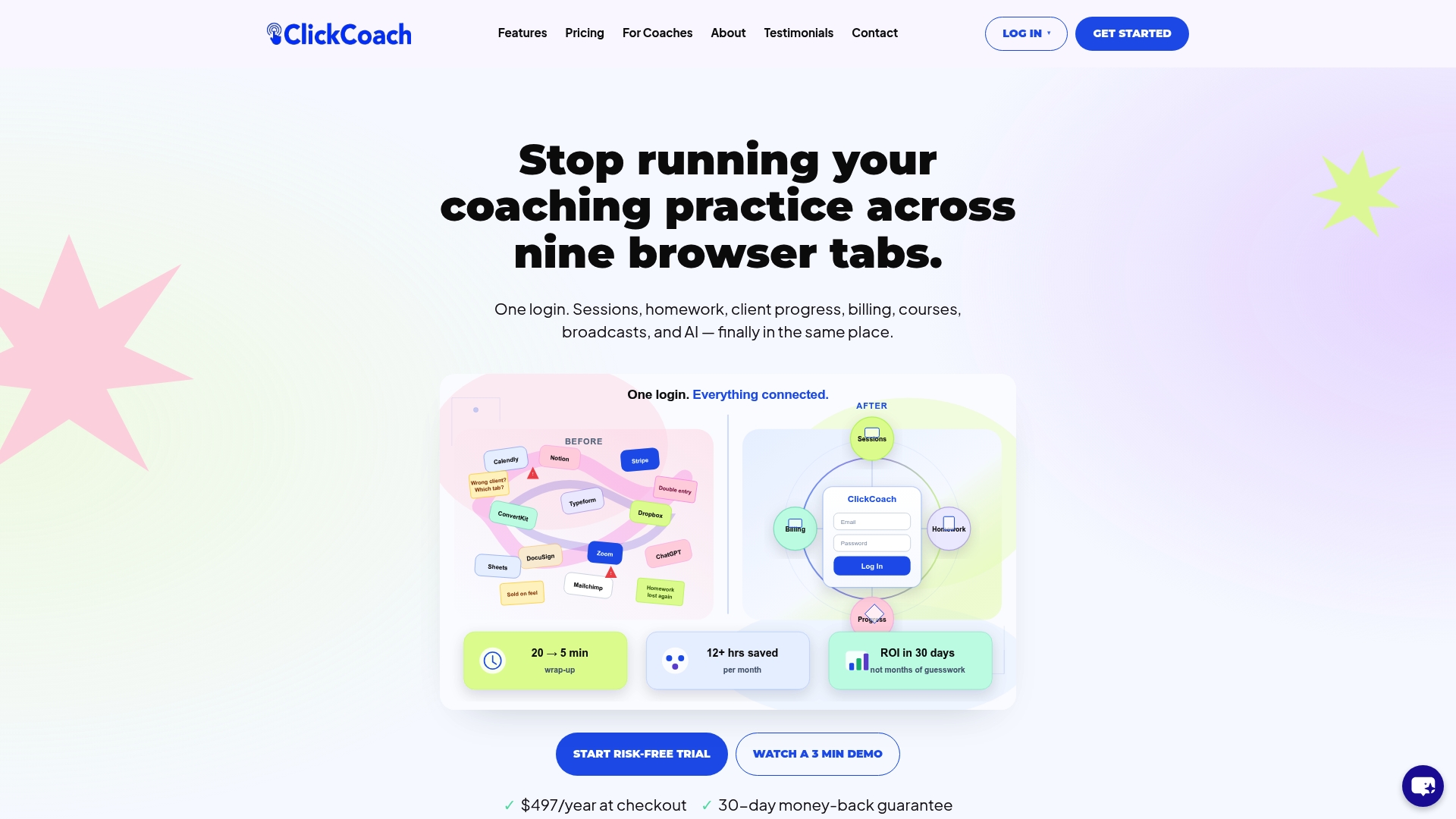
Running these assignments manually across email, spreadsheets, and group chats adds up fast. ClickCoach centralizes every step: you assign the task, participants submit evidence through a branded client portal, and the platform tracks completion automatically.
Three concrete advantages for group coaches:
- Time saved: ClickCoach can save up to 20 minutes per session by eliminating manual follow-up and evidence chasing.
- Branded portals: Participants access assignments and submit evidence through a portal that carries your brand, not a generic third-party tool.
- Cohort analytics: Completion rates and outcome metrics are visible in one dashboard, so you can spot low-engagement weeks and adapt before the next call.
Start your ClickCoach trial at ClickCoach and drop your first assignment into a cohort this week.