

Be referable: narrow your positioning and productize your offer into a named framework that sells itself. That’s the single highest-leverage move available to you right now, ahead of new certifications, more content, or a redesigned website.
Here’s what to do in the next 24 to 72 hours:
- Write a one-sentence positioning statement naming exactly who you help and the one result you deliver.
- Name your process, even if it’s just three steps, so it reads as a framework instead of “coaching.”
- Block a 90 minute session this week to draft a case study brief from your best client result.
Once your positioning is tight, the administrative side matters just as much. A platform like ClickCoach can cut the hours you spend on notes, billing, and follow-up, freeing that time for the strategic work that actually differentiates you.
Key Takeaways
Narrow positioning combined with a named, productized framework is what makes a coaching practice referable, priceable, and distinct from competitors.
| Point | Details |
|---|---|
| Pass the referability test | Ask five contacts to describe your practice in one sentence; vague answers mean your positioning is too broad. |
| Name your framework | A three to five phase named method reads as intellectual property and does selling work for you. |
| Price by outcome, not hours | Keep your core offer’s price intact and use a structurally different entry product to avoid discounting. |
| Build proof fast | One numeric case study, a framework diagram, and a review base move price more than testimonials alone. |
| Reduce admin with one workspace | A platform like ClickCoach centralizes notes, homework, billing, and client portals to cut hours spent on admin. |
Table of Contents
- How Do You Differentiate a Coaching Practice From Competitors?
- Build a Named Framework That Sells Itself for You
- What Proof and Pricing Moves Actually Raise Your Fees?
- Which Systems Actually Save You Time Without Hurting Outcomes
- What Marketing Actually Demonstrates Your Perspective?
- How Do I Execute This in 30 Days?
- Subtraction Beats Addition Almost Every Time
- How ClickCoach Supports the Systems Behind Your Positioning
- Sources
- FAQ
How Do You Differentiate a Coaching Practice From Competitors?
Coaches don’t lose clients to a competitor with a better résumé. They lose clients because prospects can’t tell coaches apart. The fix isn’t more credentials or more services. It’s subtraction: narrowing what you do until a stranger can repeat it back to you correctly.
This is the referability test, and it’s blunt. Ask a colleague, a past client, or someone at a networking event to describe what you do in one sentence. If they hedge, generalize, or default to “she’s a life coach” or “he does executive stuff,” your positioning is too broad to generate referrals. The referability test works because referrals depend on memory and repeatability, not on how impressive your bio sounds.
Here’s the subtraction exercise:
- List every service, package, and client type you currently take on.
- Mark which ones produced your best results and which ones you took because you needed the income.
- Cut anything that isn’t in your top two client types or top one result.
- Rewrite your positioning as: “I help [specific client] achieve [specific result] using [your method].”
- Test the sentence on three people outside your industry. If they can repeat it back, you’re narrow enough.
Pro Tip: If your one-sentence description still contains “and” more than once, it’s not one sentence. It’s three services wearing a trench coat.
Build a Named Framework That Sells Itself for You
A generic process reads as a commodity. A named framework reads as intellectual property, and that distinction changes what prospects are willing to pay. A named methodology gives you something to reference in sales calls, publish in content, and hand to referral partners as a shorthand for your value.
Build it in three layers:
- The framework itself: map your process into three to five phases that mirror the client’s actual transformation, not your internal workflow. Name each phase with a verb or outcome, not jargon.
- Three tiers: an entry offer (workshop, short program, or diagnostic), a core offer (your flagship one-on-one or group engagement), and a premium offer (extended access, higher-touch support, or a leadership team add-on). Tiers should differ in commitment and depth, not just price.
- Published artifacts: a one-page framework diagram, a mini case study showing the framework in action, and a sample session outline a prospect can preview before buying.
Publishing the framework in every proposal and every piece of content means it does the selling on your behalf, according to distinctive-edge research on coaching positioning. Prospects stop comparing you to “coaches in general” and start comparing you to your own named method.
What Proof and Pricing Moves Actually Raise Your Fees?
Three assets move price more than anything else: a short case study with a specific numeric result, a published framework diagram, and a visible review base. Build the first one fast by picking your single best client outcome and writing it as a before/after with one number attached, even something as simple as “reduced weekly overtime from 12 hours to 3.” Case studies and teardowns build more lasting credibility than one-off testimonials because they show mechanism, not just satisfaction.
Pricing follows proof, not the reverse:
- Price your core and premium tiers by the outcome delivered, not by the hour.
- Use a structurally different entry product, a group cohort, self-paced course, or single workshop, to protect your premium pricing architecture instead of discounting one-on-one work.
- Keep your flagship offer’s price intact even when a prospect asks for a break. Adjust scope instead.
Referrals compound proof. Ask right after a client hits a named milestone, not at the end of a contract when momentum has faded. HR directors and adjacent professionals are consistently strong referral sources for higher-fee corporate work, so a short outreach message asking one HR contact to keep you in mind for their next leadership cohort often outperforms a general ask to your entire network.
Pro Tip: Send referral asks as a specific request tied to a specific client profile: “If you know a director who just got promoted into their first VP role, I have room for one more this quarter.” Specific asks get specific referrals.

Which Systems Actually Save You Time Without Hurting Outcomes
Positioning gets you the inquiry. Systems keep the client and protect the hours you’d otherwise lose to admin. Prioritize by time saved per month against impact on client outcomes, not by whatever tool looks newest.
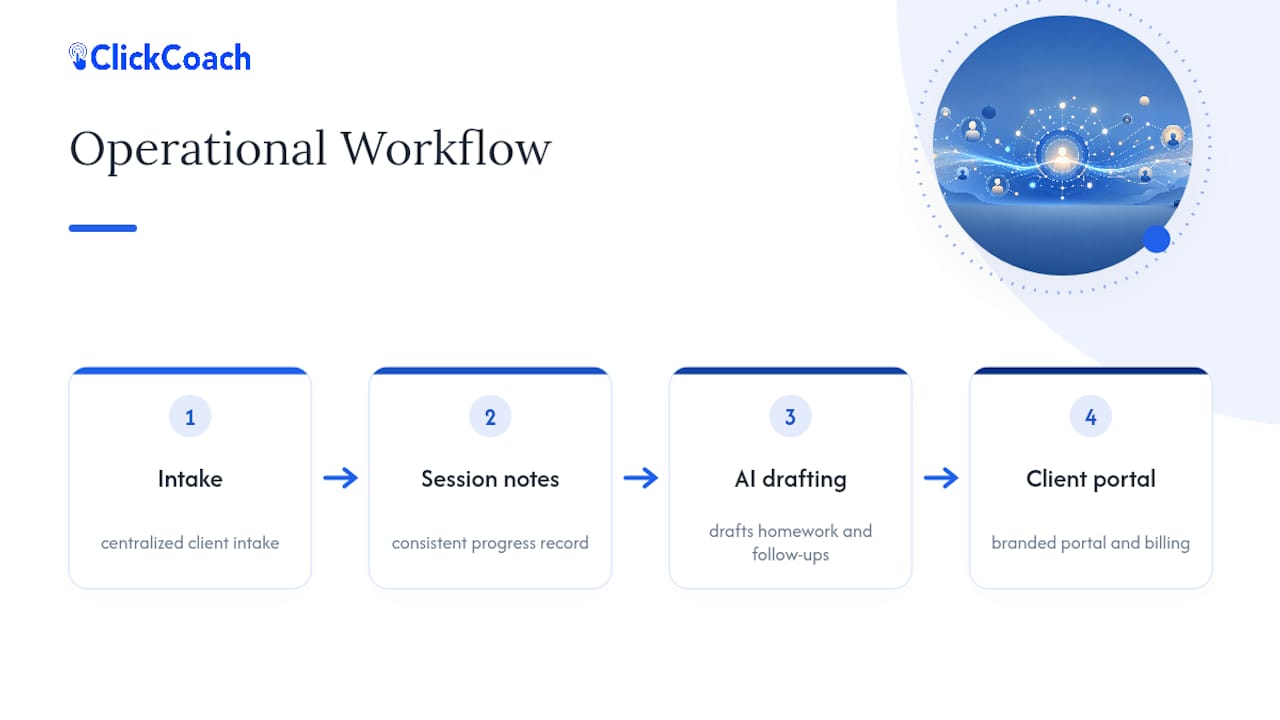
- Onboarding intake: a standard form that captures goals and context before session one, so you stop re-asking the same questions.
- Session templates: a consistent structure for notes so every session produces the same reviewable format.
- Progress tracking: a visible record of goals and milestones the client can see between sessions.
- Homework and follow-up: action items sent right after each session, while the conversation is still fresh.
- Billing: recurring invoicing that doesn’t require you to chase payments manually.
- Branded client portal: one place clients log in to see notes, homework, and progress instead of hunting through email threads.
Operationalizing these pieces in one workspace reduces the friction that eats into billable hours and keeps client accountability visible between sessions rather than reset at the start of each one.
AI drafting fits into step four specifically. Coach-controlled drafting works when you set the templates, the AI produces a first pass of homework or follow-up notes, and you review and edit before it reaches the client. The judgment stays with you; the AI just removes the blank page.
What Marketing Actually Demonstrates Your Perspective?
Generic coaching tips blend into every other coach’s feed. Content that shows your specific point of view doesn’t.
- Teardown case studies: walk through one real client scenario (anonymized) and show exactly how your framework moved them from stuck to resolved.
- Framework explainers: a short post or video breaking down one phase of your named method at a time.
- “What most people get wrong” posts: take a common assumption in your niche and explain why it fails, using your framework as the counterpoint.
Map a 90-day plan across these three formats, one framework explainer, one teardown, and one contrarian post each month, so your content builds a consistent, repeatable message instead of scattered advice. Pair that content with direct outreach to HR contacts and adjacent professionals who refer higher-fee corporate clients when they’ve seen your perspective in writing, not just your name on a directory listing.
How Do I Execute This in 30 Days?
Work through these in order. Time estimates assume evenings or a half day per week.
- Write your one-sentence positioning statement (1 hour). Metric: can three people repeat it back.
- Cut two services or client types that don’t fit (2 hours). Metric: offer list shrinks by at least a third.
- Name your framework and map its phases (3 hours). Metric: framework has a name and three to five steps.
- Draft your case study brief (90 minutes). Metric: one number attached to one outcome.
- Build your three-tier offer structure (2 hours). Metric: tiers differ in depth, not just price.
- Set up onboarding intake and session templates (3 hours). Metric: admin time per client drops.
- Send five referral asks tied to specific client profiles (1 hour). Metric: inquiries per month.
- Publish one framework explainer and one teardown (3 hours). Metric: conversion rate on discovery calls.
Quick templates to copy: positioning statement (“I help [client] achieve [result] using [framework name]”), framework name pattern (Verb + Noun + Method, like “Clarity Path Method”), referral ask (“If you know a [specific profile], I have room for one more this quarter”).
Subtraction Beats Addition Almost Every Time
Most coaches try to differentiate by adding: another certification, another service, another funnel. The coaches who actually stand out do the opposite. They cut services until one sentence describes what’s left, and they let that sentence do the marketing.
The first move I’d recommend to any coach reading this is the referability test itself. Ask five people to describe your practice in one sentence this week. Whatever they say back to you is your real positioning, whether you meant it to be or not.
— Mitch Russo
How ClickCoach Supports the Systems Behind Your Positioning
Tight positioning gets prospects to say yes. What keeps them renewing is what happens after the sale, session notes that don’t get lost, homework that arrives on time, invoices that don’t require a chase email. That’s the operational side most differentiation advice skips entirely.
ClickCoach brings client intake, session notes, homework, billing, and a branded client portal into one workspace, so you’re not juggling a notes app, a separate invoicing tool, and a shared drive for client files. The session notes and progress tracking features give you a consistent record to point to when a client asks “am I actually making progress,” which is exactly the kind of proof this article has been telling you to collect.
The AI drafting works the way the operational systems section describes: it produces a first-pass homework assignment or follow-up note based on your templates, and you review and adjust before it goes to the client. You stay the decision-maker. The AI just removes the blank page.
If you’re evaluating a trial, judge it against your own 30-day checklist above: does it cut the hours you spend on notes and billing, and does it make client progress visible without extra manual work? Start with the platform overview and check it against those two questions before committing.
Sources
- Coaching case study templates: demonstrating your value effectively
- Executive coaching vs. life coaching: what leaders, HR teams and organizations need to know
- How To Properly Differentiate Your Coaching Business | Jessica Osborn
- How to find your distinctive edge as a coach in 5 steps
FAQ
What Is the Fastest Way to Differentiate Coaching Practice Competitors?
Narrow your positioning to one client type and one outcome, then name your process as a framework. Referability, not credentials, is what drives referral volume.
How Do I Know If My Positioning Is Too Broad?
Ask five people outside your close network to describe your practice in one sentence. If they can’t, or they list multiple unrelated services, you haven’t narrowed enough.
Should I Price by the Hour or by the Outcome?
Price your core and premium offers by outcome, and use a lower-cost, structurally different entry product like a workshop or short cohort to avoid discounting your flagship offer.
Can AI Actually Help With Coaching Homework Without Losing the Personal Touch?
Coach-controlled AI drafting produces a first-pass homework or follow-up note from your own templates, and you review and edit it before it reaches the client, so the judgment stays yours.
What Systems Should I Set Up First to Reduce Admin Time?
Start with onboarding intake and session note templates, since those two save the most recurring time; add billing and a branded client portal, available through platforms like ClickCoach, once your positioning and framework are locked in.