

Run every session through five stages: check-in, contract the goal, explore the work, commit to action, and close with reflection. This structure works for a 30-minute check-in or a 60-minute deep-dive because the client sets the goal early and every minute after that serves it. Timed splits for 30, 45, and 60-minute sessions follow below.
TL;DR:
- A coaching session should allocate at least 8 to 10 minutes for converting insights into specific, dated actions, especially in longer sessions.
- Core exploration should always be the largest segment, and closing minutes must remain at least three to ensure commitments are confirmed.
- First sessions require additional time for contracting, expectations, and initial planning, with gradual shifting toward core work over successive meetings.
- Using structured templates for different session types helps maintain consistency and focus, with built-in questions guiding each stage.
- Centralized practice management software significantly reduces the time spent on notes, follow-ups, and maintaining accountability records.
Table of Contents
- What Goes Into a Five-Stage Coaching Session Structure?
- How Should You Split Time in a 30, 45, or 60-Minute Session?
- What Questions Should You Ask in Each Stage?
- First Sessions vs. Ongoing Sessions: Where Time Actually Goes
- How Do You Keep Notes and Follow-Up Without It Becoming a Second Job?
- Three Ready-to-Copy Coaching Agenda Templates
- Structure as an Ally to Presence, Not a Replacement for It
- An Optional Way to Make Your Agenda Routine Actually Stick
- Sources
- FAQ
What Goes Into a Five-Stage Coaching Session Structure?
Every strong coaching session outline runs on the same skeleton, whether you’re coaching a first-time manager or a founder scaling past ten employees. The five stages don’t change. What changes is how much time each one gets, and that depends on the client, the relationship stage, and what showed up between sessions.
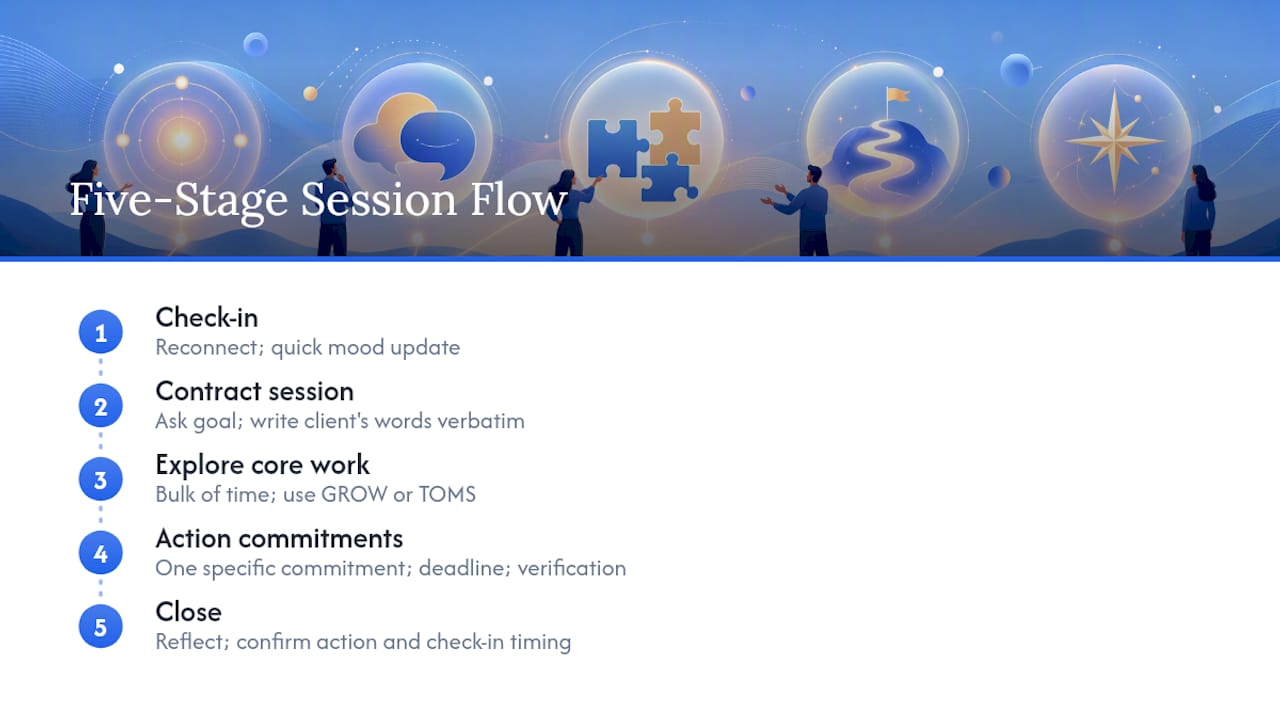
Check-in (60 to 120 seconds). Reconnect before you get to work. Ask what’s shifted since last time, or what win or blocker is sitting closest to the surface. This isn’t small talk. It’s a fast read on where the client’s head is.
Contract the session. This is the step most new coaches skip, and it’s the one the International Coaching Federation treats as foundational. Ask what would make the next 30, 45, or 60 minutes worth the client’s time, then write their answer down word for word. That sentence becomes your session goal, not your agenda template.
Explore the core work. This is where you spend the bulk of your time. A framework like GROW (Goal, Reality, Options, Will) or TOMS (Topic, Objective, Measure, Success) gives the conversation shape without boxing in the client’s thinking.
Action commitments. Convert insight into one specific commitment with a deadline and a way to verify it happened. Vague commitments (“I’ll think about it”) don’t survive the week.
Close. A short reflection on what landed, plus a spoken confirmation of the action and when you’ll check in on it.
Pro Tip: Write the client’s contracted goal in your session notes verbatim. When a session drifts, reading it back out loud is the fastest way to recontract without breaking rapport.
How Should You Split Time in a 30, 45, or 60-Minute Session?
The container is fixed. The depth inside it flexes. That’s the honest way to think about coaching session structure: the time boxes hold, but how much you dig into any one stage depends on what the client brings that day.
| Stage | 30 minutes | 45 minutes | 60 minutes |
|---|---|---|---|
| Check-in | 2 min | 3 min | 5 min |
| Contract goal | 3 min | 5 min | 5 min |
| Explore / core work | 17 minutes | 26 minutes | 35 minutes |
| Action commitments | 5 min | 7 minutes | 10 min |
| Close | 3 min | 4 min | 5 min |
A 60-minute template should protect at least 8 to 10 minutes for turning insight into a specific, dated action. Coaches who let exploration run long routinely lose this block, and the session ends with good conversation but no commitment.
Pause and recontract whenever the client’s stated goal shifts mid-session. If they arrive wanting to plan a difficult conversation but spend ten minutes venting about a different issue entirely, name it: “It sounds like the real thing on your mind today might be X, not what we agreed to. Want to shift focus?”
Two rules of thumb keep the split honest. First, core exploration should almost always be the largest single block, not a rushed middle squeezed between two long bookends. Second, never let closing minutes shrink below three, even in a fast 30-minute session. A session without a confirmed action is just a good conversation.
What Questions Should You Ask in Each Stage?
Coaches who stall mid-session are usually improvising language they haven’t thought through in advance. A small set of go-to questions removes that friction and gives every session planning session a consistent rhythm.
Check-in openers:
- “What’s different since we last talked?”
- “What’s the headline from your week?”
- “Before we dive in, what’s the win and what’s the weight you’re carrying?”
Contracting prompts:
- “What would make the next 45 minutes worth your time?”
- “If we nail one thing today, what should it be?”
- “What’s the real question underneath the topic you brought?”
Exploration and options questions:
- “What have you already tried?”
- “What would you do if you knew you couldn’t fail?”
- “What’s the option you haven’t said out loud yet?”
Decision and action questions:
- “What will you actually do, by when, and how will I know?”
- “What could get in the way, and what’s your plan for that?”
In executive contexts, lean on measurable, business-language framing (“What’s the metric that tells you this worked?”). In personal-development work, softer, identity-level questions (“Who do you want to be in this situation?”) tend to land better.
First Sessions vs. Ongoing Sessions: Where Time Actually Goes
Your first session with a new client is not a smaller version of a regular one. It’s a different animal. Intake sessions need more time for contracting: expectations, communication preferences, what success looks like over the engagement, and an initial plan the client can see and react to.
Session-one checklist: intake basics (background, current situation), explicit expectations for both sides, the key measures you’ll track together, and a first-draft action plan.
As the relationship matures, shift minutes out of contracting and into core work. By session four or five, contracting should take barely more time than a regular check-in, because the client already trusts the process. Build in a milestone or program review every six to eight sessions to step back and ask whether the original goals still hold.
How Do You Keep Notes and Follow-Up Without It Becoming a Second Job?
Session notes only earn their keep if they answer five questions later: what was the goal, what insight came up, what action got committed, when is it due, and how will you both know it happened. Templates built around these fields make it far easier to measure progress across a full engagement instead of guessing.
A repeatable follow-up workflow looks like this:
- Build the agenda before the call using last session’s committed action as your opening reference point.
- Run the session and log the new action, deadline, and evidence marker in real time, not from memory afterward.
- Send a short recap within 24 hours: “Great session today. Your commitment: [action] by [date]. I’ll check in on [evidence] next time.”
- Set a reminder to review that commitment at the start of the next session, before anything else.
A practice-management platform that ties notes, deadlines, and recap emails together removes the manual re-typing that causes most accountability systems to quietly fall apart after a few weeks.
Pro Tip: Your recap email doesn’t need to be long. One sentence naming the action and the date does more for accountability than a paragraph summarizing the whole conversation.
Three Ready-to-Copy Coaching Agenda Templates
Paste one of these directly into your notes before your next call. Each includes a single opening question and two fallback prompts for when the client goes quiet or the conversation stalls.
-
The Quick Check (30 minutes). Purpose: fast progress review and one decision. Opening question: “What’s the one thing you want to leave this call knowing?” Fallbacks: “What’s blocking progress on last week’s action?” and “If you only had 15 minutes with me, what would you use it for?” Notes checklist: goal, one insight, one action, deadline.
-
The Development Deep-Dive (45 minutes). Purpose: work through a recurring pattern or skill gap. Opening question: “What situation keeps showing up that you want to handle differently?” Fallbacks: “What did you notice about your own reaction?” and “What would the version of you six months from now do here?” Notes checklist: pattern named, insight, action, evidence marker.
-
The Strategy Session (60 minutes). Purpose: plan a decision or a quarter of work. Opening question: “What decision or plan needs your full attention today?” Fallbacks: “What are you optimizing for that you haven’t said out loud?” and “What’s the cost of not deciding this week?” Notes checklist: goal, options considered, decision, action, deadline, review date.
Test each template for a few sessions, then tweak the minute splits to match how your specific clients actually talk.
Structure as an Ally to Presence, Not a Replacement for It
The best coaching session agenda never fights against being present with the client. It frees you to be more present, because you’re not scrambling to remember what comes next. My one habit worth stealing: pre-fill your agenda in your notes ten minutes before the call, using last session’s committed action as the seed. It takes almost no time and it changes how the whole session feels.
— Mitch Russo
An Optional Way to Make Your Agenda Routine Actually Stick
Building a solid coaching meeting outline is one thing. Running it consistently across twenty or thirty clients a week, without losing track of who committed to what, is a different problem entirely. ClickCoach is built for coaches who want their session structure, notes, and follow-up living in one place instead of scattered across a notebook, a calendar app, and three email drafts.
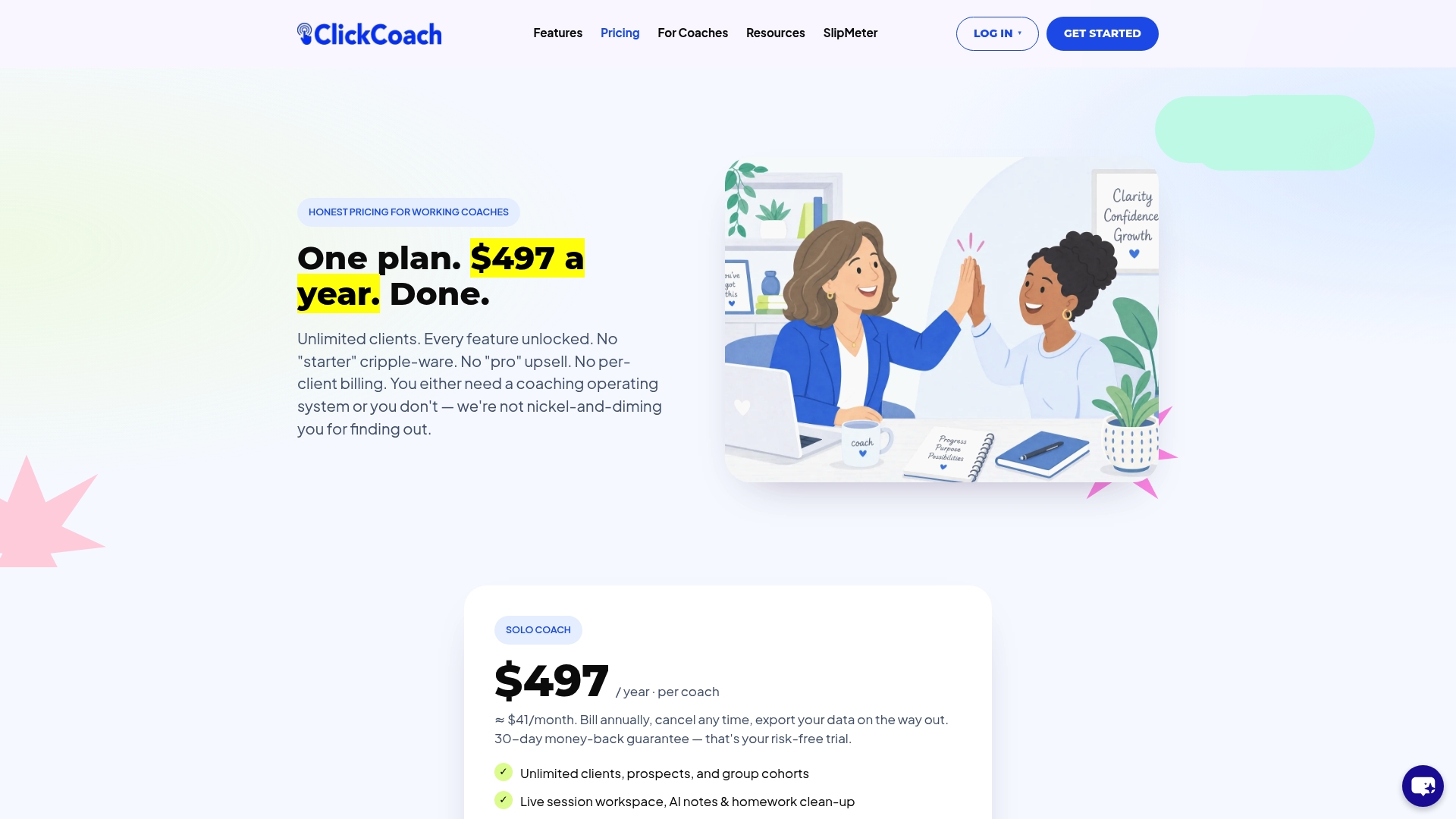
Here’s what that looks like in practice: you open a client’s record, the last session’s committed action is already sitting at the top, you build this session’s agenda around it, and once the call ends you log the outcome and next action directly into their file. A recap draft gets prepared automatically so you’re not retyping the same three lines every afternoon. This isn’t a coaching directory, a certification program, or a marketing tool. It’s practice management software built specifically to hold the session structure and accountability system you already run.
If you support clients on business or marketing goals, pairing your session agenda with a clear organic growth strategy gives you a shared framework to check progress against between sessions. And if you’re ready to see whether centralizing your notes and follow-up actually saves you time, you can check out the ClickCoach client portal and start a trial to see how it fits your current workflow.
Sources
For deeper reading beyond this coaching session agenda guide: the ICF’s guidance on session contracting, the peer-reviewed research on coaching outcomes, a practical 60-minute session template, and an AI-assisted agenda generator for when you need a fast first draft.
- What to Expect and How to Prepare for a Coaching Session
- Coaching Session Template: 60-Minute Plan | AnyGen
FAQ
What Is a Good Topic for a Coaching Session?
A good topic is whatever the client names when you ask what would make the session worth their time. Strong topics are specific and decision-oriented, not vague themes like “career stuff.”
What Are the 5 C’s of Coaching?
Definitions vary across coaching programs, and no single version is universally standardized. Rather than force-fitting one, focus on the five-stage structure covered in this guide: check-in, contract, explore, action, close.
How Do You Structure a Coaching Session?
Move through five stages in order: a brief check-in, contracting the client’s goal for that session, core exploration using a framework like GROW, converting insight into a dated action, and a short close that confirms the commitment.
What Is the 70/30 Rule in Coaching?
The general principle behind this idea is that the coach should talk less often and let the client lead the exploration to keep the session client-driven rather than coach-driven.
How Long Should a Coaching Session Agenda Take to Prepare?
With a template and last session’s notes on hand, prefilling an agenda usually takes under ten minutes, especially when a practice-management system already surfaces the client’s most recent commitment.