

Offer one clear pay-in-full price and one standardized installment option, backed by a deposit and automated billing. That combination expands access to your program without creating the administrative drag that comes from too many custom plans. Installments help clients say yes; automation and clear written terms keep your cash flow and your calendar intact.
TL;DR:
- Offering a single, automated installment plan with a deposit and clear schedule reduces administrative hassle and increases client uptake.
- Typical payment structures for coaching programs include pay-in-full discounts of 10-15%, deposits of 25-50%, and options for 3 to 6 monthly installments.
- Automating billing with retry systems, self-serve card updates, and payment status syncs recovers up to 70% of failed payments, minimizing revenue loss.
- Contract terms should explicitly state total cost, schedule, missed payment policies, and cancellation rules to prevent disputes and awkward conversations.
- Present payment options in a straightforward order: full price first, then installment plans, with clear timing and policies, to reinforce value without sounding apologetic.
Table of Contents
- What Are the Main Types of Coaching Payment Plans?
- How Should You Set Deposits, Discounts, and Total Cost?
- How Do You Automate Billing and Recover Failed Payments?
- What Belongs in a Coaching Payment Plan Contract?
- What Scripts and Templates Work for Presenting Payment Options?
- How Do You Handle Payment Disputes Without Damaging the Relationship?
- Do Payment Plans Improve Client Retention?
- What Tax Considerations Apply to Coaching Payment Plans?
- What Legal Requirements Apply to Coaching Payment Plans?
- Author Perspective: Why Payment Plan Clarity Is a Coaching Quality Issue
- How ClickCoach Reduces the Admin Load of Payment Plans
- Sources
- FAQ
What Are the Main Types of Coaching Payment Plans?
Most coaching payment plans fall into five categories, and each fits a different program length and price point.
- Pay-in-full: One upfront charge, often with a discount, for the full engagement.
- Deposit plus installments: A partial payment upfront, then a fixed number of scheduled charges.
- Equal monthly installments: The total split evenly across 3 to 6 months, no deposit required.
- Per-session packs: Clients buy a bundle of sessions (5, 10, 20) and pay as they go or upfront for the bundle.
- Subscription or retainer: A recurring monthly charge for ongoing access, common in group coaching or maintenance-phase work.
Industry guidance on coaching package structures shows that 3 to 6 month installment windows are the norm for standard packages, while longer terms tend to increase the odds of missed payments.
A $3,000 program illustrates the tradeoffs well. Pay-in-full might run $2,700 after a 10% discount. A deposit-plus-installments structure could ask for a $750 deposit followed by three payments of $750. Equal monthly installments might split the same $3,000 into six payments of $500. Per-session packs suit shorter, less structured engagements. Subscriptions work best when the coaching itself is ongoing rather than a defined program with an end date. Choose based on program length first, then price band, then how much cash-flow risk you’re willing to carry.
How Should You Set Deposits, Discounts, and Total Cost?
Pricing mechanics decide whether your payment plan protects your margin or quietly erodes it. Two anchor numbers matter most: the discount you offer for paying upfront, and the deposit you require to start an installment plan.
- Full-payment discount: 10% to 15% off the total is standard across the coaching industry.
- Deposit size: 25% to 50% of the total, collected before the first session.
- Installment premium: Some coaches add a small premium (often 5% to 10%) to the installment total rather than discounting it, framed as the cost of flexibility rather than a penalty.
Full-payment discounts commonly range from 10% to 15%, according to research on coaching package pricing psychology. That range gives you room to reward commitment without undercutting your day rate.
The math is simple. Take your full price, subtract the discount for pay-in-full, or add the premium for installments, then divide by the number of payments after the deposit. A $4,000 program with a 30% deposit and three remaining payments works out to a $1,200 deposit followed by three payments of roughly $933. Write the numbers down before you present them. Clients trust round, pre-calculated figures far more than a formula they have to do in their head.
How Do You Automate Billing and Recover Failed Payments?
Manual invoicing is where most coaching businesses lose money quietly. A card expires, a payment fails, and nobody follows up for two weeks. Fixing this doesn’t require a finance team, just the right layers set up in the right order.
Start with a payment processor (Stripe is the most common choice for coaches) connected either to a billing automation and retry layer or to an all-in-one coaching platform that already handles both. Then build automation in this order:
- Smart retries on failed cards — this recovers the largest share of lost revenue for the least setup effort.
- Self-serve card update links — let clients fix expired cards without a phone call or email from you.
- Scheduled auto-charge — remove the need to manually trigger recurring invoices.
- Status sync — connect payment status to client access, so a lapsed payment automatically flags the account.
- Reconciliation — a weekly check that payments received match sessions delivered.
Involuntary churn from failed cards accounts for 20% to 40% of total subscription churn, and most of it is recoverable. Dunning and retry systems typically recover 30% to 70% of that failed-payment revenue, which makes retries the single highest-leverage automation you can set up first.
| Automation step | What it does | When to prioritize it |
|---|---|---|
| Smart retries | Re-attempts failed charges on a schedule | First, always |
| Self-serve card update | Lets clients fix payment info themselves | Second |
| Scheduled auto-charge | Triggers recurring invoices automatically | Third |
| Status sync | Links payment status to program access | Fourth |
| Reconciliation | Confirms payments match delivered sessions | Ongoing, weekly |
A workable retry schedule spaces attempts on day 1, day 3, day 5, and day 7 after a failure, each paired with a one-click card update link; for detailed guidance, see how to set up recurring appointments in your booking system. Watch the invoice.payment_failed webhook event so you know the moment a retry sequence starts, not two weeks later when the client stops showing up.
Pro Tip: If you’re running fewer than 8 to 15 recurring clients, full automation may not be worth the setup time yet. A simple manual reminder on failed payments will cover you until volume justifies the extra tooling.
What Belongs in a Coaching Payment Plan Contract?
Ambiguity is what turns a missed payment into an awkward conversation. Your agreement and checkout copy need to answer six questions before a client ever asks them.
- The total program cost, stated in full dollar terms.
- The payment schedule, including exact due dates, not “monthly” or “biweekly.”
- What happens after one missed payment (a grace period, then a pause in access).
- What happens after two missed payments (termination, unless a new plan is agreed in writing).
- Your refund and cancellation policy, including any nonrefundable deposit.
- How exceptions get documented, so you’re not relying on memory three months later.
A workable enforcement cadence: pause access after one missed payment and a short grace window, then terminate after two unless the client proactively arranges a revised plan. Coaching-industry guidance on structuring high-ticket payment plans consistently points to writing these terms down before the first session, not after the first missed payment.
Pro Tip: Keep a single running log of every exception you grant. If you waive a late fee for one client, you’ll want to know exactly what you agreed to when a similar situation comes up with someone else.
What Scripts and Templates Work for Presenting Payment Options?
Presenting options in the right order protects your pricing. Lead with the full price. Let the installment option feel like a convenience, not a rescue.
- State the full program price and what it includes.
- Offer the pay-in-full discount as a reward for commitment.
- Introduce the installment option as a second, equally legitimate path.
- Confirm the deposit and schedule in writing before booking the first session.
A simple DM or call script: “The program is $3,000, or $2,700 if you pay in full today. If you’d rather spread it out, we can do a $750 deposit and three monthly payments of $750.” That’s it. No apology, no over-explaining.
Checkout copy should mirror the same order:
- Full price shown first, with the discount clearly marked.
- Installment plan shown second, labeled “flexible payment option.”
- Deposit and total number of payments spelled out in plain language.
A minimal contract checklist to paste into your agreement: total cost, schedule with dates, missed-payment policy, access-pause terms, refund policy, and a signature line for both parties.
How Do You Handle Payment Disputes Without Damaging the Relationship?
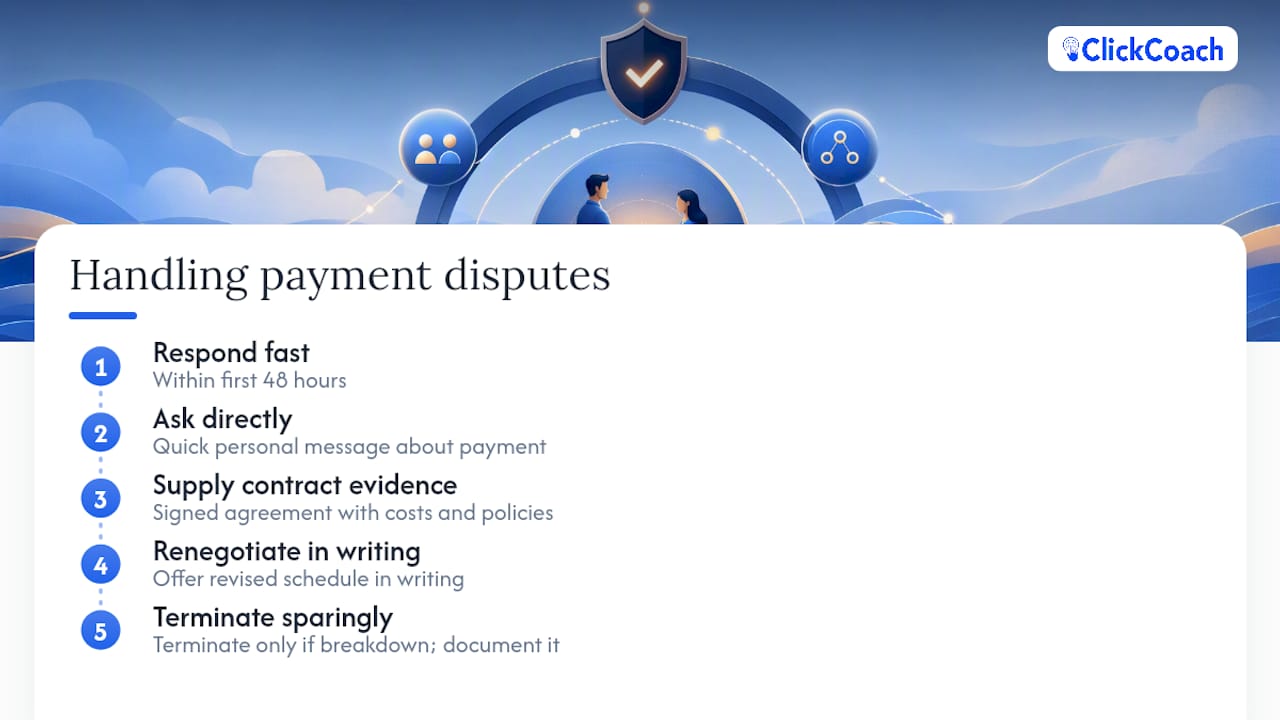
Disputes usually start small: a client questions a charge, misses a payment, or asks for a pause they never mentioned before. How you respond in the first 48 hours determines whether it stays a conversation or turns into a chargeback.
Address the issue directly and early. A quick message asking “I noticed your payment didn’t go through, is everything okay?” resolves far more disputes than an automated dunning email alone. Most missed payments are logistical, not a sign the client wants out.
When a client disputes a charge with their card issuer rather than contacting you first, your best defense is the paper trail you built into your contract. A signed agreement with the total cost, schedule, and policies spelled out gives you something concrete to submit as evidence. Coaches who rely on verbal agreements or a single confirmation email have a much weaker position in a chargeback review.
If a client asks to renegotiate mid-program, treat it as a business decision, not a personal one. Offer a revised schedule in writing rather than an informal “let’s figure it out later.” That protects both the relationship and your revenue. Reserve termination for cases where communication breaks down entirely, and always document the exception, even when you’re being generous with it.
The goal isn’t to win every dispute. It’s to have few enough of them that the ones you do face are straightforward to resolve, because your terms were clear from the start.
Do Payment Plans Improve Client Retention?
A well-structured payment plan can improve both retention and satisfaction, but only when the terms are clear enough to prevent friction later. Clients who commit to a schedule tend to show up more consistently, in part because the financial commitment reinforces the behavioral one.
The risk runs the other way when plans are vague or inconsistently enforced. A client who isn’t sure when their next charge hits, or who sees a peer get a quiet discount they didn’t get, starts to disengage before the coaching itself becomes the issue. Standardized terms remove that friction entirely.
Deposits play a specific role here beyond cash flow. That’s a sales psychology effect as much as a financial one, and it’s worth designing your plans around deliberately rather than treating the deposit as just a formality.
Subscription and retainer models add a different retention dynamic. Because the charge recurs automatically, the client’s ongoing commitment is passive rather than something they re-decide every month. That’s a strength for steady engagement, but it also means a failed payment can end the relationship abruptly if you don’t have retry automation catching it first. The two issues are connected: better automation on the back end supports better retention on the front end.
What Tax Considerations Apply to Coaching Payment Plans?
How you structure payments changes what you owe and when, not just how much a client pays you. Coaches operating in the United States generally recognize income when payment is received (cash basis) rather than when it’s earned, which matters a great deal for installment plans that span a calendar year.
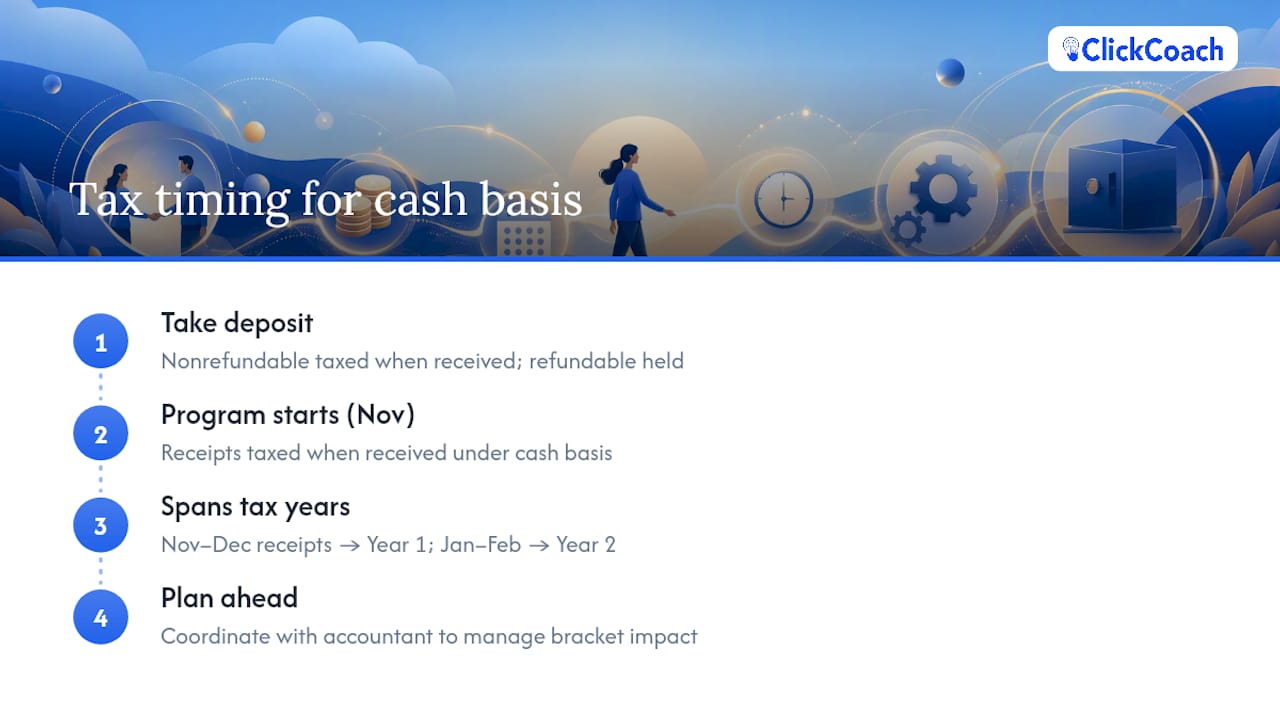
A program that starts in November and finishes in February spreads income across two tax years under cash-basis accounting, even if the total contract value was agreed in one lump sum. That can shift your tax liability from one year to the next in ways worth planning for, especially if you’re close to a bracket threshold or making quarterly estimated payments.
Deposits carry their own wrinkle. A nonrefundable deposit is typically treated as income when received, not when the coaching begins, which means you may owe tax on it before you’ve delivered a single session. Refundable deposits are usually treated differently until the refund window passes.
None of this is a substitute for advice from a licensed accountant familiar with your specific business structure and state. But it’s worth flagging to whoever handles your books: the payment structure you choose for sales reasons has a direct tax-timing consequence, and it’s far easier to plan for that upfront than to untangle it in April.
What Legal Requirements Apply to Coaching Payment Plans?
Coaching isn’t a licensed profession in the way that therapy or financial advising can be, but the payment plans themselves are still subject to consumer protection law. Automatic recurring charges, in particular, draw regulatory attention because they’re easy to set up and easy to forget about from the client’s side.
The Federal Trade Commission’s rules on negative option marketing require clear disclosure of recurring charge terms and a simple way to cancel, and enforcement in this area has increased. If your subscription or retainer model auto-renews, your checkout and contract need to say so plainly, along with how a client cancels it.
State-level consumer protection laws vary, and some states impose specific requirements on contracts involving installment payments, cancellation rights, or cooling-off periods for services sold above a certain price. If you’re coaching clients across state lines, which most online coaches are, it’s worth having your standard agreement reviewed once by an attorney familiar with services contracts rather than relying on a template you found online.
None of this should scare you away from offering installment plans. It just means the same discipline you apply to pricing and scheduling belongs in your legal terms too: write it down, make cancellation clear, and don’t bury the recurring-charge language where a client won’t see it before they pay.
Author Perspective: Why Payment Plan Clarity Is a Coaching Quality Issue
Every messy payment plan I’ve seen traces back to the same root cause: the coach never wrote the terms down before the first sale. That ambiguity doesn’t just create admin headaches, it erodes the client relationship, because uncertainty about money bleeds into uncertainty about commitment on both sides.
Start with one plan. Just one. Add a second option only after your sales data tells you clients are asking for it. Simplicity is a feature, not a compromise.
— Mitch Russo
How ClickCoach Reduces the Admin Load of Payment Plans
Running installment plans well means juggling billing schedules, client access, receipts, and progress notes without letting any of it slip. That’s exactly the operational load ClickCoach was built to absorb.
ClickCoach centralizes billing and subscription management alongside session notes, goal tracking, and branded client portals, so a missed payment or an updated card doesn’t require you to jump between three separate tools to fix it. Your client billing portal gives clients a single place to see their schedule, update payment details, and access session history, which cuts down the back-and-forth emails that installment plans tend to generate. Status sync between billing and access means you’re not manually pausing accounts when a payment fails.
For coaches managing group programs or cohorts with staggered payment dates, the same coaching business management software keeps every client’s plan, notes, and payment status in one workspace instead of scattered across spreadsheets. If you’re ready to see how it fits your practice, you can start with ClickCoach and set up your first billing structure this week.
Sources
- Why Coaching Payment Processing Stalls Cash in 2026
- Payment Plans for High-Ticket Coaching | Online Coaches 2026
FAQ
Does every coach need to offer payment plans?
No. Offering one is optional and depends on your price point and audience. A standardized installment option typically expands who can say yes without adding meaningful risk, especially for higher-priced programs.
What is the 70/30 rule in coaching?
There’s no single, widely recognized “70/30 rule” specific to coaching payment plans. If you’ve seen it referenced, it likely refers to a specific coach’s or program’s own deposit-to-balance split, not an industry standard.
What is the 80/20 rule in coaching?
Similarly, there’s no established universal rule governing coaching payment plans. Definitions vary by source, so treat any specific percentage split you see as one coach’s practice rather than a broad standard.
How much does a Dave Ramsey financial coach program cost?
Pricing for named financial coaching programs varies by provider and changes over time, and it isn’t something this article can verify with a current, sourced figure. Check the program’s own current pricing page directly for accurate numbers.
How many payment options should I offer?
Most coaching guidance recommends one or two: a pay-in-full price and a single standardized installment option, since too many choices tend to slow down the buying decision rather than help it.