

The most useful coaching homework assignments are short, measurable experiments built from three ingredients: reflection prompts, small behavior tests, and accountability checks the client helps design. These work because clients follow through on specific if-then plans far more reliably than vague intentions, and accountability multiplies that effect. Pick one experiment per session rather than a long list, and you will see stronger follow-through by your next meeting.
TL;DR:
- Short, measurable homework experiments that include reflection, behavior tests, and accountability checks significantly improve client follow-through.
- Assignments should be tailored to specific outcomes, manageable within the client’s time, and agreed upon during session with clear if-then plans.
- Using weekly progress reports, spaced reminders, and client-designed accountability measures can double goal achievement rates.
- Limiting homework to one well-chosen experiment or reflection per week increases the likelihood of completion and meaningful insights.
- Scaling homework management with coaching software reduces administrative load and centralizes tracking, reminders, and client interactions.
Table of Contents
- 1. Ready-to-use homework ideas grouped by outcome
- 2. How to choose, tailor, and agree homework with clients
- 3. Templates and delivery: scripts, worksheets, and low-effort tracking
- 3. Evidence summary: why accountability and if-then plans work
- 4. A practitioner’s note on homework that sticks
- 5. Scaling homework, reminders, and tracking with software
- Sources
- FAQ
1. Ready-to-use homework ideas grouped by outcome
The best homework fits the outcome you are working toward. Below is a working bank organized by category, each with a one-line instruction, a dose (how much, how often), and a way to measure it.
Reflection and insight exercises build self-awareness between sessions:
- Three-sentence evening reflection: client writes three sentences each night on what went well, what didn’t, and one lesson. Dose: daily for one week. Measure: number of entries completed.
- Values journal: client logs one moment per day when they acted on a stated value. Dose: daily. Measure: entries logged versus days elapsed.
- Decision log: client records one decision made and the reasoning behind it. Dose: 3 times per week. Measure: consistency of entries.
Behavior experiments test a small change with a clear success metric:
- The one-ask experiment: client asks for something they normally avoid asking for (a deadline extension, help, feedback). Dose: once before next session. Measure: yes/no completion plus outcome notes.
- Energy audit: client tracks energy levels (low, medium, high) at three points a day for five days. Measure: pattern identified or not.
- No-phone morning: client delays phone use for 30 minutes after waking. Dose: five mornings. Measure: days completed out of five.
Goal micro-steps and scheduling turn intentions into calendar commitments:
- Fifteen-minute block: client schedules one fifteen-minute session toward a stated goal, same time each day. Measure: calendar entries created and kept.
- Two-minute start: client commits to starting a delayed task for just two minutes. Measure: number of times the task was started.
- Weekly priority card: client writes the single most important outcome for the week on a card kept visible. Measure: end-of-week self-rating on progress.
Skill practice builds capability through repetition:
- Role-play rehearsal: client rehearses a difficult conversation out loud, alone or with a friend, before having it for real. Dose: once. Measure: confidence rating before and after.
- Timed practice: client practices a specific skill (a pitch, a presentation opener) for ten minutes, three times. Measure: self-rated fluency.
Social tasks extend the work into relationships:
- Feedback request: client asks a colleague or manager for one piece of specific feedback. Measure: feedback received, summarized in one sentence.
- Informational interview: client has a fifteen-minute conversation with someone in a role or field they are curious about. Measure: conversation completed, one takeaway noted.
Assessments and self-checks give a snapshot at a point in time:
- One-page wellbeing check: client rates sleep, energy, stress, and satisfaction on a 1 to 5 scale. Measure: score comparison week to week.
- Energy map: client lists tasks and activities from the past week, marking each as energizing or draining. Measure: ratio of energizing to draining items.
Creative prompts work well for clients stuck in analysis:
- Mood board: client assembles images or words representing where they want to be in six months.
- Values collage: client creates a simple visual representing their top three values.
- Letter to future self: client writes a short letter to be read in three months.
Each of these should take a client under twenty minutes to complete and produce something concrete to bring back to the session, whether that’s a completed log, a felt experience, or a simple artifact.
2. How to choose, tailor, and agree homework with clients
Homework works when the client helps build it, not when it’s handed down. A short selection checklist keeps assignments realistic:
- Readiness: is the client emotionally and practically ready to try this now?
- Alignment: does the task connect directly to the goal discussed in session?
- Time budget: can the client realistically fit this into their week?
- Learning objective: what will the client know or be able to do afterward that they can’t now?
Contracting language should shift by client type. For a busy client: “Let’s pick the smallest version of this. What’s the two-minute version?” For a skeptical client: “This is an experiment, not a test. There’s no way to fail it, only information to gather.” For an eager client: “Since you’re motivated, let’s add one accountability check so momentum doesn’t slip.”
Once you agree on the task, build an if-then plan: “If it’s 7 AM and I’ve had coffee, then I’ll write my three sentences.” Decide together how often reminders should land. Research on habit formation and mobile reminders suggests spreading reminders out tends to work better than clustering them close together, an approach known as distributed reminders.
Accountability options vary by client. Self-report suits confident, organized clients. A buddy-report (client checks in with a peer) suits socially motivated clients. A coach-check-in, even a two-line text between sessions, suits clients who need external structure.

Pro Tip: When homework isn’t done, don’t assign more. Ask what got in the way, check the task was specific enough, and adjust the dose before the client tries again.
3. Templates and delivery: scripts, worksheets, and low-effort tracking
Three short templates cover most homework needs.
- Quick homework brief: “This week, try [task]. Do it [when/where]. You’ll know it worked if [measurable sign].”
- Weekly check-in (three questions): What did you try? What happened? What will you adjust for next time?
- One-page reflection worksheet: one open prompt, plus a 1 to 5 rating field for effort and outcome.
For delivery, email works for clients who check it daily and costs about a minute to send. A shared document suits ongoing logs but requires the client to remember to open it. SMS reminders work well for time-sensitive tasks but need a separate tool. A branded client portal centralizes everything in one place, trading a short setup cost for less week-to-week friction.
3. Evidence summary: why accountability and if-then plans work
The case for structured homework rests on a small set of well-known findings. In a study of 267 goal-setters, participants who sent weekly progress reports to a friend achieved their goals at a rate significantly higher than those who kept goals private, more than doubling the completion percentage, according to Gail Matthews’ research on goal-writing and accountability. That gap is the strongest argument for weekly check-ins over open-ended homework. Separately, mHealth research on implementation intentions and reminders finds that pairing an if-then plan with a reminder improves follow-through, and that spacing reminders out tends to beat clustering them. The ICF 2025 core competencies reinforce this by asking coaches to partner with clients on designing their own accountability measures rather than imposing them.

4. A practitioner’s note on homework that sticks
The most common mistake I see is overprescribing: three assignments when one clear experiment would do more. Clients follow through on tasks they helped shape, framed as experiments rather than obligations. If you want a starting point, use this: a weekly brief check-in with three questions, one small behavior experiment framed as an if-then plan, and a concise reflection worksheet. That’s a full system in three pieces.
— Mitch Russo
5. Scaling homework, reminders, and tracking with software
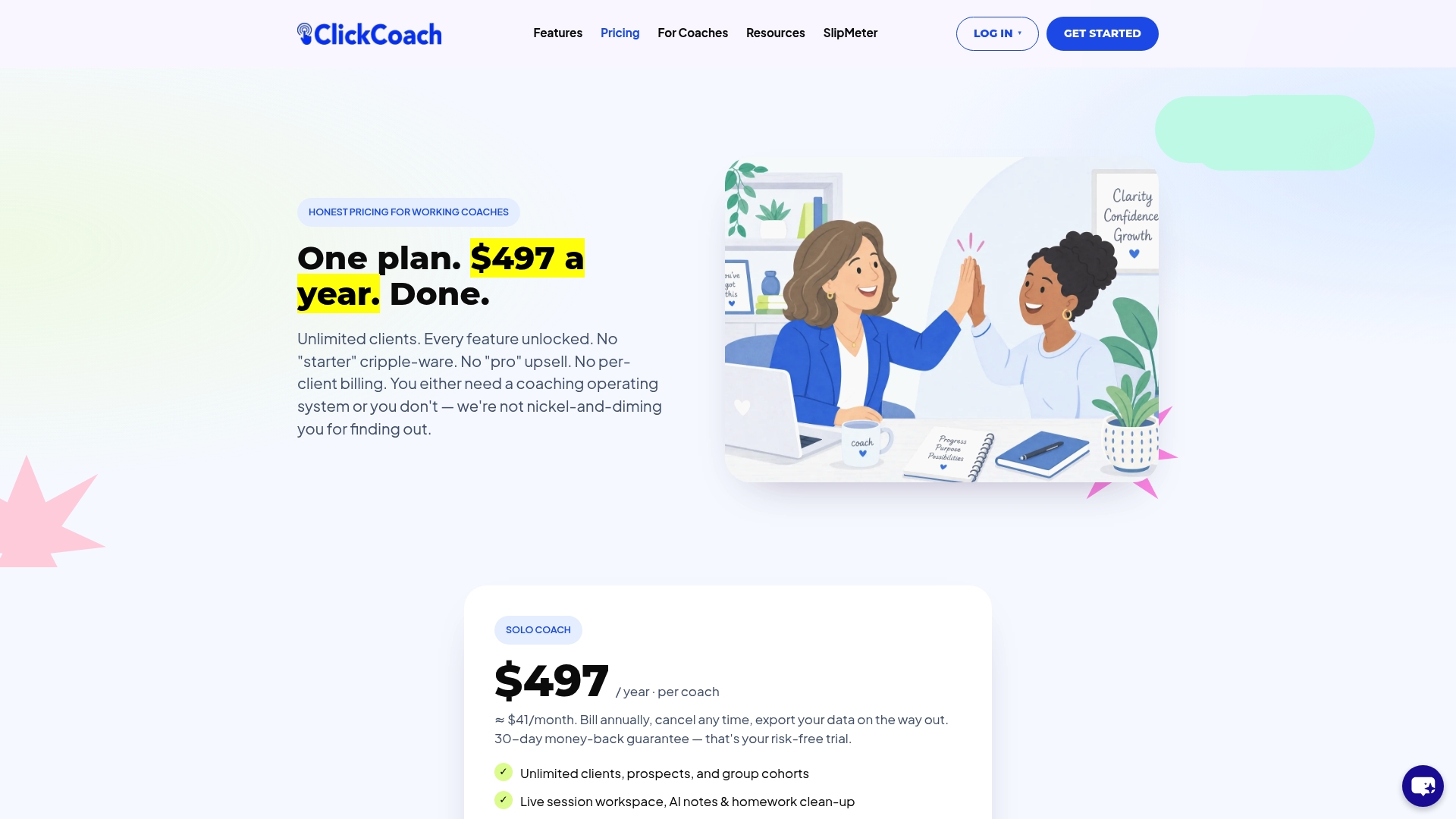
Sticky notes and email work fine for a handful of clients. Once you’re managing homework, reminders, and progress notes across a full caseload, the manual version starts eating the hours you’d rather spend coaching. That’s the specific job ClickCoach handles: it centralizes homework assignment, reminders, progress tracking, and a branded client portal in one workspace instead of several disconnected apps.
A rough rule of thumb: if you’re tracking homework for more than a handful of clients on spreadsheets or scattered messages, it’s worth looking at dedicated coaching accountability software. If you’re coaching a few clients with a simple weekly rhythm, a shared doc and a calendar reminder may be all you need.
- AI-assisted drafting helps you generate homework and follow-up actions while you stay in control of the final assignment.
- Client portals give clients one place to see homework, submit check-ins, and track progress over time.
- Plans are available for solo coaches and multi-coach teams; see current pricing and plans to find the right fit.
Sources
For coaches who want to go deeper, these four sources anchor the evidence and guidance in this article: Gail Matthews’ study on goal-writing and accountability, the PMC mHealth study on implementation intentions and reminders, the Passmore, Day, and Wang paper on intersessional activities, and the ICF 2025 core competencies.
- Study focuses on strategies for achieving goals, resolutions (Gail Matthews summary)
- mHealth study on implementation intentions and reminders (PMC)
FAQ
What are some good topics for coaching?
Good coaching topics track directly to the client’s goal category: career transitions, leadership behaviors, wellbeing habits, communication skills, and confidence building are common areas. The strongest homework topics are narrow enough to test in a week, such as one communication habit or one energy pattern, rather than broad themes like “work on confidence.”
What is the 70/30 rule in coaching?
There is no single, widely recognized “70/30 rule” tied to a named coaching body; the phrase is used inconsistently across coaching resources. If a client or reader has seen it applied to session time or listening ratios, it’s worth asking for the source, since definitions vary and no major coaching organization publishes it as a standard.
What are the 7 P’s of coaching?
The “7 P’s of coaching” is not a term defined by a major coaching body such as the ICF, and usage varies widely by author and program. Rather than rely on an unverified framework, it’s safer to ground homework and session design in documented competencies like the ICF 2025 core competencies.
What are the best questions to ask during a coaching session?
Strong coaching questions tend to be open-ended and focused on the client’s own thinking, such as “What would success look like here?” or “What’s the smallest step you could take this week?” The exact best set depends on the client’s goal and stage, so questions should follow the ICF’s emphasis on partnering with the client rather than following a fixed script.