

Every professional coach needs eight core email templates on hand: welcome/onboarding, session confirmation, pre-session check-in, post-session summary, progress follow-up, no-show/reschedule, re-engagement, and testimonial request. Used consistently, these cut administrative time, reduce no-shows, and give clients a clear paper trail of their own progress. Add a basic CAN-SPAM compliance check and a few tracking habits, and the whole system runs on autopilot.
TL;DR:
- Campaigns should be personalized using key tokens like client name, goal, or session details, which require proper setup and verification before sending.
- All promotional coaching emails must include an active unsubscribe link, a valid postal address, and a truthful subject line to comply with CAN-SPAM regulations.
- Maintaining a structured library of templates, tracking their performance, and updating them based on client feedback ensure messaging remains effective and relevant.
- Automated workflows and platforms like ClickCoach can streamline template management, trigger emails, and integrate session data to save coaching time and improve consistency.
- Tracking email outcomes beyond open rates, such as conversion rates and revenue per message, provides more actionable insights into practice growth.
Table of Contents
- Copy-Ready Coaching Email Templates You Can Use Today
- Adapting Templates by Segment, Token, and Tone
- CAN-SPAM Compliance: What Coaching Emails Legally Require
- Design, Deliverability, and the Metrics Worth Tracking
- Where Templates Live in Your Coaching Workflow
- Why Your Best Templates Are Never Finished
- An Optional Upgrade: Centralizing Templates and Automation
- Primary Sources for Legal and Email Best Practices
- Sources
- FAQ
Copy-Ready Coaching Email Templates You Can Use Today
Before writing a single custom message, build a template bank. This is the working vocabulary of your practice, the messages that go out dozens of times a month with minor edits. Below are ten templates covering the full client lifecycle, from first contact to referral request. Each includes a purpose, timing, subject-line options, and a short body snippet with placeholders you fill in per client.
-
Welcome and onboarding. Purpose: set expectations and reduce first-session anxiety. Send within 24 hours of a client signing up. Subject lines: “Welcome aboard, [First Name]!” or “Here’s what to expect before our first session.” Body: “Hi [First Name], I’m glad you’re here. Before we meet on [session date], take five minutes to fill out your intake form so we can make the most of our time together. Your main goal, as I understand it, is [client goal], and that’s exactly where we’ll start.” Personalization token: client’s stated goal from the intake call.
-
Session confirmation. Purpose: lock in attendance and cut scheduling friction. Send 48 hours before the session, paired with a calendar link. Subject lines: “Confirmed: your session on [date]” or “See you [day] at [time].” Body: “This confirms your coaching session on [session date] at [time]. Add it to your calendar here: [calendar link]. If anything changes, reply to this email at least 24 hours in advance.” Token: session date and time pulled from your scheduling tool.
-
Pre-session checklist. Purpose: prime the client to arrive ready, not scrambling. Send the morning of the session. Subject lines: “Quick prep for today’s session” or “3 minutes before we talk.” Body: “Before we meet today, jot down one win and one challenge from this week related to [client goal]. That’s all the prep you need.” Token: reference to the client’s current program stage.
-
Post-session summary and homework. Purpose: reinforce accountability the moment memory is freshest. Send within two hours of the session ending. Subject lines: “Your session recap and next steps” or “Here’s what we agreed on today.” Body: “Great work today, [First Name]. We agreed you’ll [agreed action] by [deadline]. I’ll check in on this at our next session on [next session date].” Token: the specific agreed action captured live in your session notes.
-
Progress update or check-in. Purpose: maintain momentum between sessions without demanding a reply. Send midweek, between sessions. Subject lines: “Quick check on [agreed action]” or “How’s it going with [client goal]?” Body: “Just checking in. How’s progress on [agreed action] coming along? No need for a long reply. A one-line update helps me plan our next session.” Token: last session’s specific takeaway.
-
No-show or reschedule. Purpose: recover a missed session without sounding punitive. Send within an hour of a missed appointment. Subject lines: “Missed you today” or “Let’s find a new time.” Body: “I noticed we missed our session today. These things happen. Here’s a link to grab a new time that works: [calendar link]. Looking forward to picking back up on [client goal].” Token: reschedule link tied to your live calendar.
-
Discovery-to-conversion follow-up. Purpose: move a prospect from consultation call to paying client. Send within 24 hours of a discovery call. Subject lines: “Next steps after our call” or “Ready to get started, [First Name]?” Body: “Thanks for sharing where you want to go with [client goal] on our call. Based on what you told me, I think [program name] is the right fit. Here’s how to get started: [enrollment link].” Token: the goal the prospect stated on the call.
-
Re-engagement for lapsed clients. Purpose: reopen contact with clients who have gone quiet. Send after 60 to 90 days of inactivity. Subject lines: “Still thinking about [client goal]?” or “It’s been a while, [First Name].” Body: “I haven’t heard from you in a bit and wanted to check in. Last time we spoke, you were working toward [client goal]. If now’s a good time to pick that back up, I’d love to help.” Token: the last recorded goal or milestone.
-
Testimonial or referral request. Purpose: generate social proof and warm leads from happy clients. Send two to four weeks after a client hits a major milestone. Subject lines: “Would you share your experience?” or “A quick favor, [First Name].” Body: “You’ve made real progress on [client goal] since we started working together. Would you be willing to share a few sentences about your experience? It would mean a lot, and helps other people find the right support.” Token: the specific milestone achieved.
-
Newsletter or value update (optional). Purpose: stay visible to your full list without a hard pitch. Send monthly. Subject lines: “This month in coaching: [topic]” or “One idea that might help you.” Body: “Here’s a short idea I’ve been sharing with clients lately: [insight]. If it’s useful, try applying it this week.” Token: rotate insights based on your most common client goal categories.
Adapting Templates by Segment, Token, and Tone
Rewriting every message from scratch defeats the purpose of a template bank. Instead, sort your list into three segments and swap a handful of variables.
New leads and discovery prospects need warmer, more explanatory language, since they haven’t built trust yet. Active clients, segmented by program stage (onboarding, midpoint, wrap-up), need shorter, more direct messages that assume context. Lapsed or inactive clients need a lower-pressure tone that invites rather than pushes.
Five tokens cover most personalization needs: first name, program name, main goal, last-session action, and next session date. A subject line like “Quick check on [agreed action]” becomes “Quick check on your morning routine” or “Quick check on your Q1 revenue target” with almost no extra writing time.
Before sending a batch of personalized emails, run this five-step check:
- Confirm every token field is populated, not left as a bracket.
- Read the subject line aloud, since awkward phrasing shows up faster out loud than on screen.
- Verify the send date matches the client’s actual next session, not a stale placeholder.
- Check that the tone matches the segment (warmer for prospects, direct for active clients).
- Send a test copy to yourself first if the template is new or heavily edited.
Pro Tip: Keep a “last-session takeaway” field in your client notes updated after every call. It turns a generic check-in email into one that reads like you remembered the conversation, because you did.
CAN-SPAM Compliance: What Coaching Emails Legally Require
Coaching emails that promote programs, sell spots, or advertise services count as commercial email under the CAN-SPAM Act, and that means specific legal obligations apply regardless of list size. Every commercial message needs a working unsubscribe link, a valid postal address, and a subject line that honestly reflects the content.
The FTC requires opt-out requests to be honored within 10 business days. Waiting longer, even accidentally through a broken automation, creates real liability.
One distinction trips up a lot of coaches: labeling an email “transactional” (like a session reminder) doesn’t exempt it from CAN-SPAM if its real purpose is promotional. The FTC has specifically warned that mixing a program pitch into what looks like a scheduling email is still commercial content, and enforcement has followed that logic.
A quick compliance checklist:
- Test your own unsubscribe link quarterly, not just once at setup.
- Keep your list clean by removing bounced or opted-out contacts promptly.
- Log the date each opt-out request was processed.
One FTC settlement against Experian resulted in a $650,000 penalty tied to a missing working unsubscribe mechanism, a reminder that this isn’t a paperwork formality.
Design, Deliverability, and the Metrics Worth Tracking
Most coaching emails get opened on a phone screen first. Keep subject lines under 50 characters, write a preheader that adds information rather than repeating the subject, and stick to one call to action per email. A message asking a client to both reschedule and read a blog post usually gets neither action taken.
Deliverability depends less on clever subject lines than on list hygiene. Never buy or import a purchased list. Keep your sending name and address consistent across every template, and Mailchimp recommends reconfirming stale contacts periodically to protect your sender reputation.
Open rates are close to useless on their own, since bot-driven previews and phantom opens distort the number. Litmus recommends tracking conversion per email, list churn, and revenue-per-email instead, since these connect directly to whether your emails are growing the practice.
Pro Tip: Run one A/B test per quarter, not per email. Testing subject-line phrasing (“Quick check” versus “How’s it going”) over a full quarter gives you a real pattern instead of a one-off fluke.

Where Templates Live in Your Coaching Workflow
A template scattered across old email drafts gets lost or misused. Build a workflow instead:
- Create a canonical template library with one master version per template type.
- Tag variants by purpose and client segment so the right one surfaces fast.
- Automate confirmations and post-session follow-ups so they fire without manual triggering.
- Run a monthly re-engagement pass on any client inactive for 60-plus days.
Store the version number, last-modified date, and a sample outcome metric (booking rate, homework completion) with each template so you can tell which version actually works. A branded client portal can serve as one place clients receive these summaries and homework, which keeps the whole exchange out of a cluttered inbox.
Why Your Best Templates Are Never Finished

Templates that never change eventually sound like form letters. I’ve seen coaches take a flat “session confirmed” line and rewrite it after noticing clients kept asking the same follow-up question, folding the answer directly into the template. That single edit cut a week’s worth of clarifying emails down to almost none.
Treat every template as a working draft, not a finished asset. Update it when client replies reveal confusion, and track a simple completion metric so you know which version is pulling its weight.
— Mitch Russo
An Optional Upgrade: Centralizing Templates and Automation
Every template in this guide works fine from Gmail, Outlook, or whatever email tool you already use. Nothing here requires special software. But if you’re running a growing practice with multiple clients cycling through different program stages, keeping templates, triggers, and outcome data in separate places starts to cost you real time.
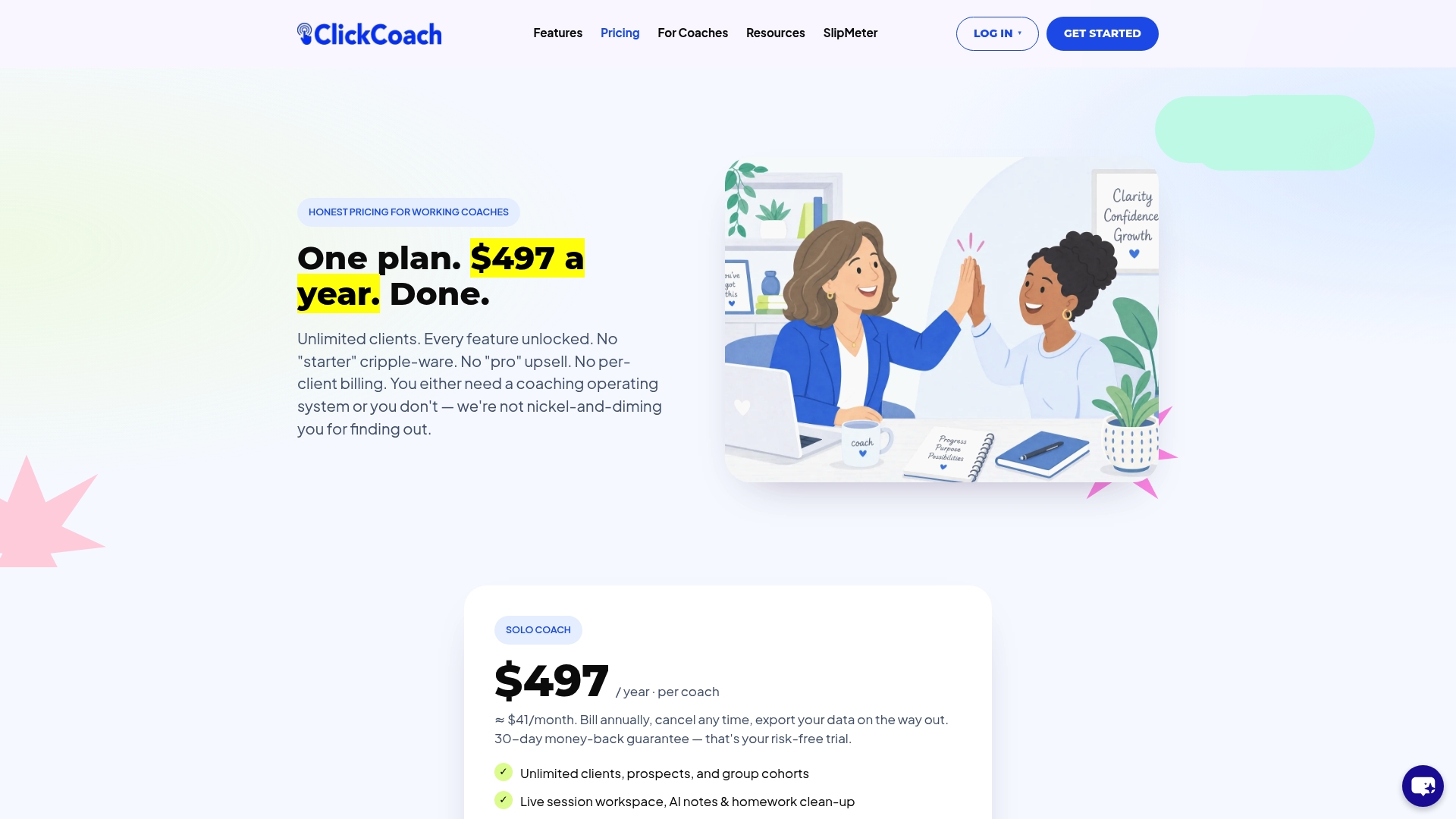
ClickCoach centralizes that work in one login instead of stitching together a scheduler, a separate email tool, and a spreadsheet for tracking client progress. Session confirmations and post-session follow-ups can trigger automatically off your actual session data, and homework delivered through a branded client portal keeps client-facing communication consistent without you rebuilding the same message every week. This is not a replacement for your email provider. It’s a layer that ties your templates to real session and progress data so nothing depends on memory.
If your practice is at the point where copy-paste templates and manual tracking are eating into coaching time, take a look at ClickCoach’s pricing, which runs $497 per year per coach for full platform access. For a broader view of what the platform handles beyond templates, the coaching business management overview walks through the rest.
Primary Sources for Legal and Email Best Practices
- FTC CAN-SPAM Compliance Guide: the legal baseline for every commercial coaching email.
- FTC blog on transactional vs. commercial email: clarifies a common compliance mistake.
- Litmus on email metrics: why open rates mislead coaches tracking growth.
- Mailchimp compliance guidance: practical list-hygiene habits.
- For broader context on email program value, see this email marketing guide.
Sources
- CAN-SPAM Act: A Compliance Guide for Business | Federal Trade Commission
- When sending commercial email, businesses can’t unsubscribe from CAN-SPAM compliance | FTC blog
- The email metrics marketers measure and the ones they should | Litmus
- About compliance for email marketing | Mailchimp
FAQ
How do I write a coaching email?
Start with the outcome you want: confirm a session, recap homework, or re-engage a lapsed client. State that outcome in the first sentence, reference something specific to that client (their goal or last action), and close with one clear next step.
What are the 5 C’s of coaching?
Definitions of the “5 C’s” vary across coaching frameworks, and no single version is universally standard. Rather than relying on an unverified acronym, focus your emails on what actually drives outcomes: clarity, consistency, and accountability between sessions.
What is the 70/30 rule in coaching?
The 70/30 rule isn’t a standardized, verifiable coaching metric, and claims about it vary widely by source. A more reliable focus for your emails is tracking conversion per email and list churn, which Litmus recommends instead of vanity metrics like open rate.
How should I properly email a coach or client?
Keep it specific and short: reference the exact goal or action discussed last, use a subject line that states the purpose plainly, and always include one clear ask or next step rather than several competing requests.
Does ClickCoach include email templates?
ClickCoach centralizes session data, client progress, and branded client portal delivery, which pairs naturally with the templates in this guide. Current plan details and pricing are listed on the ClickCoach pricing page.