

Create a viable paid coaching course by designing from the outcome back: define the measurable result your client will reach, decide how they will prove they reached it, and then build short, practice-focused modules that produce that proof. This is backward design applied to coaching, and it keeps your course focused on transformation rather than content volume. A platform can support the workflow once you have the structure figured out, but the structure comes first.
TL;DR:
- Coaches should design modules around specific, measurable client outcomes and align evidence collection to prove progress.
- Using a consistent module template of instruction, practice, evidence submission, and feedback ensures predictable progress tracking.
- Selecting delivery formats should match the need for live feedback, with weekly live sessions best for practice-heavy skills and self-paced modules needing built-in evidence.
- Implementing simple rubrics that assess clarity, evidence, reflection, and next steps keeps evaluations straightforward and actionable.
- An integrated coaching workflow platform can streamline administration, evidence tracking, client progress, and group session management.
Table of Contents
- Use backward design as your course blueprint
- A repeatable module template: instruction, practice, evidence, feedback
- Delivery formats and cohort mechanics that support practice
- Assessment and feedback loops that prove client progress
- Accessibility basics and FTC-aligned marketing
- Packaging, pricing, and a short pilot plan
- What I’ve seen work and what tends to fail
- Where ClickCoach fits in your course workflow
- Sources
- FAQ
Use backward design as your course blueprint
Backward design flips the usual course-building habit. Instead of listing what you know and turning it into lessons, you start with what the client will be able to do when the program ends. The University of Illinois Chicago’s teaching guide lays out three stages universities use for this exact reason: define desired results, determine acceptable evidence, then plan learning experiences that get clients there.
Applied to coaching, that looks like this:
- Stage 1, outcomes: write what the client can do after the program, not what they will “understand” or “learn about.”
- Stage 2, evidence: decide what artifact proves the outcome: a completed plan, a recorded practice session, an implementation log.
- Stage 3, experiences: design modules that directly produce that evidence, cutting anything that does not.
An outcome like “client can run a weekly team check-in without it turning into status theater” needs evidence: a script, a recording, and a debrief note. A vaguer goal like “client understands communication” produces no evidence at all, which is exactly the trap OSU’s course design resources warn against when objectives and assessments are not aligned.
A repeatable module template: instruction, practice, evidence, feedback
Once your outcomes and evidence are set, each module follows the same shape. This keeps cohorts predictable and keeps you from overloading sessions with material that never gets tested against real behavior.
- Prepare: send a short pre-read or framework, no more than clients can absorb in ten minutes.
- Teach one concept: deliver it live or recorded, focused on a single skill.
- Demonstrate: show the skill applied to a realistic scenario.
- Practice: have clients attempt it in session or between sessions.
- Submit evidence: a plan, a recording, or a log that shows the attempt.
- Give feedback: specific, tied to the rubric, delivered promptly.
- Revise: clients adjust and resubmit if the evidence falls short.
Weekly micro-assignments work well for cadence: a short reflection prompt, a one-page action plan, or a five-minute practice recording. Digital-learning research supports scaffolding modules this way, pairing micro-lectures with frequent low-stakes checks rather than one large assessment at the end.
Pro Tip: Require one concrete deliverable per module, even a rough one. A finished artifact beats a polished discussion every time.
Delivery formats and cohort mechanics that support practice
The format you choose should match how much live feedback your outcomes require. A course teaching negotiation scripts needs more live practice than one teaching a planning framework; choosing from the best webinar platforms can help you deliver those live cohort sessions effectively.
- Weekly live cohort: best when clients need real-time coaching on behavior, typically 60 to 90-minute sessions with 6 to 12 participants to keep practice time meaningful.
- Blended: short live sessions paired with async submissions, good for busy executive clients who need flexibility without losing accountability.
- Self-paced: works only when evidence collection is built in, otherwise completion rates drop.
Whatever the format, you need a way to collect submissions, track who completed what, and schedule group sessions without juggling separate tools. This is where an integrated group coaching workflow reduces the manual tracking that eats into coaching time.
Assessment and feedback loops that prove client progress

Formative assessment happens during the module: quick checks that reveal where a client is stuck before it becomes a bigger problem. Summative assessment happens at milestones: a full demonstration that the client can perform the outcome independently. Both matter, and skipping formative checks is the most common reason clients arrive at a final demonstration unprepared.
A simple rubric works better than a complicated one. Track these elements per deliverable:
- Clarity of plan: can someone else follow it without more explanation.
- Evidence of implementation: did the client actually do the thing, not just describe it.
- Client reflection: what did they notice about the effect.
- Coach-verified next step: what changes before the next attempt.
For program-level metrics, track completion rate per module, evidence submission rate, and any shift in a client’s self-rating on the target skill. These numbers matter at renewal time because they show change instead of asserting it. Assessment tools built into an accountability workflow can hold homework, reflections, and practice submissions in one place so nothing gets lost between sessions.
Accessibility basics and FTC-aligned marketing
Course materials need to work for clients using screen readers, captions, or keyboard navigation, and the baseline is not complicated. Section 508 guidance outlines the core practices:
- Captions and transcripts for any recorded video.
- Alt text for images and descriptive link text instead of “click here.”
- Keyboard-accessible controls and labeled forms.
- Manual testing alongside automated accessibility checkers.
A large majority of business-opportunity red flags the FTC tracks involve unsupported earnings or outcome claims, according to the FTC’s proposed rule changes to deter deceptive earnings claims. Your sales page should state prerequisites and typical effort honestly. “This program gives you a repeatable framework and weekly practice” holds up. “You will guarantee a raise within 90 days” does not, regardless of how confident you feel about your method.
Packaging, pricing, and a short pilot plan
Package modules around client time and support level, not around how much content you have produced. A tighter program with four modules and strong feedback loops often outperforms a bloated twelve-module course clients never finish.
- Bundle by outcome, not by topic count: three to six modules with clear deliverables usually fit a cohort’s attention span.
- Choose a pricing shape: cohort-based one-time pricing suits a defined start and end date, while subscription pricing suits ongoing group coaching with rotating cohorts.
- Pilot before scaling: run one small cohort, collect real evidence artifacts, and adjust pacing and rubrics before opening enrollment broadly, a practice digital-learning playbooks recommend for validating course design.
What I’ve seen work and what tends to fail
The biggest mistake I see is overloading modules with passive video content and skipping evidence collection entirely. Coaches who run a short pilot and require one real artifact per module consistently get better renewal conversations. Measure what clients actually produce, then adjust.
— Mitch Russo
Where ClickCoach fits in your course workflow
Once your backward-design structure is set, the daily administration is what eats your time: collecting submissions, tracking who completed what, drafting follow-up homework, and running group sessions without losing track of individual progress. Some platforms bring those pieces into one workspace built for coaches, not course platforms borrowed from other industries.
Specifically, it supports parts of this playbook that tend to become administrative drag:
- Centralized client records and session notes so evidence from each module stays attached to the right client.
- Assisted drafting of homework and follow-up actions, with review before anything goes out.
- Client portals where clients submit deliverables and track their own progress.
- Group coaching tools for scheduling and managing cohort sessions alongside individual work.
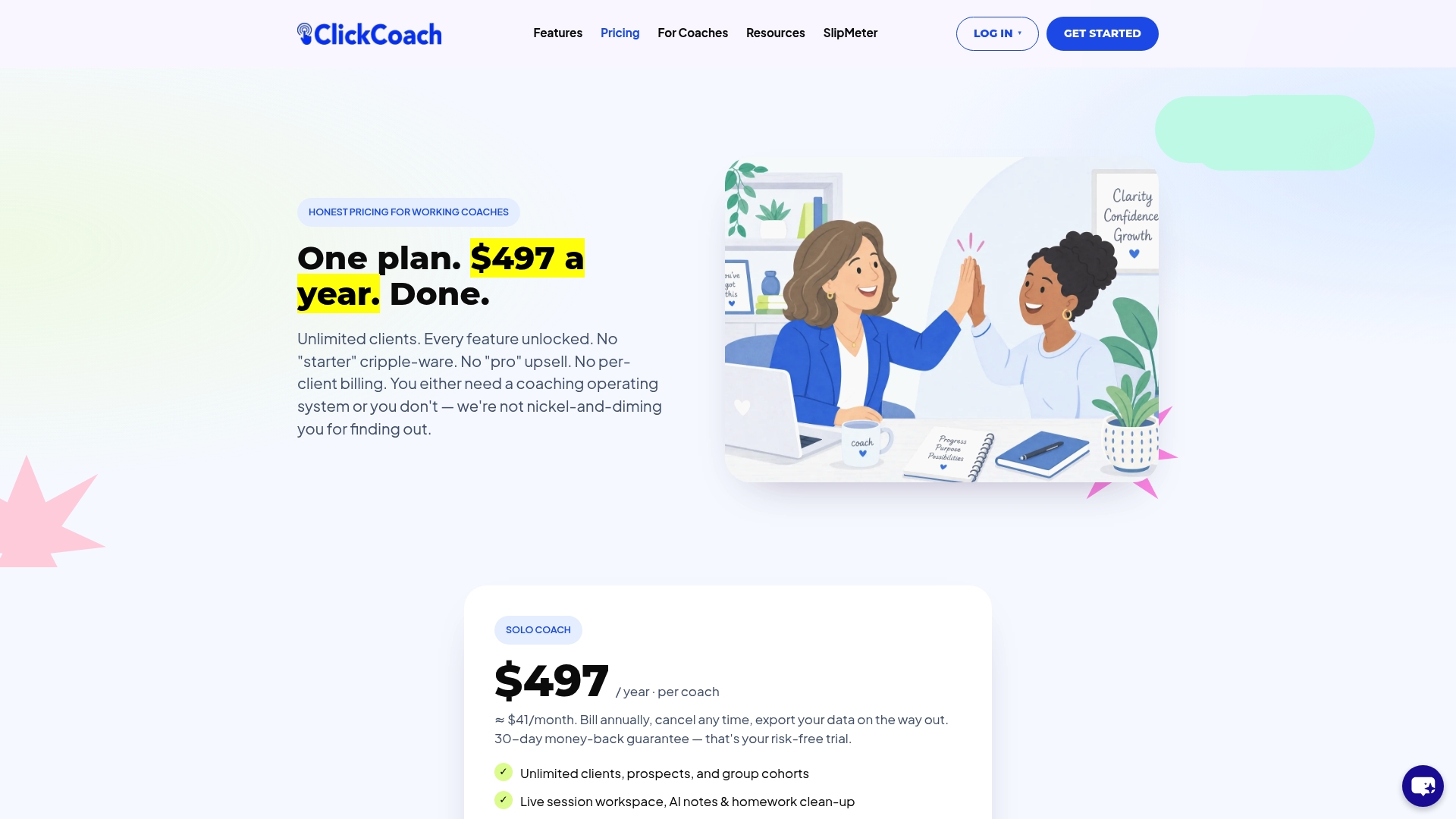
If you are evaluating whether an all-in-one platform fits your practice, the pricing page lists the Solo coach and Multi-coach company plans at $497 USD per year per coach, along with the Partner and white-label option for firms that need it.
Sources
- Backward Design | Center for the Advancement of Teaching Excellence | University of Illinois Chicago
- Using backward design to plan your course | OSU Teaching Resources
- Section 508: Guide to accessible web design and development
- FTC press release on proposed rule changes to deter deceptive earnings claims
- Optimizing high-quality digital learning experiences: a playbook for faculty
FAQ
What is backward design in coaching course creation?
Backward design means starting with the measurable result a client will achieve, then deciding what evidence proves it, and only then building the modules and activities. This sequence, outlined by university course-design guidance, prevents courses from becoming a pile of content with no clear proof of client change.
How many modules should a paid coaching course have?
There is no fixed number, but three to six modules built around one clear outcome each tend to hold client attention better than long, content-heavy programs. Pair each module with a deliverable so you can track completion and implementation rather than just attendance.
What counts as acceptable evidence of client progress?
Acceptable evidence is something concrete a client produces: a written action plan, a recorded practice attempt, or an implementation log showing what they tried and what happened. A simple rubric covering plan clarity, implementation evidence, client reflection, and a coach-verified next step keeps this consistent across a cohort.
What accessibility steps matter most for coaching course materials?
At minimum, add captions and transcripts to recorded video, alt text to images, and make sure controls and forms work with a keyboard. These practices come from Section 508 guidance and cover most of what a coaching course needs without requiring specialized tools.
Can ClickCoach replace my course platform entirely?
ClickCoach is coaching practice management software, not a dedicated course authoring or hosting platform, so it works alongside however you deliver content rather than replacing it. It centralizes client records, homework, progress tracking, and group coaching workflows, which covers the administrative side of running a cohort once your curriculum is built.