

Start with the outcomes: define the transformation you want clients to achieve, then design the assessments that prove it happened. This is backward design, and it reverses the usual habit of stacking content first and hoping the results follow. Before you write a single session, draft three things: your learning outcomes, the evidence that would convince you a client mastered them, and a rough module map. Everything else in your curriculum, from activities to homework to delivery format, gets built to serve those three artifacts.
TL;DR:
- Effective curriculum design begins with defining clear outcomes and assessments before developing content to ensure skill mastery proof.
- Sequencing modules from simple to complex, with repeated practice and balanced delivery, builds learner confidence and prevents gaps in skill development.
- Using layered assessment tools like rubrics, portfolios, and observed practice ensures consistent, objective evaluation of coaching competence.
- Piloting with a small group and measuring against a logic model helps identify and fix weak modules before scaling to larger cohorts.
- A dedicated management platform streamlines administration, tracks progress, and integrates assessment data, supporting curriculum implementation and scaling.
Table of Contents
- A step-by-step blueprint for building your curriculum
- Defining aims, learner profiles, and measurable outcomes
- Designing assessments and rubrics that prove mastery
- Structuring modules and sessions so mastery builds
- The learning activities that actually build coaching skill
- Templates and delivery tech that keep the program running smoothly
- Building a logic model to test and improve the curriculum
- A copyable 8-week coaching curriculum template
- What working coaches consistently get wrong
- How ClickCoach fits into curriculum delivery
- Sources
- FAQ
A step-by-step blueprint for building your curriculum
Building a curriculum is a sequence, not a brainstorm. Follow this order and you will avoid the most common trap: designing beautiful content that never gets tested against a real result.
- Identify the transformation and the learner. Name the specific change your program produces and describe who it is for, including their starting skill level and constraints.
- Define assessments and success criteria. Decide what evidence would prove mastery before you plan a single lesson.
- Map modules and sequence learning. Break the transformation into ordered skill blocks that build on each other.
- Design activities and feedback cycles. Choose practice formats and decide how and when clients get feedback.
- Produce materials and a delivery plan. Build templates, choose your tech, and decide on cohort, self-paced, or hybrid delivery.
- Pilot, evaluate, and iterate. Run a small version, collect data against your outcomes, and revise before a full launch.
This order matters because each step constrains the next. If you skip straight to modules, you end up with content sequencing decisions made on instinct instead of evidence. The University of Iowa’s teaching center frames this as designing intentionally: goals, assessments, and activities have to align, and that alignment only happens when goals come first.
Treat this list as a project plan, not a philosophy. Give yourself a deadline for each step, and resist the urge to perfect module five before you have tested whether module one produces the skill it promises.
Defining aims, learner profiles, and measurable outcomes
Program aims and learning outcomes are not the same thing, and confusing them is where most curricula go soft. An aim is directional: “help new managers coach their teams instead of directing them.” A learning outcome is specific and checkable: “by week 4, the learner conducts a 15-minute coaching conversation that includes at least three open questions and one summarized commitment.” Aims inspire. Outcomes get assessed.
Before you write outcomes, sketch a learner persona. Note their current skill level, time available per week, and the situational factors that will shape how much you can realistically teach: a curriculum for full-time HR directors with 30 minutes a week looks different from one for coaches in a 10-week certification cohort. The Iowa teaching center describes this as accounting for situational factors, an addition to backward design that keeps your goals honest about context.
Once you know the learner, write outcomes using Bloom’s taxonomy as your vocabulary. Bloom’s gives you active verbs tied to cognitive levels, so instead of “understand active listening” you write “demonstrate active listening” or “critique a recorded coaching session for missed opportunities.” Higher verbs like analyze, evaluate, and create signal that a learner needs practice and feedback, not just reading.
- Use verbs like “demonstrate,” “apply,” or “design” instead of “understand” or “know.”
- Attach a condition and a standard to each outcome, such as “within a 20-minute session” or “using the GROW framework.”
- Write no more than three to five outcomes per module so assessment stays manageable.
- Check each outcome against your learner persona: is it realistic for their time and skill level?
Coach-education curricula that visibly align with recognized competency frameworks give learners and credentialing bodies a clear way to evaluate rigor. That alignment matters if you plan to position your program for coaches pursuing or maintaining a credential. Map two or three of your core outcomes directly to ICF coach-education competencies, such as demonstrating ethical practice or establishing a coaching agreement, and note the mapping in your program materials. It costs you an afternoon of work and saves a prospective learner from guessing whether your program will count toward anything they care about.
Designing assessments and rubrics that prove mastery
An outcome without an assessment is a hope. Once you know what a learner should be able to do, decide exactly what evidence will convince you they can do it. Four assessment types cover most coaching curricula, often layered together rather than used alone.
- Observed practice: a live or recorded coaching session evaluated against a rubric.
- Client outcome measures: progress data from the learner’s own coaching clients, such as goal completion rates or session notes.
- Portfolios: a collection of session recordings, reflections, and written coaching plans gathered over the program.
- Reflective logs: short written entries after each practice session that show the learner’s developing self-awareness.
Rubrics turn subjective judgment into something you can apply consistently. Build one by listing the behaviors tied to each outcome, then defining three or four performance levels for each. A rubric for a coaching conversation outcome might score presence, question quality, goal focus, and ethical conduct, each on a scale from “not yet demonstrated” to “consistently demonstrated.” Coach-educator guidance on program design consistently points to rubrics, practica, and portfolios as the standard tools for assessing coaching competence, precisely because a single graded conversation rarely tells the whole story.
If you are running a cohort or certification-style program, decide your pass or fail rules before launch, not while grading the first practicum. A workable structure: require an observed session scored against your rubric, a reflective portfolio of at least three entries, and a minimum score threshold on each rubric category rather than an average, so a learner cannot pass on one strong category while failing ethics. Practicum design that pairs a timed observed session with a short rubric and a reflective portfolio gives you two independent views of the same competency, which catches learners who perform well under observation but struggle to reflect on their own practice, and vice versa.
Report progress back to learners in the same terms you used to define outcomes. A scorecard that says “goal focus: developing” means more to a learner than a percentage grade, because it points directly at what to practice next.
Structuring modules and sessions so mastery builds
Sequencing decisions either build momentum or quietly sabotage it. Three principles keep a curriculum coherent: order skills from simple to complex, space repeated practice across sessions rather than clustering it, and distribute practice time evenly instead of front-loading theory and back-loading application.
Module length depends on your outcomes, not on convention. A micro-module of one to two weeks suits a single narrow skill, such as asking better opening questions. A standard 4 to 12 week module fits a cluster of related skills that build toward a visible capability, like running a full coaching conversation start to finish. A multi-month program suits certification-style curricula where learners need repeated cycles of practice, feedback, and revision before a summative assessment. Shorter modules keep learners engaged and give you faster iteration cycles; longer ones support deeper skill integration but risk losing learners who need earlier wins.
Each session plan should follow the same anatomy so facilitators and learners always know what to expect:
- Objective: the single outcome this session moves toward.
- Activity: the practice format that builds it, not a lecture about it.
- Assessment: a quick check, even informal, that the objective landed.
- Homework: a task that extends practice before the next session.
Delivery format is a sequencing decision too. Cohort programs work well when peer feedback and shared accountability matter to the skill, such as group coaching practice. Self-paced formats suit learners who need flexibility and where skills can be practiced solo, like reflective journaling or framework study. Hybrid models, self-paced content paired with live practice sessions, often give you the best of both: learners absorb material on their own time and spend live sessions on the practice that actually builds skill.
The learning activities that actually build coaching skill
Lectures teach coaches what a good question looks like. They do not teach coaches to ask one under pressure. Higher-order outcomes like analysis, evaluation, and creation require interactive practice, not passive content consumption, and coaching skill sits almost entirely in that higher-order territory. If your curriculum is heavy on video lessons and light on practice time, you are training people to recognize good coaching rather than to do it.
Match activities to the outcome level you are targeting:
- Role plays and triads: for practicing full coaching conversations with rotating observer feedback.
- Micro-coaching drills: short, repeated bursts focused on one skill, like reframing a limiting belief in under five minutes.
- Recorded self-review: learners watch their own session and score themselves against the rubric before anyone else weighs in.
- Peer assessment: learners apply the same rubric to a peer’s recording, which sharpens their own diagnostic eye.
Feedback design matters as much as activity design. Immediate coach feedback right after a practice round corrects habits before they set. Recorded reviews let learners catch what they missed in the moment and build self-assessment skill. Peer assessment, used carefully, teaches the rubric from the inside, since scoring someone else’s session forces a learner to internalize the standard.
Scaffold the progression deliberately: guided practice with a script or prompt list early on, then semi-guided practice with a general structure but no script, then fully independent application with a real or simulated client and no support. Moving too fast from guided to independent practice is the single most common reason learners freeze in their first unsupervised session.
Pro Tip: Record every practice session, even informal ones. A learner’s own recorded voice, replayed a week later, teaches self-awareness faster than any feedback you can give them.
Templates and delivery tech that keep the program running smoothly
A curriculum lives or dies on the materials behind it. Before launch, build four templates you will reuse constantly: a session plan template with the objective-activity-assessment-homework structure, a rubric template tied to your outcomes, a learner contract that sets expectations and commitments, and a homework template that standardizes how you assign and collect practice work.
Delivery technology needs to cover a short list of jobs reliably:
- Video hosting for lessons or recorded practice sessions.
- Assignment submission so homework and reflections land somewhere trackable.
- Discussion space for cohort programs where peer interaction matters.
- Progress tracking so both coach and learner can see mastery developing over time.
- Branded client portals so the experience feels like your program, not a patchwork of unrelated tools.
Package your materials differently depending on format. A cohort kit bundles session plans, group discussion prompts, and shared rubrics for a live facilitator to run week by week. Self-paced modules need more explicit written instructions, since there is no live facilitator to fill gaps, plus built-in checkpoints that prompt the learner to submit evidence before moving forward.
Facilitator and admin checklists protect consistency once you are running more than one cohort or working with co-facilitators. A simple pre-session checklist, materials sent, rubric ready, homework from last week reviewed, keeps quality steady even when you are tired or delegating delivery to someone else. This is also where a lot of admin time quietly leaks: chasing homework submissions, updating spreadsheets, and re-sending materials by hand. Tools built for accountability tracking exist specifically to take that friction off a coach’s plate.
Building a logic model to test and improve the curriculum
A curriculum you never measure is a guess you keep repeating. The CDC’s program evaluation framework recommends a one-page logic model as a core tool for describing and testing a program: inputs (your time, materials, facilitators), activities (sessions, practice, feedback), outputs (sessions delivered, learners who complete modules), and outcomes (skills demonstrated, client results). Laying these out on one page forces you to see whether your activities actually connect to the outcomes you claimed at the start.
- Draft your logic model. List inputs, activities, outputs, and short, intermediate, and long-term outcomes in four columns.
- Write evaluation questions. Ask directly: did learners meet the module 3 rubric threshold? Did their real coaching clients report progress?
- Choose indicators. Pick a small number of measurable signals, such as percentage of learners passing the practicum on the first attempt or average rubric score by category.
- Collect pilot data. Run a small cohort and gather rubric scores, completion rates, and reflective log themes.
- Interpret and refine. Look for modules where scores lag consistently. That is your signal to redesign the activity, not the assessment.
Design outcomes and acceptable evidence before writing lessons, since this keeps the whole program anchored to a result rather than a stack of content. That discipline pays off most clearly during a pilot, when it is tempting to blame low scores on the learners rather than a module that never actually taught the skill it assumed.
Run a short pilot, measure against your indicators, and refine before a full launch. A five to eight person pilot cohort is usually enough to expose the two or three modules that need rework, and it is far cheaper to fix a curriculum before fifty people have gone through it than after. Progress tracking tools that visualize rubric scores and completion over time make this evaluation step considerably less manual than exporting spreadsheets after every pilot round.

A copyable 8-week coaching curriculum template
Here is a week-by-week skeleton you can adapt to almost any coaching niche. Each week follows the objective, activity, assessment, homework structure from earlier, with formative checks early and a summative assessment at the end.
- Week 1: Objective: establish the coaching agreement. Activity: role play setting session goals. Assessment: peer checklist review. Homework: draft a personal coaching agreement template.
- Week 2: Objective: ask open, non-leading questions. Activity: micro-coaching drills in triads. Assessment: self-review of a recorded drill. Homework: log five questions asked in a real conversation.
- Week 3: Objective: active listening and reflection. Activity: paired listening exercises with no advice-giving allowed. Assessment: peer feedback using the listening rubric. Homework: reflective log on a personal listening habit.
- Week 4: Objective: full coaching conversation, guided. Activity: 15-minute role play with a prompt sheet. Assessment: formative rubric score from the facilitator. Homework: watch back the recording and self-score.
- Week 5: Objective: goal-setting frameworks (GROW or similar). Activity: apply the framework to a peer’s real goal. Assessment: framework checklist. Homework: apply the framework with an actual client or volunteer.
- Week 6: Objective: handling resistance and difficult moments. Activity: role play with a deliberately resistant “client.” Assessment: peer-observed rubric. Homework: reflective log on a resistance moment.
- Week 7: Objective: full conversation, semi-independent. Activity: 20-minute session with no script, observer present. Assessment: formative rubric, focus on ethics and presence. Homework: compile portfolio entries so far.
- Week 8: Objective: demonstrate mastery. Activity: full independent coaching session, recorded. Assessment: summative rubric plus portfolio review. Homework: final reflective summary of growth across the program.
Place formative checks in weeks 2, 4, and 6, and reserve the summative assessment for week 8, so learners get three checkpoints before the moment that counts most. For a 4-week version, compress into agreement and questions, listening and goals, full conversation, and independent demonstration. For a multi-month certification track, repeat weeks 4 through 7 as a full second cycle before the final summative assessment, giving learners two full passes through guided-to-independent practice instead of one.
What working coaches consistently get wrong
The mistake I see most often is building content before deciding what proof of learning looks like. Coaches spend weeks polishing slide decks, then scramble to invent an assessment two days before a cohort starts. Flip that order and the whole program gets easier to build, not harder.
The second mistake is over-scoping the first version. Your minimum viable pilot needs only three things: one clear outcome, one rubric, and five to eight real learners. Skip the polished workbook and branded video intro until you know the curriculum actually produces the skill.
Between sessions, learners disengage when homework feels disconnected from what happens next. Tie every homework task directly to the following week’s activity, and learners show up already primed instead of starting cold.
— Mitch Russo
How ClickCoach fits into curriculum delivery
Building the curriculum is half the job. Running it week after week without losing track of homework, session notes, and client progress is the other half, and it is where most coaches quietly bleed time. ClickCoach brings client records, session notes, goals, homework, and progress tracking into one workspace, so the rubric scores and reflective logs from your curriculum live in the same place as your billing and client portal.
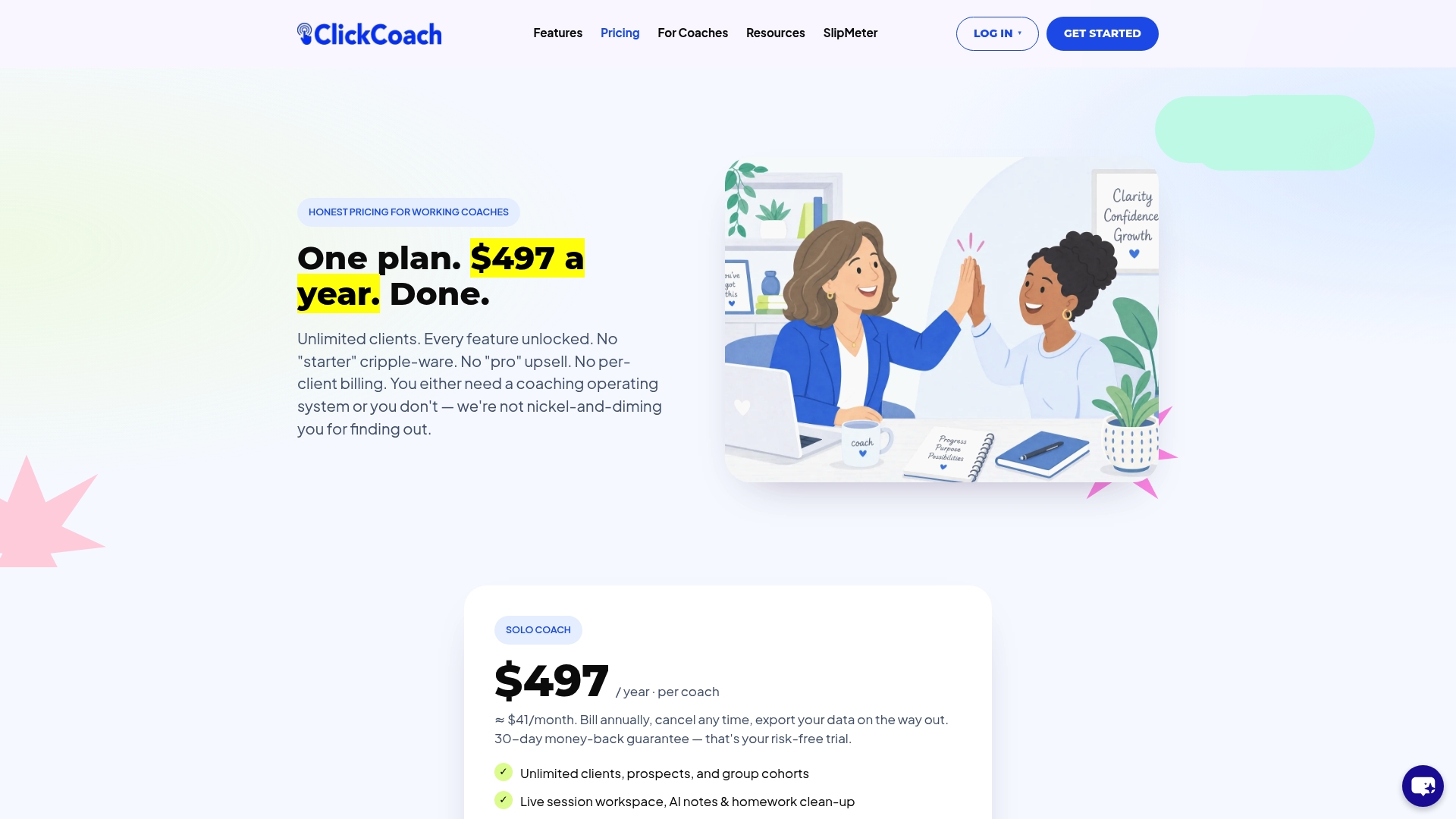
For a curriculum built on backward design, that matters practically: your outcomes and assessments only prove anything if you can actually see the data across a cohort instead of digging through separate note apps, spreadsheets, and email threads. Branded client portals give learners one place to submit homework and see their own progress charts, which reduces the back-and-forth that eats into a coach’s week. AI-assisted homework drafting speeds up the admin around each session while you stay in control of the actual coaching. If you are scaling a curriculum across a cohort or a multi-coach practice, the Solo coach and Multi-coach company plans are priced at $497 per year per coach, with details on the full pricing page.
Sources
The frameworks in this article draw on established, publicly available guidance rather than coaching folklore. For backward design, MIT’s Teaching + Learning Lab and the University of Iowa’s teaching center offer clear primers. For program evaluation and logic models, the CDC’s evaluation framework is the standard reference. For coaching-specific competency alignment, review the ICF coach education competencies directly. For measurable objectives, Vanderbilt’s Bloom’s taxonomy guide is a practical starting point, and this guide to setting team goals offers useful complementary thinking on alignment.
- Where to Start: Backward Design – Teaching + Learning Lab (MIT)
- Step 2 – Describe the Program | Program Evaluation | CDC
- Designing intentional courses through backward design | The University of Iowa
- ICF coach education competencies (2025)
FAQ
What are the 5 C’s of coaching?
Definitions vary across programs and no single authoritative source fixes the “5 C’s” universally, so treat any list you find as one program’s framework rather than an industry standard. If you want a defensible structure, build your own around outcomes: define, for example, clarity, commitment, capability, and checkpoints and name them explicitly in your curriculum documentation.
What is the 70/30 rule in coaching?
There is no fixed, universally cited rule tied to a primary coaching source, so avoid presenting any specific ratio as an established standard. What the evidence does support is that higher-order coaching skills require far more active practice than passive instruction, which is the principle behind any activity-heavy ratio you build into your curriculum.
What are the 7 P’s of coaching?
As with the 5 C’s, there is no single authoritative definition of “the 7 P’s” that a primary coaching body has established, so different programs use the term differently. If a client or student asks about it, clarify which program’s framework they mean rather than assuming a shared definition.
How can I create my own coaching program?
Start with backward design: define the transformation you want learners to achieve, decide what evidence would prove they achieved it, then build modules, activities, and assessments to match. Pilot the program with a small group first, measure against a simple logic model, and refine before a full launch.
Does ClickCoach help with curriculum delivery specifically?
ClickCoach is a coaching practice management platform, not a curriculum design tool or certification provider, so it does not build your outcomes or rubrics for you. It does support delivery by centralizing session notes, homework, progress tracking, and branded client portals once your curriculum is built.