

The fastest way for health and wellness coaches to improve client outcomes and cut administrative work is to adopt an all-in-one coaching practice management platform that centralizes client records, session notes, homework, progress tracking, billing, and a branded client portal in one place. We built ClickCoach to meet exactly that need. The sections below walk through how to evaluate options, what to check for compliance, and how to migrate without losing momentum.
TL;DR:
- During demos, require vendors to show your three biggest workflows live, provide a real progress report, and confirm export formats and record ownership after cancellation.
- If you handle protected health information for a covered entity, obtain a signed Business Associate Agreement; a vendor’s HIPAA claim alone does not establish compliance.
- Model your busiest month before choosing per client pricing, include messaging, video, storage, and processing fees, and compare annual costs with time saved.
- Run migration with a small client group, and wait until one full billing cycle passes without errors before moving everyone.
Table of Contents
- How to Choose Wellness Coaching Software: a One-Page Framework
- Feature Checklist: What Wellness Coaches Actually Need
- Privacy and Compliance Essentials: HIPAA, FTC, and BAAs
- Integrations and Real Workflows to Test During Demos
- Pricing Models and ROI Checklist Before You Buy
- Step-by-Step Migration and Rollout Checklist
- User Interface and Ease of Use Across Coaching Specialties
- Customization Options for Coaching Workflows and Client Engagement
- Customer Support and Training Resources to Expect
- Multi-Coach and Team Collaboration Features
- What Matters Most When You Actually Run a Coaching Practice
- ClickCoach: a Direct Path to Less Admin and Better Outcomes
- FAQ
- Sources
How to Choose Wellness Coaching Software: a One-Page Framework
Picking the right platform comes down to three things: does it improve measurable client outcomes, does it save you real administrative hours, and will your clients actually use it? Features matter less than adoption. A tool with a beautiful dashboard that clients ignore does nothing for retention.
Before any demo, score vendors against a short checklist:
- Progress tracking depth: can you chart outcomes over time, not just log a single session note?
- Templates and program reuse: can you build a program once and reuse it across clients?
- Client portal quality: will your clients log in more than once?
- Billing flexibility: does it support payment plans, subscriptions, and refunds without a separate invoicing tool?
- Security and BAA availability: will the vendor sign a Business Associate Agreement if you handle health information?
- Integrations: does it connect to your calendar, payment processor, and any wearable or health data your clients use?
- Reporting: can you export client progress for renewal conversations?
Run each demo through a simple rubric. Give every feature one of three labels: must-have, nice-to-have, or deal-breaker. A platform that fails a must-have should be out of the running regardless of price.
- List your three biggest administrative pain points before the demo starts.
- Ask the vendor to show those three workflows live, not in a slide deck.
- Request a sample client report or progress chart, not a mockup.
- Confirm data export format and whether you keep ownership of client records after cancellation.
- Ask directly whether they will sign a BAA, what their data retention policy is, and whether an API is available.
Most coaches can score a vendor quickly if they stick to this structure instead of letting the sales rep set the agenda.
Feature Checklist: What Wellness Coaches Actually Need
Not every “all-in-one” platform is actually all-in-one once you dig into the demo. Here is what to verify feature by feature.
- Client records and session notes: look for structured templates, searchable fields, and export options, not a single free-text box.
- Outcome-tracking charts: progress should be visual and tied to specific goals, not buried in a notes feed.
- Reusable programs and homework: you should be able to build a template once and assign it to new clients in minutes, with AI-assisted drafting for homework and follow-ups speeding up prep while you keep final control over what goes out.
- Scheduling and reminders: calendar sync and automated reminders cut the back-and-forth that eats up a coaching day.
- Group and cohort management: if you run group programs, check that scheduling and communication tools scale beyond one-to-one sessions.
- Billing and subscriptions: payment plans, recurring billing, refunds, and bookkeeping exports should live inside the platform, not in a separate invoicing app.
- Client portal and secure messaging: a branded client portal that clients log into regularly is worth more than a feature list that never gets used.
- Telehealth and mobile access: confirm whether video sessions and mobile client access are native or bolted on through a third party.
- Integrations and APIs: calendar, payment processor, wearable data, and course or LMS connections determine how much manual re-entry you avoid.
- Onboarding and admin tools: bulk client import, coach templates, and a clear admin dashboard save hours during a busy intake month.
Pro Tip: During a demo, ask the vendor to build a sample program from scratch in front of you. If it takes more than a few minutes, your clients will feel that friction too.
Privacy and Compliance Essentials: HIPAA, FTC, and BAAs
Compliance is where a lot of wellness coaching software claims fall apart under scrutiny. Wellness apps that are not covered entities under HIPAA are not automatically exempt from federal oversight. The Federal Trade Commission requires reasonable privacy and security practices for software handling sensitive health information, and its Health Breach Notification Rule requires notifying consumers and the FTC after a breach of unsecured health data, even outside HIPAA’s scope.
If you or your software vendor create, receive, or transmit Protected Health Information on behalf of a covered entity, a signed Business Associate Agreement is not optional. HHS guidance on business associates makes clear that only the HHS Office for Civil Rights can determine HIPAA compliance, and a vendor’s marketing claim of being “HIPAA-compliant” means nothing without a signed BAA on file. Under the HITECH Act, business associates can carry direct liability for certain HIPAA requirements, which means the responsibility does not stop with the software vendor.
A signed Business Associate Agreement, not a vendor’s HIPAA claim, is the document that actually protects you according to HHS guidance on business associates, since only OCR can determine HIPAA compliance.
Before signing with any platform, request:
- A current security whitepaper or SOC 2 report.
- A BAA template you can review before committing.
- A data-flow diagram showing where client information is stored and processed.
- Disclosure of any tracking technologies or pixels used on client-facing pages.
Keep copies of every signed BAA and security document in a compliance folder. If OCR or the FTC ever asks, you want those answers ready, not reconstructed.
Integrations and Real Workflows to Test During Demos
The integrations that matter most for wellness coaches are calendar sync, payment processors, telehealth or video, wearable and health-data sync, and course or LMS connections for drip content. Test them with real workflows, not a features list.
- Workflow A, one-on-one coaching: intake form, session notes, homework assignment, automated reminder, progress chart update, and billing, all in one pass.
- Workflow B, group program: cohort onboarding, automated drip content release, group session scheduling, subscription billing, and aggregate analytics across the cohort.
During the demo, run an import and export test with a handful of real (anonymized) client records to confirm formatting holds. Trigger an automation, like a session reminder, and watch whether it fires correctly. Ask what happens to scheduled automations during a connectivity outage, and get a straight answer on data retention after cancellation.
Pro Tip: Never evaluate a workflow in isolation. Watch what happens when a client reschedules mid-sequence. That’s where most “automated” platforms actually break.
Pricing Models and ROI Checklist Before You Buy
Wellness coaching software is typically priced per coach seat, per client, as a flat tier regardless of client count, or as freemium with paid add-ons. Per-coach pricing tends to favor solo practices and small teams where client count fluctuates. Per-client pricing can get expensive fast once your roster grows, so model your busiest month before committing.
Watch for hidden costs that do not show up on the pricing page:
- Message or messaging-volume limits that force an upgrade mid-year.
- Telehealth or video add-ons billed separately from the core subscription.
- Per-client storage fees once you pass a certain roster size.
- Payment processor fees layered on top of the subscription itself.
A simple break-even calculation works well here: add the hours saved per month multiplied by your billable rate to any reduction in client churn from a better experience, then compare that total against the annual subscription cost. If the math does not clear within the first renewal cycle, keep shopping.
Before signing, confirm billing cadence, refund policy, and whether you can export all client data on termination. A platform that locks your records in on exit is not a partner, it is a liability.
Step-by-Step Migration and Rollout Checklist
Switching platforms does not have to disrupt active client work if you sequence it correctly.
- Inventory everything first: client records, active automations, program content, and current billing cycles.
- Map your notes, progress metrics, and client histories to the new platform’s fields before importing anything in bulk.
- Run a pilot with a small cohort of clients to confirm automations and reports behave as expected.
- Only move to full cutover once the pilot clears a full billing cycle without errors.
After launch:
- Send a short client announcement explaining what changes for them, if anything.
- Walk every staff member through the new system before they touch a live client record.
- Track success over time: admin hours saved, client portal logins, and on-time payments.
User Interface and Ease of Use Across Coaching Specialties
A life coach, an executive coach, and a wellness coach do not need the same screen layout, but they do need the same thing from an interface: nothing that slows down a session. Wellness coaches in particular often work with recurring assessments and progress charts, so an interface that buries those behind extra clicks will cost you time every single week.
Look for a platform that lets you customize which fields show up for your specialty rather than forcing a generic client record on every practice type. A business coach may need a goals and KPI view front and center, while a wellness coach needs recurring health metrics and homework completion visible at a glance.
Test the interface the way your clients will actually experience it, not just from your coach dashboard. If a client has to hunt for their homework or their next session time, the interface has already failed, regardless of how clean your side looks. Mobile responsiveness matters here too, since most clients will check in from a phone between sessions, not from a desktop.
The sign of a workable interface is straightforward: you stop thinking about the software and start thinking about the client in front of you.
Customization Options for Coaching Workflows and Client Engagement
Every coaching practice develops its own rhythm, and software that forces a rigid structure on you will eventually get abandoned in favor of a spreadsheet. Look for the ability to build custom intake forms, assessment templates, and homework sequences that match your actual method, not a generic template that approximates it.
Client engagement customization matters just as much. Branded portals, custom email cadences, and the ability to adjust how often clients receive check-ins or reminders all affect whether clients actually open the app between sessions. A coaching business management platform that lets you adjust these touchpoints by client or by program gives you more control than a one-size-fits-all notification schedule.
For group and cohort programs, customization extends to how content drips out over time and how group members interact with shared resources. A group coaching workflow that lets you stagger content release by week, rather than dumping an entire curriculum on day one, tends to keep engagement higher through a full program cycle.
The goal is not maximum customization for its own sake. It is enough flexibility that the software adapts to your method instead of the other way around.

Customer Support and Training Resources to Expect
Support quality becomes obvious the first time something breaks mid-session. Before buying, ask what support channels are available, what the typical response time looks like, and whether support is included in the subscription or sold as an add-on.
Training resources matter just as much as live support, especially during onboarding. Look for a knowledge base you can search without opening a ticket, short video walkthroughs for common tasks, and a clear path to reach a real person when a client-facing issue needs immediate attention. Coaches switching platforms mid-practice do not have time to wait days for an answer to a billing question a client is asking about right now.
Ask vendors directly whether support is staffed by people who understand coaching workflows specifically, versus a general software help desk. The difference shows up fast when you ask a question about session note templates or client progress reporting and get a blank response.
Multi-Coach and Team Collaboration Features
Solo practices and multi-coach firms need different things from the same software. If you run or plan to grow a team, confirm the platform supports role-based permissions, so associate coaches see only their own client rosters while administrators retain oversight across the practice.
Look for shared program libraries that let a lead coach build a template once and roll it out across every coach on the team, rather than each coach rebuilding the same homework sequence from scratch. Centralized billing and reporting also matter here: a practice owner should be able to pull revenue and client progress data across the whole team without logging into each coach’s individual account separately.

Team collaboration features can become a dealbreaker as a practice grows, since the administrative overhead of disconnected systems multiplies with every additional team member.
What Matters Most When You Actually Run a Coaching Practice
After years of building and advising coaching businesses, I’ve learned that reliability beats feature count every time. A platform with more features than a competitor is worthless if it goes down during a client’s scheduled session or if the client portal is confusing enough that nobody logs in.
Consolidating client records, notes, and billing into one system cuts real administrative hours and makes renewal conversations easier because the progress is already charted and visible.
Pro Tip: Before you commit to any platform, test the client onboarding flow yourself on an actual phone, not just your laptop. That’s where most client adoption problems start.
— Mitch Russo
ClickCoach: a Direct Path to Less Admin and Better Outcomes
Everything covered above, client records, branded portals, progress charts, flexible billing, and AI-assisted homework drafting, maps directly to what we built ClickCoach to do. We designed it as a single workspace for professional and wellness coaches who want to stop juggling separate tools for notes, billing, and client communication.
Inside ClickCoach, you get:
- Client records and session notes alongside recurring progress tracking in one view.
- A branded client portal clients actually log into between sessions.
- Integrated billing and subscription management without a separate invoicing app.
- AI-assisted drafting for homework and follow-up actions, with you reviewing and approving every item before it goes out.
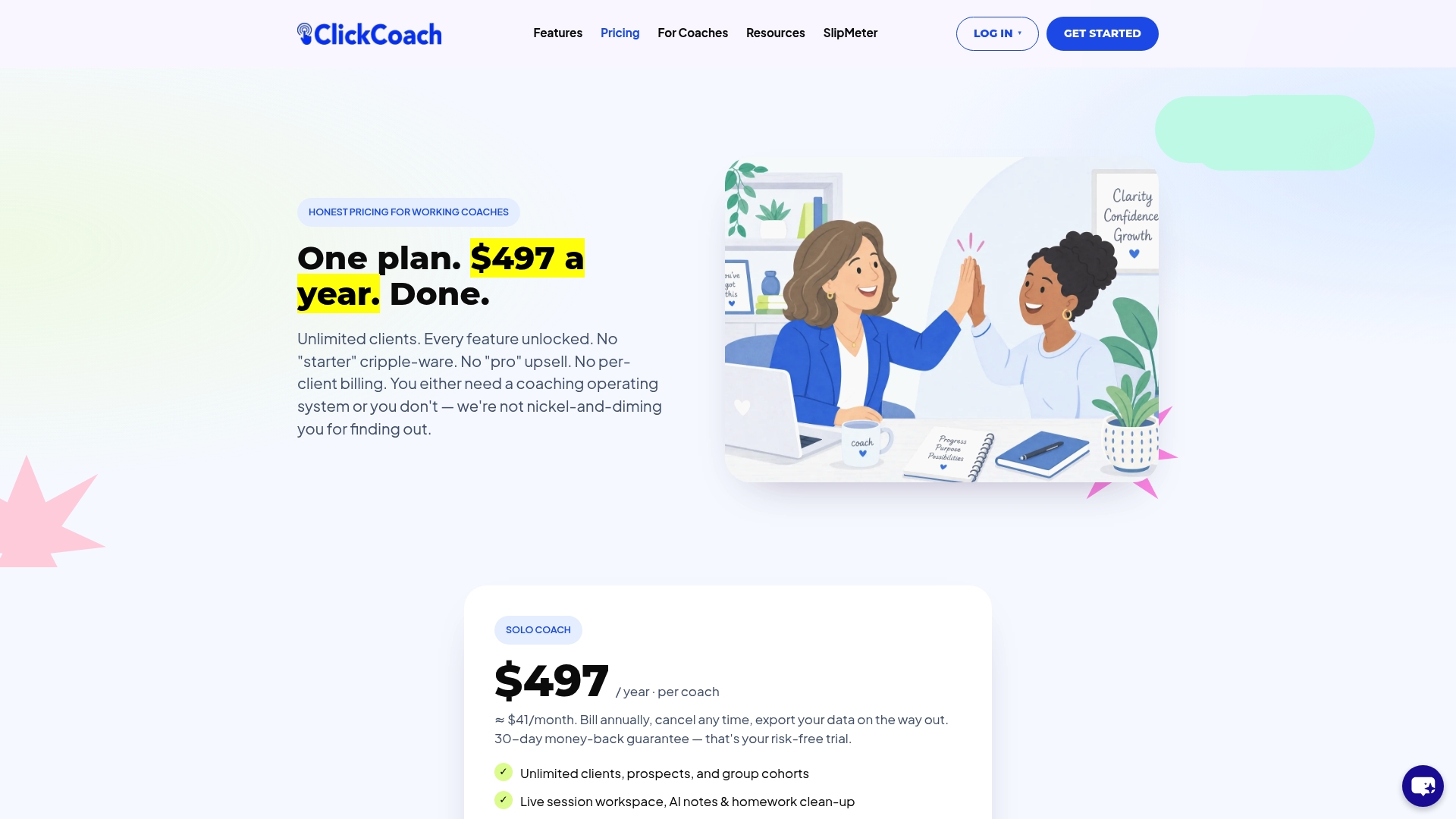
We offer a Solo coach plan and a Multi-coach company plan, both priced at $497 per year per coach. If you are ready to see how it fits your practice, visit our coaching business management software page or check pricing and plans directly.
FAQ
What makes software “all-in-one” for wellness coaches?
All-in-one wellness coaching software combines client records, session notes, scheduling, billing, and a branded client portal in a single platform instead of requiring separate tools for each task. This consolidation is what actually reduces administrative time, since you stop re-entering the same client data across multiple systems.
Do wellness coaches need a HIPAA-compliant platform?
It depends on whether you or your software handle Protected Health Information on behalf of a covered entity; when you do, a signed Business Associate Agreement is required, not just a vendor’s marketing claim. HHS guidance confirms only the Office for Civil Rights can determine actual HIPAA compliance, so verify the BAA directly rather than relying on a website badge.
What should I check before switching coaching platforms?
Run a pilot with a small group of clients first, confirm you can export all your existing client data in a usable format, and verify that automations and billing cycles behave correctly before moving your full roster. A rushed full cutover without a pilot phase is where most migration problems surface.
How much does ClickCoach cost?
ClickCoach offers a Solo coach plan and a Multi-coach company plan, each priced at $497 per year per coach. A Partner or white-label option is also available; current pricing details are on our pricing page.
What’s the difference between coaching software and a coaching directory?
Coaching practice management software, like the kind covered in this guide, helps you run your own client work: notes, scheduling, billing, and progress tracking. A coaching directory, by contrast, is a listing service that helps prospective clients find coaches, and it does not manage your actual client sessions or records.