

For most L&D teams scaling group and team coaching, we recommend ClickCoach as the operationally complete choice: one login for session management, progress tracking, branded portals, and billing. If your program needs enterprise-grade coach networks, consider an enterprise coaching suite; if you want AI-driven nudges inside daily workflows, look at AI-native platforms; if coaching must live inside your existing HR stack, an HR-platform-with-coaching may fit better.
TL;DR:
- ClickCoach charges $497 per coach annually, while AI tools commonly cost $5 to $10 per user monthly and enterprise suites command premium rates.
- Track attendance and homework monthly, assess competencies and team health quarterly, and plan at least three months to separate results from organizational noise.
- Pilot two or three teams, assign each a sponsoring manager, and require one coaching reference at a team meeting monthly; access alone is insufficient.
- Confirm data export, current security certifications, live integrations, and SCIM provisioning before signing to reduce manual account changes as teams grow.
Table of Contents
- Comparing ClickCoach to the Main Platform Categories
- How to Choose a Coaching Platform: A Buyer’s Checklist
- Integrations That Actually Drive Adoption
- What Metrics and ROI Reports to Expect
- How We Evaluated These Platforms
- ClickCoach: Features Mapped to What Buyers Actually Need
- Implementation Timeline and Onboarding for a Team Coaching Platform
- Support and Training Resources to Expect
- Scalability and Customization as Your Practice Grows
- User Experience for Coaches and the People They Coach
- What Case Studies Can and Cannot Tell You
- Platform-Only vs. Blended Coaching: When Each Makes Sense
- Getting Started With ClickCoach
- FAQ
- Sources
Comparing ClickCoach to the Main Platform Categories
Before you book a single demo, it helps to know what you are actually choosing between. Most buyers assume they are comparing one tool to another, but the market splits into a few distinct shapes: all-in-one practice management platforms like ClickCoach, enterprise coaching suites built around large coach networks, AI-native platforms that embed nudges into daily tools, and HR platforms that bolt coaching onto a broader talent stack. Practitioner market analysis groups vendors into these categories because pricing, scale, and the buyer’s underlying job differ so widely between them, and treating them as interchangeable leads to apples-to-oranges comparisons during procurement.
The table below lines up ClickCoach against the three category types on the dimensions that matter most for a team or group coaching rollout.
| Dimension | ClickCoach | Enterprise coaching suite | AI-native coaching platform | HR-platform-with-coaching |
|---|---|---|---|---|
| Best for | L&D teams and coaching practices running group and team coaching end to end | Large enterprises needing vetted external coach networks at scale | Teams wanting in-workflow nudges and lightweight AI-driven check-ins | Organizations adding coaching to an existing HR or talent suite |
| Licensing and pricing shape | Annual subscription, $497 per year per coach for solo or multi-coach plans | Typically priced per user per month, often at premium rates for full-service coaching | Usage or seat based, commonly in the $5 to $10 per user per month range for team-level tools, per practitioner market data | Bundled into broader HR or talent-suite licensing |
| Team and cohort features | Group coaching tools, cohort scheduling, shared progress views | Structured cohort programs with dedicated coach matching teams | Lightweight team check-ins and pulse-style nudges | Coaching modules layered onto performance or learning modules |
| Coach management and matching | Multi-coach administration with centralized client and session records | Algorithmic or curated matching across large coach rosters | Limited or no human coach matching; AI handles most interaction | Matching tied to internal HR workflows, not a dedicated coach pool |
| Assessment and analytics | Recurring assessments, progress charts, goal tracking | Competency frameworks and executive-level reporting | Behavioral analytics drawn from in-app or in-chat activity | Analytics tied to existing performance review data |
| Integrations and adoption supports | Branded client portals, billing, e-sign, file storage in one workspace | Calendar and video integrations, dedicated success management | Slack, Teams, and messaging-native integrations for daily use | Native to the HR system; SSO and HRIS integration built in |
| Security and compliance signals | Secure, single-workspace data handling for coaching records | SOC 2 certifications commonly expected at this tier, per market analysis | Varies widely; verify certifications per vendor | Inherits the security posture of the parent HR platform |
A few things stand out once you see the categories side by side.
- ClickCoach suits teams that want one workspace for sessions, portals, progress, and billing instead of stitching together separate tools for each function.
- Enterprise coaching suites fit organizations that need a large, vetted network of external coaches and are prepared to pay a premium monthly per-user rate for that reach.
- AI-native platforms work well for teams that want lightweight, in-workflow nudges rather than full coaching program management.
- HR-platforms-with-coaching make sense when coaching needs to live inside an existing talent or performance system rather than as a standalone tool.
Matching your category to your actual job to be done, before you compare specific vendors inside that category, saves weeks of procurement back-and-forth.
How to Choose a Coaching Platform: A Buyer’s Checklist
Procurement teams waste time when they evaluate coaching platforms feature by feature instead of against the job the platform needs to do. A structured checklist keeps the comparison honest.
- Usability for coaches and coachees. Can a coach run a full session, log notes, and assign homework without a training manual? Longitudinal research on digital team coaching found that usability, more than feature breadth, determines whether an intervention gets adopted and transfers into daily behavior.
- Coach quality and matching. Does the platform support your existing coach roster, or does it require you to use its own network?
- Measurement capability. Can the platform track goals, competencies, and engagement over a multi-month window, not just log session attendance?
- Pricing model fit. Does the licensing shape (per seat, per coach, per user per month) match your expected scale and budget cycle?
- Data ownership. Who owns the session notes, assessments, and client records if you switch platforms later?
- Integration depth. Does it connect to the calendar, messaging, and HRIS tools your teams already use daily?
When you get to a live demo, ask vendors these ten questions directly: how session notes are stored and exported, whether coaches can be added or removed without per-seat renegotiation, what the onboarding timeline looks like, whether assessments are customizable, how billing and invoicing work, what integrations are live versus roadmap, what security certifications are current, how pricing changes at scale, what support is included, and what happens to your data on contract termination. Vague answers on data export or security certification status are red flags worth taking seriously.
Pro Tip: Score each vendor against your checklist using simple weights, usability and data ownership at 30% each, measurement and integrations at 20% each, to keep the final decision defensible when leadership asks why you picked one platform over another.

Integrations That Actually Drive Adoption
A coaching platform with every feature in the world fails if nobody logs in after week two. The integrations that matter most are the ones that put coaching inside the tools people already use.
- Slack or Teams integration keeps coaching nudges and reminders inside the flow of work rather than in a separate app nobody opens.
- Calendar sync removes the friction of manually scheduling sessions across coach and coachee calendars.
- SSO (SAML) and SCIM provisioning let IT add and remove users automatically as teams change, which matters for any rollout past a handful of pilot participants.
- LMS or HRIS connections tie coaching activity to existing learning records instead of creating a parallel system nobody maintains.
Research on AI-enabled coaching in team settings found that coaching interventions delivered inside the flow of work, rather than through a separate portal, produced measurable performance gains with minimal intervention, which is a strong argument for prioritizing messaging-native tools over standalone dashboards.
A simple pilot plan works better than a full rollout on day one: pick two or three teams, assign a sponsoring manager to each, and require that manager to reference the coaching program in at least one team meeting per month. Manager activation, not just tool access, is what separates a pilot that sticks from one that quietly dies.
Pro Tip: Before signing, confirm SCIM support in writing; without it, every org chart change becomes a manual ticket for your IT team.
What Metrics and ROI Reports to Expect
Set your measurement expectations before the contract is signed, not after the first quarterly review. Longitudinal research on team coaching found that team coaching interventions show measurable improvements in team processes and organizational outcomes when programs are evaluated with multi-indicator frameworks like the balanced scorecard, rather than attendance alone.
Team coaching interventions linked to measurable organizational gains over time. Longitudinal evaluation found that coaching interventions improved teamwork capacity and could influence objective management indicators when programs used structured, multi-indicator measurement over an extended period, underscoring why a single post-session survey is not enough.
Recommended KPIs fall into three buckets: engagement (session attendance, homework completion), competency growth (pre- and post-assessment scores on named skills), and team health (short pulse surveys on trust, communication, and workload). Measure on a monthly cadence for engagement and a quarterly cadence for competency and team health, since those shift more slowly.
Most vendor dashboards report usage metrics well: logins, sessions completed, homework opened. Fewer report business-outcome correlation out of the box, so ask explicitly whether the platform can export raw data for you to triangulate against your own indicators, like retention, internal mobility, or manager effectiveness scores. The same source recommends budgeting at least a three to six month measurement window to detect a real signal above normal organizational noise, which is a useful planning anchor for any pilot timeline.
How We Evaluated These Platforms
We built this shortlist around four criteria: feature completeness for group and team coaching workflows, security and compliance posture, adoption risk based on integration depth and usability research, and measurement capability. We drew on peer-reviewed and practitioner research on digital team coaching, including experimental work on AI-enabled coaching, a longitudinal evaluation of a digital leadership coaching tool, and a longitudinal study of organizational outcomes from team coaching, alongside vendor category analysis and user sentiment on sites like G2. Published outcome data for several platforms remain limited, a limitation the underlying research itself acknowledges, so we weighted documented capability and independent research over vendor marketing claims. In your own procurement process, ask vendors for sample reports, security audit summaries, and references from organizations at a similar scale to yours before you sign.
ClickCoach: Features Mapped to What Buyers Actually Need
ClickCoach was built around the day-to-day reality of running a coaching practice, and the feature set maps directly to the checklist items most L&D buyers care about.
- Session management and notes give coaches one place to log every session, replacing scattered documents or generic note apps.
- Progress tracking and recurring assessments produce the kind of longitudinal data that research on team coaching outcomes points to as necessary for demonstrating real organizational impact.
- Branded client portals give coachees a single place to see goals, homework, and progress, which supports the usability factor that research on digital coaching tools identifies as the real gate to adoption.
- Integrated billing and subscription management remove a separate invoicing tool from the coach’s stack.
- AI-assisted homework drafting speeds up between-session follow-up while keeping the coach in control of what gets sent.
For coaching practices and internal L&D teams evaluating whether to add a dedicated case study or internal adoption metric here, that detail is best supplied directly from your own program data rather than assumed.
This article is written by Mitch Russo for ClickCoach.
Implementation Timeline and Onboarding for a Team Coaching Platform
A realistic onboarding timeline runs in phases rather than a single go-live date. In the first one to two weeks, expect account setup, coach profile creation, and importing any existing client or team records. Weeks two through four typically cover configuring assessments, branding client portals, and connecting calendar or messaging integrations.
A pilot cohort, often two to three teams, usually launches in month one so you can surface friction points before a full rollout. Expect the first full measurement cycle, covering engagement and early competency data, to take another one to two months beyond that. Vendors that promise same-week, organization-wide rollouts for team coaching programs are worth questioning: the research on adoption consistently ties success to manager activation and usability testing, both of which take real time to get right, not to speed of technical setup alone.
Budget your internal rollout plan around a 90-day horizon: 30 days to configure and pilot, 30 days to gather first-round feedback and adjust, and 30 days to expand to additional teams with lessons already applied.

Support and Training Resources to Expect
Support quality varies more than most buyers expect, and it is worth testing before you sign rather than after. During a trial or demo period, ask what support channels are available (chat, email, phone), what the typical response time looks like, and whether onboarding includes live training or only self-serve documentation.
Look for platforms that offer a structured onboarding session for new coaches, not just a help center article. Coaches who are new to a platform need guidance on setting up client portals, configuring assessments, and connecting billing, and a short live walkthrough catches configuration mistakes that a documentation page will not.
Ask specifically whether training resources are included in your plan or billed separately, since this affects total cost once you factor in ramping additional coaches. For multi-coach practices, also confirm whether support scales with your plan, meaning additional coaches can access the same help resources without an extra support tier purchase.
Scalability and Customization as Your Practice Grows
A platform that works well for a single coach does not always scale cleanly to a multi-coach practice or a full L&D department. Before committing, check whether adding coaches requires a new contract negotiation or simply an additional seat at the same per-coach rate.
ClickCoach’s plan structure, for example, prices both solo and multi-coach company plans at $497 per year per coach, which means growing from one coach to a small team does not require a separate pricing conversation. That kind of flat, predictable per-coach pricing matters more than it might seem once you are forecasting budget for a growing practice.
Customization worth checking for includes branded client portals under your own name rather than the vendor’s, customizable assessment templates rather than a fixed set, and the ability to organize clients or teams into cohorts that match how your organization actually structures coaching engagements. A platform that forces every client into the same intake flow regardless of program type will create workarounds that undermine the data you are trying to collect.
User Experience for Coaches and the People They Coach
The interface a coach uses every day and the portal a coachee logs into occasionally are two different design problems, and a platform needs to solve both. Coaches need fast access to session history, notes, and homework assignment during a live call, without digging through menus while a client waits.
Coachees, by contrast, log in far less often, so their experience needs to be self-explanatory with no training required. Research on digital team coaching tools found that usability was the main factor determining whether participants actually transferred coaching insights into daily behavior, which means a clean, branded portal is not a cosmetic nice-to-have. It is a functional requirement tied directly to whether the coaching program produces results.
During a demo, ask to see the coachee-facing view, not just the coach dashboard most vendors lead with. A platform that looks polished for the coach but confusing for the client will show adoption gaps within the first month of a pilot.
What Case Studies Can and Cannot Tell You
Vendor case studies are useful for understanding how a platform gets configured for a specific use case, but they rarely isolate the platform’s contribution from the coaching program design itself. A case study showing improved team performance after a coaching rollout is describing the combined effect of the coach, the program structure, and the tool, not the software alone.
Experimental research on AI-enabled coaching is useful here because it isolates the intervention under controlled conditions and still found measurable team performance gains from minimal, well-timed coaching nudges. That is a meaningfully different kind of evidence than a vendor’s own success story, and it is worth weighting more heavily during procurement.
When a vendor presents a case study, ask what was measured, over what time period, and whether the same metrics were tracked before the program started. A case study without a clear before-and-after measurement window tells you less than it appears to.
Platform-Only vs. Blended Coaching: When Each Makes Sense
A platform-only approach works well for teams running structured, repeatable programs, think skills-based group coaching with clear assessments, where consistency matters more than deep personalization. Blended approaches, pairing the platform with live human coaches, fit better for leadership development or situations involving interpersonal conflict, where nuance and judgment are harder to automate.
A reasonable rule of thumb: pilot platform-only coaching for 60 to 90 days with a single cohort before deciding whether to layer in dedicated human coaching. Scale gradually, team by team, rather than organization-wide, so you can adjust based on what the first cohort’s data actually shows.
— Mitch Russo
Getting Started With ClickCoach
If the checklist above points you toward an all-in-one platform rather than an enterprise coaching network or an HR-bolted-on tool, ClickCoach’s coaching platform is built for exactly that job: one login for sessions, portals, progress, and billing instead of four separate subscriptions.
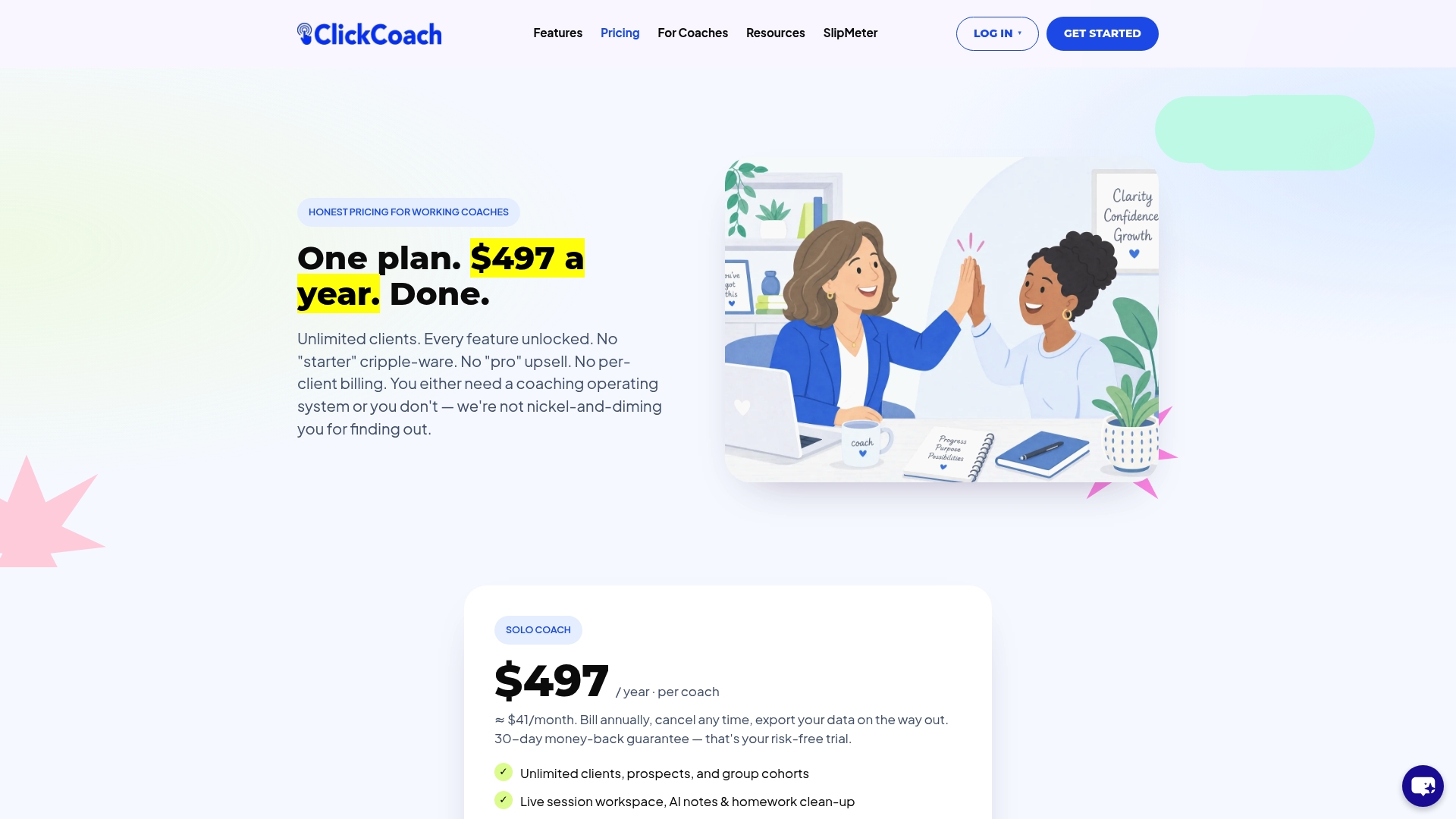
- Single login replaces separate tools for notes, portals, billing, and scheduling.
- Branded client portals give coachees one clear place to track goals and homework.
- Integrated billing and business management remove a separate invoicing subscription from your stack.
FAQ
What is the best platform for coaching?
The best platform depends on your use case: for L&D teams and coaching practices running group or team programs that need session management, portals, and billing in one place, ClickCoach is built for that job. Enterprise organizations needing a large external coach network, or teams wanting lightweight AI-native nudges, may fit better with those respective platform categories.
What are the top platforms coaches compare when choosing software?
Buyers typically compare across categories rather than a single fixed list: all-in-one practice management platforms like ClickCoach, enterprise coaching suites, AI-native coaching tools, and HR platforms with coaching features bundled in. The right category depends on whether you need full practice management, a large coach network, in-workflow nudges, or integration with existing HR systems.
What is the 70/30 rule in coaching?
Definitions vary by source and context, and no single authoritative definition applies across the coaching industry.
Can ChatGPT be my life coach?
General-purpose AI chat tools can offer conversational prompts and reflection exercises, but experimental research on AI-enabled coaching specifically studied purpose-built coaching systems with structured, task-time interventions rather than open-ended chat. A dedicated coaching platform or a trained human coach remains the better fit for structured goal tracking, accountability, and measurable progress over time.
How do I choose a coaching platform for a growing team?
Start with a checklist covering usability, data ownership, measurement capability, and integration depth rather than comparing feature lists alone. Confirm that pricing scales predictably as you add coaches, and run a small pilot cohort for 60 to 90 days before committing to an organization-wide rollout.