

An all-in-one life coaching software combines practice management, client progress tracking, billing, and client portals in one platform while keeping coaches in control of AI-assisted follow-ups. Solo coaches running structured programs get the most value. Coaches who only need a scheduler, or who sell one-off courses to a large audience, may still be better served by a lighter tool.
TL;DR:
- All-in-one coaching platforms are most suitable for solo practitioners and growing practices that need integrated scheduling, billing, notes, and client portals to streamline daily workflows.
- Features like client progress tracking, session notes, and workflow automation are more effective when aligned with specific coaching methods, avoiding unnecessary complexity.
- A structured 30-day trial with real clients provides deeper insight into usability, client engagement, and friction points than demo accounts or feature lists alone.
- Choosing the right software depends on your practice profile, with cohort-based programs favoring course platforms and 1:1 coaching benefiting from comprehensive all-in-one tools.
- Evaluate total cost, security, mobile access, and scalability before committing, ensuring the platform can grow with your practice without disrupting your existing workflow.
Table of Contents
- What Coach Profile Are You? Matching Software to Your Practice
- Deep Dive: ClickCoach Feature Mapping to Real Coaching Workflows
- How to Choose Life Coaching Software: A Weighted Decision Framework
- Comparing Feature Categories: All-in-One vs. Program-First vs. Lightweight Tools
- Pricing Shapes and Total Cost of Ownership
- Security, Privacy, and Compliance Basics for Coaches
- How This Guide Was Put Together
- Mobile App Availability and Functionality
- User Interface and Ease of Use
- Compatibility With Different Devices and Operating Systems
- Scalability to Support Growing Coaching Practices
- What Coaches Get Wrong When Choosing Software
- Getting Started With ClickCoach
- Sources
- FAQ
What Coach Profile Are You? Matching Software to Your Practice
Before you compare features, figure out what kind of coaching business you actually run. The wrong category of software is a worse mistake than the wrong vendor within the right category.
Three profiles cover most of the market. A solo 1:1 practitioner runs individual sessions, tracks goals between meetings, and bills a small, stable client roster. A program or cohort leader sells a structured curriculum to groups, often with modules, homework, and a start/end date. A growing multi-coach practice has associate coaches, needs shared client records, and has to standardize how sessions get documented across a team.
- Solo 1:1 coaches generally need an all-in-one platform that handles scheduling, notes, and billing without forcing them to become a systems administrator.
- Program and cohort leaders often prioritize a course platform or learning management system built around content delivery, cohorts, and drip-fed modules.
- Growing multi-coach practices need role-based access, shared client visibility, and reporting that works across every coach on the team, not just one calendar.
The trade-off is that a platform strong in one category is rarely the strongest in every category. A research-backed feature checklist recommends judging tools against your actual workflow rather than the length of their feature list. A coach who runs weekly 1:1 sessions and occasionally sells a small group program does not need a full learning management system. They need session notes, progress tracking, and a portal their clients will actually open.
Fit matters more than features once you cross a basic capability threshold. A platform with 40 features you never touch is worse than one with 15 you use every week.
Deep Dive: ClickCoach Feature Mapping to Real Coaching Workflows
ClickCoach was built around the actual mechanics of running a coaching practice: booking sessions, documenting what happened, tracking whether the client is improving, and getting paid. Rather than bundling generic project management features and calling it “coaching software,” ClickCoach organizes its workspace around the specific artifacts a coach produces every week: session notes, goals, action plans, homework, and progress metrics.
Here is how the core modules map to daily coaching tasks:
- Scheduling and session logistics. Clients book into available slots, and each session links directly to that client’s ongoing record, so you are never hunting for context before a call.
- Session notes. Notes attach to a structured client history rather than sitting in a separate document, which means a new associate coach picking up a client can see prior goals and commitments in seconds.
- Progress tracking. Recurring assessments and goal fields let you show a client, in concrete terms, where they started and where they are now, rather than relying on your memory of “they seem better.”
- Client portals. Each client gets a branded space to view homework, track their own progress, and see upcoming sessions, which cuts down on the “what am I supposed to be doing” emails between meetings.
- Billing and subscriptions. Recurring billing runs inside the same workspace as the client relationship, so a lapsed payment does not require switching to a separate finance tool.
- Group coaching tools. Cohort-based clients can be tracked alongside 1:1 clients without duplicating your entire client management setup.
The AI layer works on drafting, not deciding. When a session ends, AI can propose homework or a follow-up action plan based on what was discussed, but the coach reviews and edits before anything reaches the client. That distinction matters because market commentary on AI in coaching platforms flags a real risk in 2026: tools that auto-send AI content directly to clients erode the personal judgment that makes coaching valuable in the first place. This approach keeps the coach as the final checkpoint on anything client-facing.
Pro Tip: Run your first two weeks on ClickCoach using only real clients you already see weekly. Skip the demo data. You will surface friction points (a missing template field, a workflow step that feels backward) far faster with live sessions than with a sandbox account.
Consider a coach who runs a 12-week leadership program for six clients simultaneously. Without a unified system, that coach juggles a calendar app for scheduling, a notes app for session records, a spreadsheet for tracking whether each client hit their milestones, and a separate invoicing tool. Every new client adds four more places to update. Inside ClickCoach, one client record carries the schedule, the notes, the milestone tracking, and the invoice history together. The administrative load scales with the number of clients you manage, not with the number of tools you have to keep synchronized.
A related workflow benefit shows up with session notes and templates that reflect actual coaching methodology rather than generic meeting notes. Structured goal fields and reusable templates let a coach reuse a proven session structure across clients instead of rebuilding it from scratch every time, which is exactly the kind of differentiator worth testing during a trial.
How to Choose Life Coaching Software: A Weighted Decision Framework
Picking software by gut feeling after a slick demo is how coaches end up locked into a tool that fights their workflow for a year. A structured evaluation takes an afternoon and saves you months of frustration.
Start with a checklist that reflects what actually happens in your practice, not a generic feature audit. The technology checklist coaches use to evaluate software before scaling recommends judging platforms against these categories, in roughly this order of importance:
- Client experience. Will your clients actually open the portal, or will it sit unused? Test this with a real client, not your own assumption.
- Scheduling. Does booking respect your actual availability rules, buffer times, and time zones without manual fixes each week?
- Notes and progress tracking. Can you find a specific client’s goal history from six sessions ago in under 30 seconds?
- Billing. Does recurring billing handle failed payments and renewals without you manually chasing invoices?
- Integrations. Does it connect to the calendar and video tools you already use, or does it demand you switch those too?
- Security. Are client records encrypted, backed up, and access-controlled in a way you could explain to a client who asks?
- Scalability. If you added a second coach or doubled your client roster tomorrow, would the platform bend or break?
Once you have that list, weight each category by how much it actually affects your week. A simple weighted scoring model, similar to the one Swipnews recommends for coaches assessing software, might look like this:
Score each platform you shortlist from 1 to 5 on every row, multiply by the weight, and add it up. The numbers will not make the decision for you, but they will stop a flashy feature demo from overriding a real gap in something you weighted heavily.
Pro Tip: Score the platform twice, once as yourself and once as your most tech-hesitant client. A tool that scores a 5 for you but a 2 for your least tech-savvy client is a support headache waiting to happen.
The trial itself matters as much as the scoring. Advice on picking the right coaching software is blunt about this: choose for the practice you run today, not the one you imagine running in three years, and test with real clients for 30 days before committing. During that window, track three things specifically:
- Time saved per week compared to your current setup, measured honestly, not estimated.
- Client engagement signals, like whether clients actually log into the portal or complete homework without a reminder.
- Friction points that only show up under real use, like a scheduling rule that does not match your actual calendar habits.
A 30-day trial with two or three live clients tells you more than any product demo, because a real-world trial surfaces the small daily frictions a sales call never will.
Comparing Feature Categories: All-in-One vs. Program-First vs. Lightweight Tools
Coaching software splits into three broad categories, and each one trades strength in one area for weakness in another. None of them is universally “better.” They are built for different jobs.
All-in-one platforms consolidate scheduling, notes, progress tracking, billing, and client portals into a single workspace. They tend to require more setup time upfront because you are configuring an entire system rather than one narrow tool, but that setup cost pays off in fewer integrations to manage long term, according to guidance on picking coaching software. Some all-in-one platforms fall in this category.
Program-first platforms (course builders and learning management systems) are built around delivering structured content to cohorts: modules, drip schedules, quizzes, and completion tracking. They excel at content delivery and can handle large groups efficiently, but they typically treat 1:1 session notes and individualized progress metrics as an afterthought, if they support them at all.
Lightweight tools solve one job well: a booking calendar, a simple invoicing app, a notes document. They have almost no setup friction and a low learning curve, but every additional job (billing, portals, progress tracking) means adding another disconnected app, which is exactly the fragmentation that consumes a coach’s administrative time.
Here is how the categories stack up across the rows that matter most:
- Scheduling: all three categories handle this reasonably well; lightweight tools are often fastest to set up.
- Progress tracking: all-in-one platforms lead here because notes and goals live in the same record as everything else; program-first tools track course completion, not individualized coaching progress.
- Program delivery: program-first platforms win decisively for structured, multi-week curricula with modules and cohorts.
- Billing: all-in-one platforms integrate billing with the client record; lightweight tools usually need a separate invoicing app.
- Client portal: all-in-one and program-first platforms both offer portals, but all-in-one portals tend to reflect the full coaching relationship rather than just course content.
- Automations: all-in-one platforms increasingly offer AI-assisted drafting for follow-ups and homework; lightweight tools rarely offer this at all.
- Analytics: all-in-one platforms report on client outcomes and engagement; program-first platforms report on course completion rates.
- Integrations: lightweight tools need the most external integrations to cover gaps; all-in-one platforms need the fewest.
- Setup complexity: lightweight tools are simplest to start; all-in-one platforms take longer to configure but reduce ongoing complexity.
If your business is one thing, structured cohort programs sold to dozens of people at once, a program-first platform is worth serious consideration. If your business is primarily 1:1 relationship-based coaching with some group work mixed in, an all-in-one platform built around client records generally serves you better than stitching together three lightweight tools.
Pricing Shapes and Total Cost of Ownership
Sticker price rarely tells the whole story. Coaching software pricing shows up in a few recurring shapes, and the gap between the advertised price and what you actually pay often comes down to fees buried outside the subscription line.
Common pricing shapes include:
- Flat annual or monthly subscriptions covering full platform access, sometimes with a client-count cap that triggers a tier upgrade.
- Per-seat pricing for multi-coach practices, where each additional coach adds to the bill.
- Transaction fees on payments processed through the platform, on top of the subscription cost.
- Add-on charges for features like extra storage, premium support, or advanced reporting that are not included in the base tier.
Coaches evaluating software before scaling are specifically warned to check for these hidden costs, since a subscription fee is often only part of what a platform actually costs to run. A tool that looks cheaper on the pricing page can end up costing more once you add payment processing fees and a support add-on you did not know you needed until month two.
A simple way to estimate total cost of ownership: add the subscription price, expected transaction fees based on your monthly revenue, any per-seat costs if you have associate coaches, and the value of your own time spent on onboarding and setup. Compare that total against the hours saved weekly on scheduling, note-taking, and billing admin, valued at what your time is actually worth per hour as a coach.
Statistic in context: there is no universal industry average to quote here because pricing shapes vary too widely by vendor and tier, but the pattern is consistent enough to plan around: platforms with a single upfront subscription and no transaction fee layer tend to be the easiest to forecast a full year in advance, which matters if you are budgeting a coaching business on annual revenue.
At the low end, a lightweight scheduling app might run a modest monthly fee with no transaction cut, but you will still pay separately for an invoicing tool and a notes app. At the mid tier, a program-first platform bundling cohort delivery and payments might charge a moderate subscription plus a percentage on transactions. At the all-in-one tier, a single annual subscription that includes practice management, billing, and portals, with no added transaction cut, tends to be the most predictable to budget against, since one price covers the full year regardless of client volume.
Security, Privacy, and Compliance Basics for Coaches
Client sessions contain sensitive material: health details, career struggles, relationship information. Treating software security as an afterthought is a liability, not a shortcut.
Before you commit to any platform, verify the basics rather than taking a sales page’s word for it. Security checklist guidance for coaches recommends confirming these items directly with the vendor:
- Encryption for data both in transit and at rest, not just one or the other.
- Regular backups, so a server failure does not mean losing months of client notes.
- Multi-factor authentication for account access, especially if multiple coaches share a workspace.
- Access controls that let you restrict which team members see which client records.
Ask vendors directly about their data retention and deletion policies. If a client asks you to delete their records, can the platform actually do that, and how quickly? Ask where data is stored and whether that location matters for any professional or ethical obligations your certifying body imposes on you.
On your side, a few habits reduce risk regardless of which platform you choose. Get written client consent for how you store and use session data. Keep retention minimal. Delete records you no longer need rather than letting years of client history accumulate in a system you have stopped actively managing. A platform can only protect what it holds; you control what you feed it.
How This Guide Was Put Together
This guide was built around a feature-mapping approach rather than a marketing comparison. Every core capability, scheduling, session notes, progress tracking, billing, client portals, group coaching support, was evaluated against the actual tasks a coach performs in a working week, then checked against a weighted scoring framework similar to industry checklists coaches use before scaling a practice.
,
The evaluation approach favors practical trial testing over spec-sheet comparison. Rather than treating a longer feature list as automatically better, the guidance here leans on a structured checklist, the same kind recommended for coaches assessing software before scaling, and on running real 30-day trials with live clients rather than sandbox demos.
This is a publisher perspective built on documented product features and independent guidance for coaches, not an exhaustive third-party lab benchmark. It does not test every platform on the market, and it does not simulate every possible practice size or specialty. Coaches running highly specialized programs, therapy-adjacent practices with unique compliance needs, or very large multi-location teams should treat this as a starting framework, then run their own weighted scoring and trial process against their specific requirements before signing an annual contract.
Mobile App Availability and Functionality
Coaching does not stop when you close your laptop. A client message, a schedule change, or a quick note after an unplanned call often happens away from a desk, which makes mobile access a practical requirement rather than a nice extra.
Look for a mobile experience that lets you check your schedule, view a client’s recent notes, and respond to portal messages without needing your full desktop setup. The gap between platforms shows up in the details: some offer a full native app with offline access to notes, while others rely on a mobile browser view that strips out key functionality.
Test this directly during your trial period rather than trusting a feature list. Try logging a session note from your phone in the minutes right after a call, while the details are still fresh. If that workflow feels clumsy, awkward taps, slow load times, missing fields, you will likely skip it in practice and lose the accuracy that comes from capturing notes immediately.
For coaches who see clients across multiple locations or run sessions by phone between office visits, mobile functionality is not a convenience feature. It is the difference between documenting a session the moment it ends and trying to reconstruct it from memory that evening.
User Interface and Ease of Use
A powerful platform that takes 20 minutes to find a client’s last session note is not actually saving you time. Interface design matters as much as the underlying feature set, particularly for coaches who are not naturally drawn to software navigation.
The clearest test of usability is not how the interface looks on a marketing screenshot. It is how quickly you can complete your five most common tasks: booking a session, logging a note, checking a client’s progress history, sending an invoice, and reviewing what homework is due. Time yourself doing each during a trial.
Pay attention to how the platform organizes client information. A workspace where scheduling, notes, and billing exist as separate tabs disconnected from the client record forces you to hold context in your head as you click between screens. A workspace where everything about one client, past sessions, current goals, outstanding invoices, lives on a single page reduces that mental load considerably.
Ease of use also matters for your clients, not just you. If the client portal is confusing, clients will not use it, and the accountability benefit of a portal disappears entirely. Test the client-facing side yourself, or better yet, watch an actual client try to navigate it during your trial period, before assuming it is intuitive.
Compatibility With Different Devices and Operating Systems
Your practice does not run on one machine. You might book sessions from a laptop, review notes on a tablet between meetings, and check your schedule on a phone while commuting. Software that only behaves well on one device type creates friction exactly when you need speed.
Cloud-based platforms accessed through a web browser generally offer the broadest compatibility, since they work the same way regardless of whether you are on Windows, macOS, iOS, or Android, without requiring a separate download for each. That browser-based approach also means updates roll out automatically, so you are not stuck running an outdated version on one device while another has the newest features.
Check specifically whether a platform’s mobile experience matches its desktop functionality, or whether certain features (like AI-drafted follow-ups or detailed progress reports) are locked to desktop only. Some platforms treat mobile as a stripped-down companion app rather than a full extension of the desktop experience, which can leave you unable to complete a task on the device you happen to be holding.
If you work with an associate coach who uses a different operating system than you do, cross-platform compatibility stops being a preference and becomes a requirement. Confirm during your trial that shared client records display consistently no matter which device or operating system opens them.
Scalability to Support Growing Coaching Practices
The software that fits a solo practice with 15 clients can become the bottleneck the moment you add a second coach or double your roster. Scalability is not about hypothetical future growth. It is about whether the platform bends without breaking when your actual client count changes.
Watch for a few concrete signals. Can you add a second coach without duplicating your entire client management setup from scratch? Does the platform support role-based access, so an associate coach sees their own clients without exposing every other client record in your practice? Does progress tracking and billing still make sense when you go from managing five clients personally to overseeing a team of coaches managing forty?
Setup complexity often trades off against long-term scalability: platforms that took longer to configure initially, because they were built to handle a full practice rather than a single calendar, tend to repay that setup time when you scale, since you are not re-platforming everything at the exact moment your business is busiest.
Ask this concretely before committing: if you added a second coach next month, what exactly would you need to change? If the honest answer involves migrating client records to a new system, you have picked a tool sized for where you are today, not where a growing practice needs to be in a year.
What Coaches Get Wrong When Choosing Software
Most coaches treat their first software decision like a permanent one, when it is really a hypothesis you test for 30 days. That mindset shift alone would save a lot of practices from a painful mid-year migration.
Here is the onboarding sequence that tends to work: start with your calendar and notes template first, since those touch every single session you run. Add billing and the client portal only after the daily workflow feels natural, not on day one when you are still learning the interface. Invite your two or three most patient clients into the portal first, not your entire roster, so you catch friction points before they become a pattern across forty people.

The most common mistake is trying to migrate everything at once, historical notes, active billing, every client’s full history, in a single weekend. That is how coaches end up frustrated with a tool that was never actually the problem. Migrate active clients first, and backfill history when you have breathing room.
For quick wins that make clients notice the change immediately: send your first AI-drafted follow-up within 48 hours of a session (after you review and personalize it), turn on the client portal for homework tracking before your next session cycle starts, and show one client their own progress chart out loud on a call. That last one, more than any feature, is what makes clients feel the shift is working for them, not just for your back office.
— Mitch Russo
Getting Started With ClickCoach
If the categories above have you leaning toward an all-in-one platform, the practical next step is testing one with your actual clients, not just reading feature pages. ClickCoach brings client records, session notes, goals, action plans, homework, progress tracking, billing, and branded client portals into a single workspace, which is the exact combination this guide has been measuring every category against.
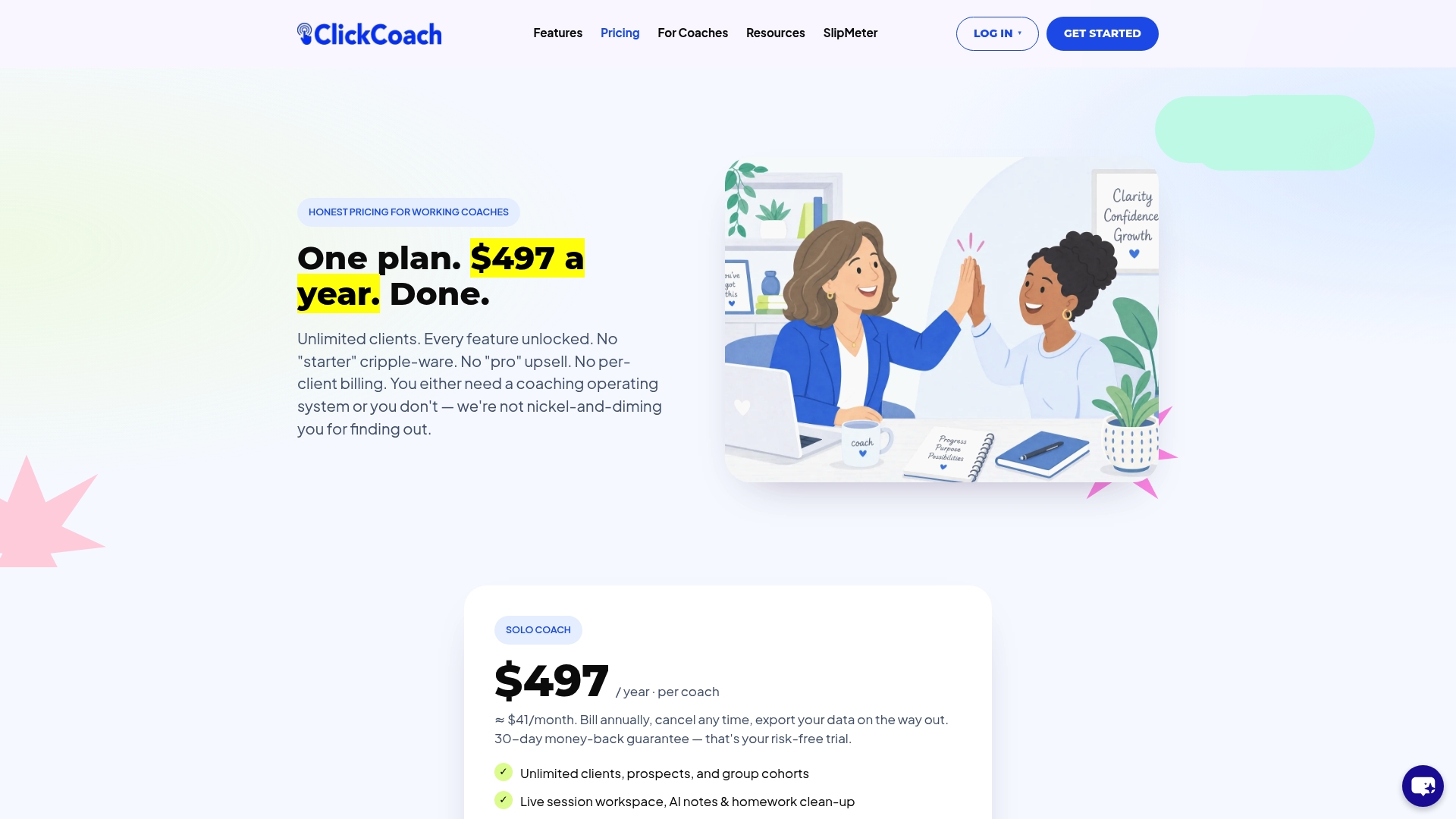
During a trial, focus on three things: how quickly you can log a note right after a real session, whether your clients actually open and use the branded portal without a reminder, and whether AI-drafted follow-ups save you time without ever going to a client before you review them yourself. Those three tests reveal more in a week than any feature comparison chart.
If you run associate coaches or plan to soon, also test how client records display across your team, since that is where lightweight tools tend to fall apart the fastest. Explore ClickCoach’s practice management features directly, and start a trial with two or three current clients before committing your full roster to a new system.
Sources
- Technology Checklists for Coaches: How to Assess Software Before Scaling Your Practice - Swipnews
- How to Pick the Right Coaching Software for Your Practice - Pick-Kart .com
FAQ
What is the best life coaching software?
For most professional coaches running 1:1 or blended group practices, an all-in-one platform that combines scheduling, session notes, progress tracking, billing, and client portals fits the widest range of workflows. Coaches selling large structured cohort programs may be better served by a program-first course platform instead.
What is the best life coaching program?
“Program” can mean either a certification curriculum or a coaching methodology, and this guide covers software rather than certification providers, so no specific program is being recommended here. The stronger question for software purposes is which platform best supports whatever program structure you already teach.
Can ChatGPT be my life coach?
General AI chat tools can offer suggestions and reflection prompts, but they lack the ongoing client record, accountability structure, and human judgment a trained coach provides across a real coaching relationship. Coaching platforms in 2026 increasingly use AI to help coaches draft homework and follow-ups faster, with the coach reviewing and approving everything before a client sees it, rather than replacing the coach entirely.
What is the 70/30 rule in coaching?
Definitions of this rule vary by coach and training program, and no single canonical version is consistently documented across coaching organizations, so it’s worth confirming the specific definition with whichever certifying body or trainer you reference.
How long should I trial coaching software before switching?
A 30-day trial with two or three real, active clients gives a far more accurate picture than a product demo, since it surfaces scheduling quirks, portal engagement, and note-taking friction under actual working conditions.