

We recommend ClickCoach as the practical starting point for coaches and coaching teams who need one platform to run sessions, track client progress, and handle billing without stitching together separate apps. For organizations evaluating enterprise coaching delivery, the strongest alternatives to compare alongside it are Growthspace, BetterUp, CoachHub, EZRA, Torch, Sounding Board, CoachAccountable, and Bunch. This guide walks through what separates practice-management tools from enterprise coaching platforms, and how to test either kind before you buy.
TL;DR:
- Tools for running a coaching practice handle records, sessions, progress, and billing; enterprise platforms prioritize coach supply, language coverage, and sponsor reporting.
- For organizational programs, favor human coaching supported by AI over AI only tools, and verify coach credentials, confidentiality practices, consent, and AI disclosure.
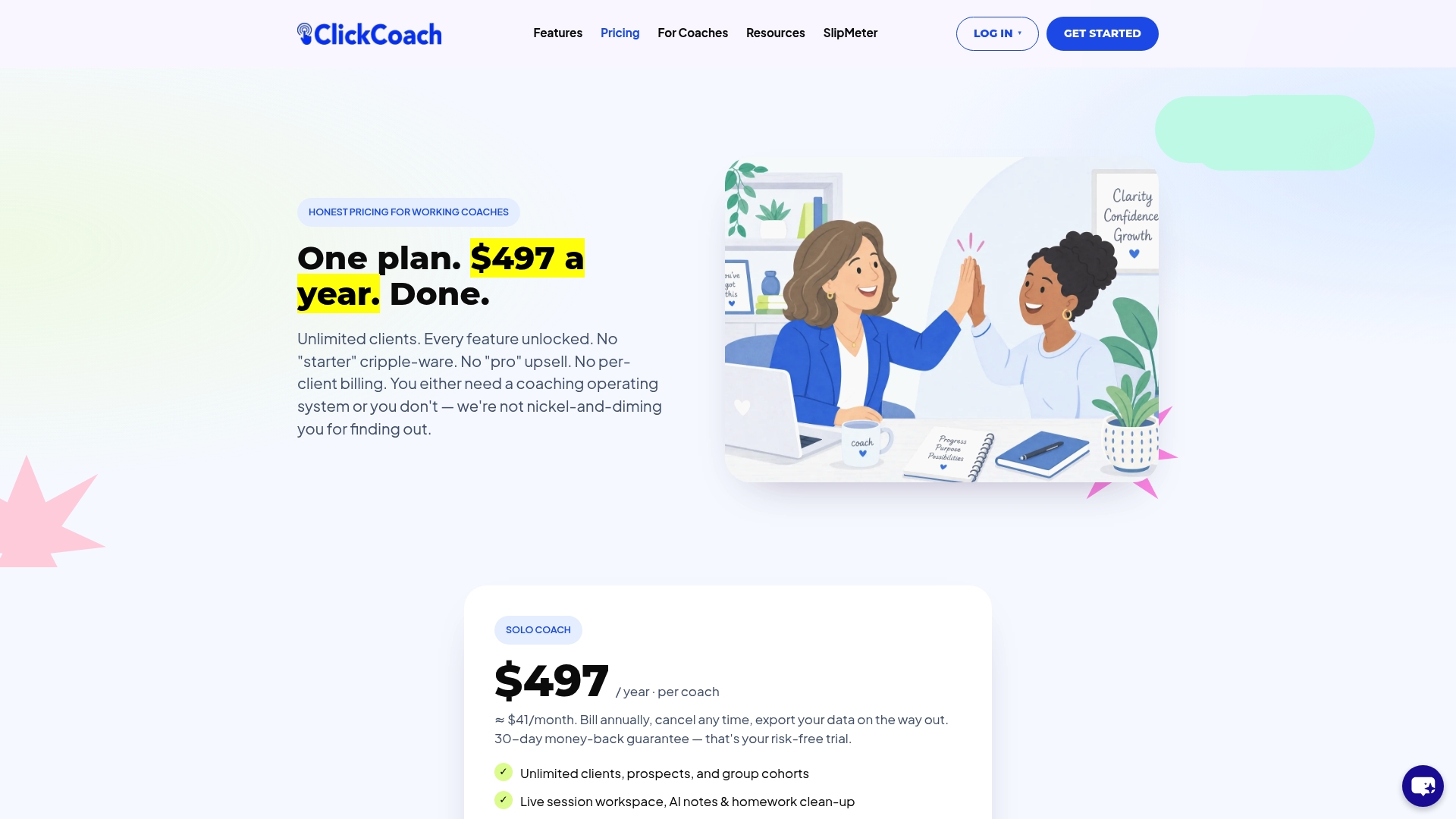
- ClickCoach lists both solo and multi coach plans at $497 per coach annually; white label pricing is available on request.
Table of Contents
- Shortlist: ClickCoach and the Top Leadership Coaching Platforms
- Comparing Platforms on the Axes That Actually Matter
- How to Choose: Checklist, Demo Questions, and Pilot Design
- How Practice-Management Software Solves a Coach’s Daily Operational Load
- What Working Coaches Should Prioritize Over a Feature Checklist
- ClickCoach: Where to Start
- FAQ
- Sources
Shortlist: ClickCoach and the Top Leadership Coaching Platforms
Each platform below solves a different piece of the leadership coaching puzzle. Some are built for coaches running their own practice; others are built for HR and L&D teams buying coaching as a managed service. We start with the platform coaches actually own and operate, then move through the enterprise field.
We built ClickCoach as an all-in-one practice-management workspace for professional and executive coaches. It brings client records, session notes, goals, action plans, homework, progress tracking, billing, and branded client portals into a single login, with AI-assisted drafting for homework and follow-up actions while the coach stays in control of what goes out. It fits solo coaches, multi-coach firms, and white-label partners who need consolidated administrative workflows rather than a bundle of disconnected apps.
Growthspace pairs human experts with AI-managed sprints aimed at specific skill gaps. It suits learning and development teams that want targeted, time-boxed development programs with built-in measurement rather than open-ended coaching engagements.
BetterUp operates a large coaching network built for workforce-wide rollouts. Its strength is scale: employers can deploy coaching across broad employee populations and lean on enterprise reporting to track participation and outcomes.
CoachHub delivers digital coaching across many languages and regions, which makes it a common pick for multinational employers that need consistent coverage across geographies rather than a single-market program.
EZRA runs enterprise coaching contracts built around high-volume one-to-one sessions, often structured with unlimited or near-unlimited session models inside the agreement. It’s suited to large organizations negotiating a single enterprise deal rather than per-seat purchasing.
Torch combines coaching with structured mentoring programs in one system, which appeals to organizations that want both coaching and mentoring to live under the same administrative workflow instead of running two separate initiatives.
Sounding Board blends program design with coaching delivery and administrative support, aimed at talent leaders who need a managed partner to help build the leadership program itself, not just supply coaches.
CoachComet focuses on independent coaches and boutique practices, offering structured engagement templates and assessments. It fits coaches who want guided journey structures built into the platform rather than building their own session cadence from scratch.
CoachAccountable is practice-management software aimed squarely at scheduling, notes, billing, and client tracking for practicing coaches, making it a direct point of comparison for coaches evaluating administrative fit over enterprise scale.
Bunch is a leadership coaching app centered on daily habit-building with AI coaching assistance, designed for individuals and teams who want a lightweight, daily touchpoint rather than a full session-based program.
A handful of other names round out the field worth knowing before a procurement search: Valence builds team-coaching and manager-enablement tools aimed at peer and team dynamics; Coachello and Wave.ai offer AI-assisted coaching experiences positioned as always-available complements to human coaching; Rocky.ai focuses on AI-driven personal development coaching for individuals; AIMY by CoachHub is CoachHub’s AI coaching companion product, built to extend its human coaching network with on-demand AI sessions; Simply.Coach and Profi are practice-management and client-engagement platforms aimed at coaches and consultants running structured programs; and Coaching.com provides enterprise coaching program management software used by coaching firms and internal L&D teams to administer larger coaching engagements.
Here’s the quick way to sort them by what you’re actually buying:
- Running your own coaching practice: ClickCoach, CoachAccountable, CoachComet, Simply.Coach, and Profi compete directly on session workflows, client portals, and billing.
- Buying workforce-wide coaching as an HR or L&D leader: BetterUp, CoachHub, EZRA, and Torch compete on coach supply, language coverage, and sponsor reporting.
- Wanting AI-first or hybrid daily coaching: Bunch, Rocky.ai, Coachello, Wave.ai, and AIMY by CoachHub compete on engagement cadence and AI coaching design.
- Administering a multi-coach program or firm: Coaching.com, Sounding Board, and Growthspace compete on program design and administrative oversight at scale.
Comparing Platforms on the Axes That Actually Matter
Delivery model, coach vetting, and reporting depth separate an enterprise coaching platform from a coach-owned practice-management tool faster than any feature list. The table below lines up the shortlist on the axes that tend to decide a procurement conversation.
| Platform | Best for | Delivery model | Coach vetting support | Core workflows | Pricing model |
|---|---|---|---|---|---|
| ClickCoach | Solo and multi-coach practices, white-label partners | Human coach led, AI-assisted drafting | Coach brings own credentials; platform supports record-keeping | Session notes, portals, billing, homework, progress tracking | Flat annual fee per coach |
| Growthspace | L&D teams running skill sprints | Human expert plus AI-managed scheduling | Vendor-managed expert matching | Sprint programs, measurement | Enterprise/per-program quote |
| BetterUp | Workforce-wide coaching rollouts | Human coach network | Vendor-managed coach network | Coaching sessions, enterprise dashboards | Enterprise quote |
| CoachHub | Multinational, multi-language coaching | Human coach network, AI companion available | Vendor-managed coach network | Sessions, reporting, language coverage | Enterprise quote |
| EZRA | High-volume enterprise 1:1 contracts | Human coach led | Vendor-managed coach network | Unlimited-style session models | Enterprise quote |
| Torch | Coaching plus structured mentoring | Human coach and mentor led | Vendor-managed network | Coaching and mentoring workflows combined | Enterprise quote |
| Sounding Board | Managed leadership program design | Human coach led with program design support | Vendor-managed, program-tied | Program design, coaching delivery, admin support | Enterprise quote |
| CoachAccountable | Independent coaches wanting scheduling and billing | Human coach led | Coach brings own credentials | Scheduling, notes, billing, client tracking | Per-coach subscription |
| Bunch | Daily habit-driven coaching | AI-assisted, human coaching optional | Not a core feature | Daily prompts, habit tracking | Subscription, per-user |
Coach vetting matters most where it’s the least visible in a demo. Senior leader coaching carries real reputational and confidentiality stakes, so a platform’s ability to surface coach credentials, hours coached, and domain experience is worth more than its session-scheduling polish. The ICF guidance on AI coaching standards frames this directly: coaches are expected to manage confidentiality, consent, and record handling explicitly, and to disclose when AI is involved in any part of the coaching process.
Delivery model is the other axis that quietly decides fit. Task-Technology Fit research on AI coaching agents finds that hybrid models, where AI supports a human coach rather than replacing one, tend to be the most accepted and practical configuration inside organizations. That argues for weighting AI-only tools carefully against what the coaching task actually requires, rather than assuming more automation is automatically better.
Pro Tip: Ask every vendor one question before anything else: “If my sponsor wants to see progress evidence next quarter, what exactly will I be able to export, and in what format?” The answer separates enterprise-reporting platforms from practice-management tools faster than any feature sheet.
How to Choose: Checklist, Demo Questions, and Pilot Design
Buying coaching software works best as a short, structured evaluation rather than a feature-by-feature scroll through marketing pages. Separate what you cannot compromise on from what’s simply convenient, then test both in a live demo.
Must-have checklist items:
- Confidentiality and consent handling that meets the standards in the ICF Code of Ethics, including clear disclosure when AI touches any part of a session or follow-up.
- Data security basics: encryption in transit and at rest, documented data location, and defined access controls for anyone who can view client records.
- Reporting that matches your actual audience, whether that’s a sponsor dashboard for an enterprise buyer or a simple progress view for a solo coach’s clients.
- Coach credential visibility, so you or your sponsor can confirm who is coaching and what they’re qualified to coach on.
- Core session workflows: scheduling, notes, action plans, and homework that live in one place instead of across email and spreadsheets.
Nice-to-have checklist items:
- Single sign-on and HRIS integration for larger organizations managing many accounts.
- Calendar sync that eliminates manual scheduling back-and-forth.
- Branded client portals that reinforce your own practice identity rather than the vendor’s.
Bring a short demo script instead of letting the vendor run the whole show. Ask directly: “What exactly do you disclose to clients when AI drafts or suggests content?” “Can I export all client records and notes if we part ways?” “How do you verify coach credentials, and can I see an example coach bio?” “What does the sponsor or manager dashboard actually show, and how often does it refresh?” “What’s the realistic timeline from signed contract to first session?”
Procurement goes smoother with a pilot before a full rollout. A workable design runs six to eight weeks with twenty to fifty coachees, measuring baseline and endline results on two or three agreed metrics, such as behavioral goal attainment and an engagement rate. A systematic review of digital coaching notes that digital coaching can improve well-being and emotional intelligence, but flags that measurement standards still vary widely across vendors, which is exactly why a pilot with metrics you choose matters more than a vendor’s own case studies. Use the pilot to negotiate: ask for pilot-to-scale pricing locked in before rollout, and confirm you retain export access to all client data regardless of what you decide afterward.
How Practice-Management Software Solves a Coach’s Daily Operational Load
Practice-management software is not a coaching directory, a certification program, or a marketing tool, and it’s worth keeping those categories separate when you’re evaluating options. A directory helps clients find a coach. A certification program trains and credentials a coach. A marketing or email platform helps a coach find clients. Practice-management software, by contrast, is what runs the coaching itself once a client relationship exists: the records, the sessions, the follow-through, and the billing behind it.
We built ClickCoach around that specific job. In practice, that means:
- Centralized client records so session history, goals, and notes live in one place instead of scattered across notebooks and folders.
- Structured session notes that keep every meeting’s key points and commitments in a consistent, reviewable format.
- Goals and action plans that carry forward from session to session instead of resetting each time.
- AI-assisted homework drafting that gives coaches a starting point for follow-up actions, with the coach reviewing and finalizing before anything reaches a client.
- Progress tracking that gives both coach and client a visible record of movement over time, useful for renewal conversations and for demonstrating value.
- Branded client portals so clients experience a consistent, professional touchpoint between sessions.
- Integrated billing so payment collection doesn’t live in a separate system from the coaching relationship itself.
Pro Tip: If you’re a solo or small-team coach, test whether a platform’s progress tracking produces something you’d actually show a client or sponsor at a renewal conversation. That’s the real test of whether “reporting” is a feature or just a label.
For a solo coach or a small multi-coach firm, this kind of consolidated workflow is usually the right fit. An enterprise coaching platform like BetterUp or CoachHub becomes the better fit when the buyer is an HR or L&D function purchasing coaching as a managed service across hundreds or thousands of employees, where coach sourcing and multi-language delivery matter more than practice ownership.
What Working Coaches Should Prioritize Over a Feature Checklist
Feature lists are easy to compare and easy to get wrong. The platforms on this list can all schedule a session and store a note. What separates a coaching engagement that actually changes behavior from one that just generates meeting minutes is program design: a clear goal, a cadence that matches the client’s capacity to act between sessions, and a way to see whether anything moved.

For senior-leader coaching specifically, coach fit and sponsor alignment matter more than almost any platform feature. A credentialed coach who has never operated at the level they’re coaching into will struggle regardless of how polished the reporting dashboard looks. Confirm the coach, not just the software, before you confirm the contract.
Treat vendor claims about outcomes the way you’d treat a client’s self-report: useful, but worth verifying. A short pilot with two or three metrics you chose, not the vendor’s own case study, is the fastest way to find out whether a platform fits your actual coaching work rather than a sales demo’s best-case scenario.
— Mitch Russo
ClickCoach: Where to Start
If you’re weighing whether to recruit pilot participants through paid channels while you test a new platform, a guide to buying and vetting solo ad traffic is a reasonable starting point for coaches exploring outside recruitment methods during a pilot window.
We offer two plans built around how coaching practices actually scale:
- Solo coach, at $497 USD per year per coach, for independent practitioners who want the full platform under one account.
- Multi-coach company, also at $497 USD per year per coach, for firms adding coaches without adding separate software subscriptions for each one.
A white-label partner plan is also available for organizations that want to offer the platform under their own brand; pricing for that tier is available on request.
If you’re ready to see whether it fits your practice, check current pricing or start with the coaching platform overview to walk through the core workflows before you commit.
FAQ
What’s the best CRM for coaches?
The right CRM for a coach depends on whether you need general sales pipeline tracking or coaching-specific workflows like session notes and progress tracking built in. A practice-management platform that bundles CRM-style client records with session management, such as ClickCoach, often serves coaches better than a generic CRM built for sales teams.
Can I use ChatGPT as a life coach?
General AI chat tools can offer reflective prompts and suggestions, but they are not a substitute for a credentialed coach bound by confidentiality and ethical standards. The ICF’s AI coaching guidance calls for explicit disclosure and human oversight whenever AI plays a role in a coaching process, which a standalone chatbot interaction does not provide.
How much is leadership coaching?
Leadership coaching pricing varies widely by delivery model, from enterprise contracts priced per employee or per program to independent coaches setting their own session rates. Software costs are separate from coaching fees themselves; for practice-management software specifically, ClickCoach lists a flat $497 USD per year per coach for both its solo and multi-coach plans.
What is leadership-based coaching?
Leadership-based coaching focuses on developing a person’s capacity to guide others, make decisions under pressure, and influence organizational outcomes, as distinct from coaching aimed purely at personal life goals. It typically involves goal setting tied to specific leadership behaviors, regular sessions, and some form of progress measurement tied to those behaviors.
What should I check before choosing a coaching platform instead of a competitor’s?
Before committing, confirm how the platform handles data security, AI disclosure, and client record export, since these vary significantly between vendors. Run a short pilot with two or three metrics you define yourself, rather than relying solely on vendor case studies, to confirm the platform fits your actual coaching workflow.