

For coaches running structured, paid cohort programs, One strong overall fit combines cohort management, client progress tracking, and branded portals in one system built specifically for coaching practices. Circle and Mighty Networks lead if community is your product. Kajabi, Kartra, and Thinkific fit coaches selling courses alongside coaching. Pick your platform by delivery format first, not by feature count.
TL;DR:
- Platforms with native community support, like Circle and Mighty Networks, foster higher engagement by keeping discussions within the same environment as course content.
- Cohort management features such as drip scheduling, milestone-linked discussions, and automated assignment unlocks are critical for maintaining organization and reducing chaos.
- The best systems combine live and asynchronous delivery, offering simplicity and saving time, especially for coaches managing multiple cohorts or hybrid formats.
- Clear data export options in standard formats and transparent pricing structures are essential to prevent hidden costs and facilitate smooth platform transitions.
- Choosing a platform aligned with your revenue model—coaching-heavy versus course-focused—ensures you avoid paying for unnecessary marketing infrastructure or missing crucial cohort management features.
Table of Contents
- What Makes a Group Coaching Platform Actually Great?
- Ranked Shortlist: Best Group Coaching Platforms Compared
- Quick Platform Briefs: What Each Tool Does Best
- How to Choose: A Demo-Ready Checklist for Vendors
- Why an Integrated System Changes What “Progress” Looks Like
- What This Comparison Gets Right That Most Roundups Miss
- Try ClickCoach for Your Next Cohort
- Sources
- FAQ
What Makes a Group Coaching Platform Actually Great?
Most platform comparisons list features. Few explain why those features matter once you have 20 clients moving through the same eight-week program at the same time. That distinction is where good group coaching software separates from software that merely tolerates groups.
Native community, not a bolted-on forum. When discussion lives inside the same environment as your lessons and assignments, clients stay engaged. When you push them to Slack or a Facebook group to talk about the material, you introduce a second login and a second habit they have to build. Platforms that force community off-platform tend to see higher learner drop-off because leaving the learning environment breaks the flow. User reviews of tools like Circle repeatedly cite community integration as the deciding factor in overall satisfaction.
Cohort management that understands cohorts. A cohort isn’t a course with a start date slapped on it. It needs drip scheduling tied to actual calendar weeks, assignments that unlock on a group timeline, and discussion threads linked to specific lesson milestones rather than one giant free-for-all channel. This is the feature set that determines whether your program feels organized or chaotic by week three.
Live and async delivery working together. Some sessions happen live on video. Others happen asynchronously through homework, check-ins, and recorded content. A platform that handles both without forcing you into a third-party conferencing workaround saves real administrative time every single week.
Progress tracking that flags who’s falling behind. This is the difference between a coach who reacts to a client quitting and one who catches disengagement in week two and intervenes. Reporting that surfaces at-risk clients, not just completion percentages, is what actually protects retention.
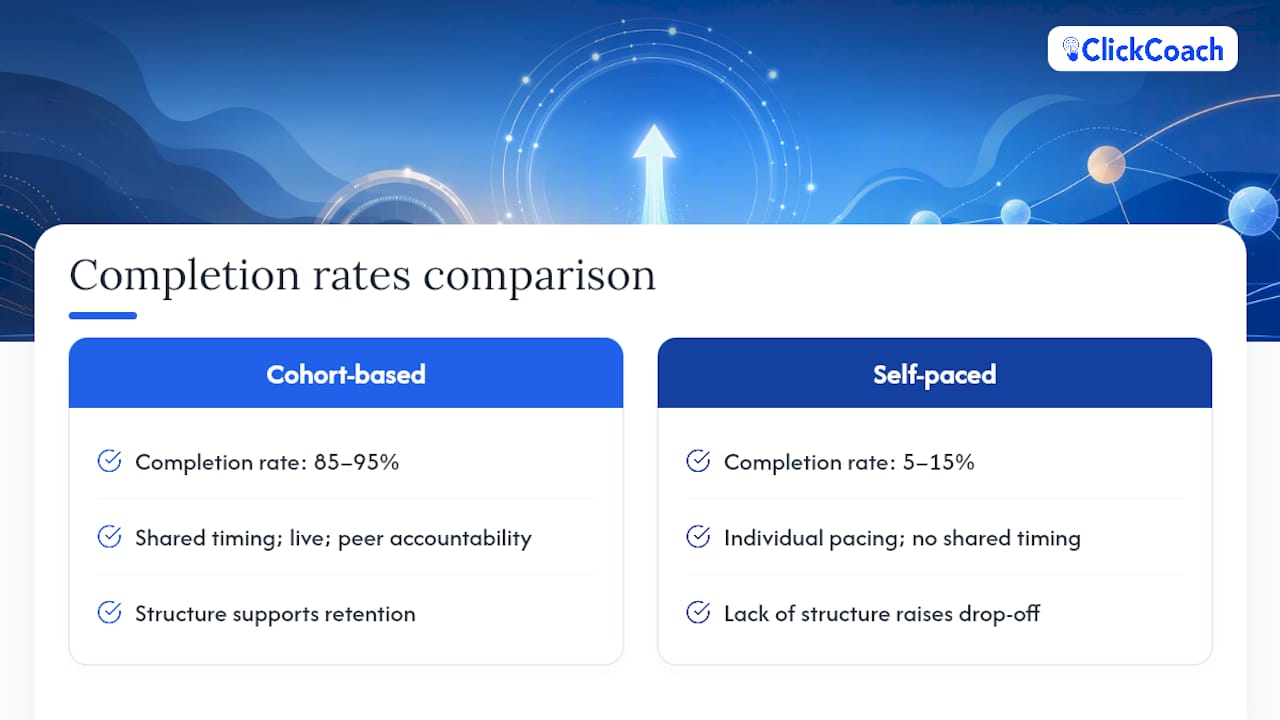
Here’s the number that should reshape how you think about platform choice: cohort-based programs with shared timing, live interaction, and peer accountability post completion rates of 85 to 95 percent, compared with roughly 5 to 15 percent for self-paced courses. That gap isn’t about content quality. It’s almost entirely about structure, and structure is exactly what your platform either supports or fights against.
Pricing shape and what it does to your margins. Per-seat pricing punishes you the moment your cohort grows. Flat pricing protects margin at scale but sometimes caps features. Tiered or per-coach annual pricing tends to be the most predictable for a growing practice, because you know your cost before you know your enrollment number.
Integration depth and data ownership, particularly for multi-coach teams, deserve a hard look before you sign anything. Ask whether you can export client records and course content in a standard format, and whether adding a second coach to your account multiplies your cost or simply adds a seat.
Ranked Shortlist: Best Group Coaching Platforms Compared
One platform designed for cohort-based coaching was built around the buyer job most coaches struggle with: consolidating client records, session notes, cohort progress, and billing into one workspace instead of stitching together four separate subscriptions. The platform includes structured client progress charts that double as renewal evidence, branded client portals, integrated billing, and AI-assisted homework drafting where the coach stays in the editing seat rather than handing control to a bot.
That combination matters more than it sounds. A coach running three concurrent cohorts doesn’t need better email automation. They need one place to see who’s behind, one portal their clients actually open, and one bill to reconcile at renewal time.
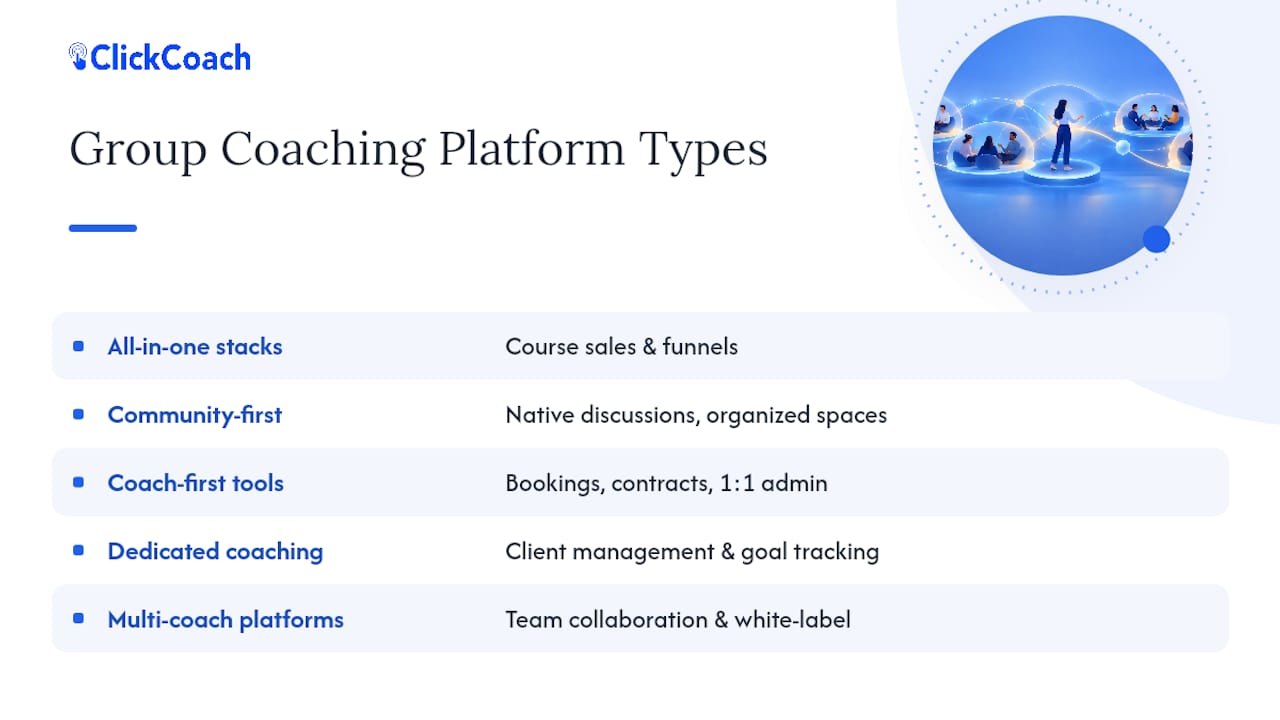
Testing across the group coaching software category consistently shows a split: all-in-one marketing stacks win on course bundling, live streaming, and payment funnels, while dedicated coaching platforms win on client management and goal tracking. That split runs through every entry below.
None of the platforms above publish reviews consistently enough across independent aggregators to compare on star rating alone, which is exactly why this list ranks on delivery architecture and client management depth instead.
A few patterns are worth pulling out of that table. Mighty Networks and Circle both built their businesses around community first, and it shows. Discussion feels native, spaces feel organized, and members rarely need to leave the app to talk to each other. Neither was built with coaching-specific workflows like session notes or client progress charts as the primary focus, so coaches running structured 1:1 work alongside their cohorts often end up layering a second tool underneath.
Kajabi, Kartra, and Thinkific share a different center of gravity: they were built to sell courses and convert leads through funnels, and group coaching features sit on top of that foundation. If more than 40 percent of your revenue already comes from course or cohort sales rather than 1:1 coaching, that architecture fits your revenue mix. If your revenue is coaching-heavy, you’ll be paying for marketing infrastructure you barely touch.
Satori, Paperbell, CoachAccountable, CoachVantage, and Bonsai occupy the opposite end. These are admin and scheduling tools built by and for coaches, and they handle bookings, contracts, and 1:1 accountability well. Group and cohort support is usually an add-on rather than the core design, which matters once you’re running more than one cohort at a time.
Delenta and Profi sit in between, with Profi specifically built for multi-coach organizations that need team collaboration and white-labeling rather than a single practitioner’s workflow. Practice Better leans toward wellness and health coaching niches with its own scheduling and intake conventions.
Pro Tip: Before comparing feature lists, calculate what each platform would actually cost you at your target cohort size. Per-seat and per-student transaction fees are where “affordable coaching platforms” quietly stop being affordable once you scale past 20 or 30 active clients.
Quick Platform Briefs: What Each Tool Does Best
-
ClickCoach. All-in-one practice management built for professional and group coaches, combining client records, cohort tracking, branded portals, and AI-assisted homework drafting in one login. Best for coaches running structured cohorts or multi-coach practices who are tired of reconciling three or four separate subscriptions. Pricing runs $497 per year per coach for both solo and multi-coach plans. Tip: use the progress charts as your renewal conversation starter, not just a retention dashboard.
-
Mighty Networks. Community-first platform supporting courses, memberships, and cohorts in one social space. Best for coaches whose program lives and dies on peer interaction between sessions. Pricing is tiered by plan level. Tip: set community guidelines before launch, since an unmoderated space grows noisy fast once you cross 50 active members.
-
Kajabi. Marketing and course infrastructure with membership delivery layered in. Best for coaches who sell courses as a funnel into higher-ticket group coaching. Pricing is tiered monthly or annually. Tip: its strength is the marketing funnel, not cohort-specific reporting, so pair it with a separate tracking system if you need at-risk client alerts.
-
Satori. Coaching-specific booking and program management with automated workflows. Best for booking-heavy solo coaches who want simple contracts and payment automation. Pricing is tiered monthly. Tip: works well for 1:1 to small-group hybrids, less well for large asynchronous cohorts.
-
Kartra. All-in-one marketing platform with funnel automation and membership tools. Best for marketing-led program launches with heavy automation needs. Pricing is tiered monthly. Tip: the learning curve on funnel building is real; budget setup time before your first cohort launch.
-
Paperbell. Lightweight scheduling and package tool built by a coach for coaches. Best for new coaches or small practices who want simple admin without complexity. Pricing is flat monthly. Tip: excellent starting point, but plan a migration path once you add group programs at scale.
-
CoachAccountable. Accountability and goal-tracking platform built around client engagement rather than course sales. Best for coaches who prioritize accountability structure over content delivery. Pricing is tiered monthly. Tip: its habit and goal tracking pairs well with cohort programs that emphasize between-session action.
-
CoachVantage. Practice management with scheduling, billing, and light group features. Best for solo and small-team coaches needing operational support without a full course ecosystem. Pricing is tiered monthly. Tip: solid administrative backbone, but check its cohort-specific reporting depth before committing a full cohort program to it.
-
Bonsai. Contract, invoicing, and admin automation. Best for coaches who need strong billing and legal document workflows more than course delivery. Pricing is tiered monthly. Tip: pair with a dedicated coaching or community tool if group delivery is central to your offer.
-
Delenta. Coaching platform emphasizing analytics and a client-facing app. Best for coaches who want session delivery and data in one dashboard. Pricing is tiered monthly. Tip: useful for practices that want to show clients visual progress data during renewal conversations.
-
Profi. Platform for medium to large coaching organizations with team collaboration tools. Best for multi-coach organizations running collaborative or white-labeled programs. Pricing is tiered or enterprise. Tip: overbuilt for a solo practice, but worth evaluating once you add a second or third coach to your team.
-
Circle. Community and cohort platform with a clean interface for engaged learner communities. Best for coaches who put community discussion at the center of the program. Pricing is tiered monthly or annually. Tip: pairs naturally with cohort-linked Q&A threads tied to lesson milestones, which keeps discussion from turning into a single unstructured feed.
-
Thinkific. Course-first platform supporting cohorts and memberships. Best for course creators adding group coaching elements to existing content. Pricing is tiered monthly or annually. Tip: strongest for content delivery, weaker for live cohort facilitation without add-ons.
-
Teachable. Popular course platform with basic membership and coaching add-ons. Best for coaches focused on content sales with occasional group calls. Pricing is tiered monthly. Tip: simple commerce setup, but treat group coaching as a secondary feature rather than the core use case.
-
Practice Better. Wellness-oriented coaching practice tool with scheduling and client notes. Best for health and wellness coaching practices needing streamlined client workflows. Pricing is tiered monthly. Tip: check its cohort scheduling depth if you’re running group wellness programs rather than 1:1 work.
How to Choose: A Demo-Ready Checklist for Vendors
Walking into a vendor demo without a script means you’ll leave with a favorable impression and no real answers. Bring this list instead.
Non-negotiables to confirm before you sign anything:
- Native cohort support with start/end dates, drip scheduling, and lesson-linked discussion threads
- Community discussion built into the platform, not routed to Slack or an external forum
- A clear data export option for client records and course content, in a standard format like CSV
- Transparent per-seat or per-student fees stated up front, not discovered at your first invoice
Exact questions to ask on the demo call:
- How does a new cohort get created, and can assignments unlock automatically by week?
- What reporting exists to flag clients who are falling behind, not just tracking who’s completed?
- What does data export look like if we leave, and does it include client notes and progress history?
- Are there per-student or per-seat charges once we exceed our current plan’s client count?
- Does the platform support SSO or API access if we add coaches or connect other tools later?
Watch for a few warning signs during that call. Vendors who dodge a direct pricing question, who push community discussion off-platform “for now,” or who can’t clearly explain data export terms are telling you something about how they’ll handle your account later. A format-first evaluation beats a feature checklist every time, because the wrong architecture for your delivery model costs you far more than a missing button ever will.
If you do decide to switch platforms, export your raw client data and course content before you cancel anything, and plan a two-week overlap where both platforms run simultaneously for active cohorts. That overlap window protects program momentum and gives you a real safety net if the migration hits a snag.
Pro Tip: Ask every vendor the exact same five questions in the exact same order. Comparing answers side by side, rather than trusting your notes from three different sales calls, is the only way to catch the vendor who quietly avoided the pricing question.
Why an Integrated System Changes What “Progress” Looks Like
Coaches don’t lose clients because the coaching was bad. They lose clients because nobody could show the client, in concrete terms, that the work was moving somewhere. That’s the operational gap consolidated tools close, and it’s worth being direct about why it matters more than most feature comparisons suggest.
When client records, session notes, homework, and progress data live in separate tools, a coach spends renewal week hunting for evidence instead of presenting it. When they live in one system that evidence is already assembled.
Branded client portals aren’t a vanity feature. They’re the difference between a client who logs in weekly to see their own progress chart and a client who forgets what “working with a coach” was even supposed to change. Progress a client can see in their own portal is progress they renew for.
The caveat matters as much as the benefit: tool choice still has to match delivery format. A coach running a course-heavy funnel needs different infrastructure than a coach running tight, accountability-driven cohorts. And once you add a second or third coach to your practice, integration depth and reporting consistency stop being nice extras and start being the thing that keeps your team’s client data from fragmenting across five different logins.
What This Comparison Gets Right That Most Roundups Miss
Most “best coaching software” articles rank platforms by feature count, as if more buttons equal a better fit. That’s backwards. The coaches who struggle most with their tools aren’t missing a feature. They’re running a coaching-first practice on marketing-first software, or vice versa, and wondering why nothing feels smooth.
The format-first decision rule this article leans on isn’t a hedge. It’s the actual answer. If your revenue is coaching heavy, a platform built to sell courses will always feel like it’s fighting you, no matter how many integrations it has. If your revenue depends on course sales and cohort bundling, a coaching-first tool will feel thin on marketing infrastructure.
What I’d prioritize first, before any feature comparison: pull up your last three renewal conversations and ask whether you had concrete progress evidence ready or whether you were improvising. If you were improvising, that’s your platform gap, not a marketing gap or a scheduling gap. Fix that first, and the rest of the stack tends to sort itself out.
— Mitch Russo
Try ClickCoach for Your Next Cohort
This platform is built for coaches running structured cohorts who need integrated admin and real progress evidence, not another dashboard to check separately from everything else. It brings client records and progress charts into one view, gives each client a branded portal they actually open between sessions, and uses AI to help draft homework and follow-up actions while the coach stays in the editing seat.
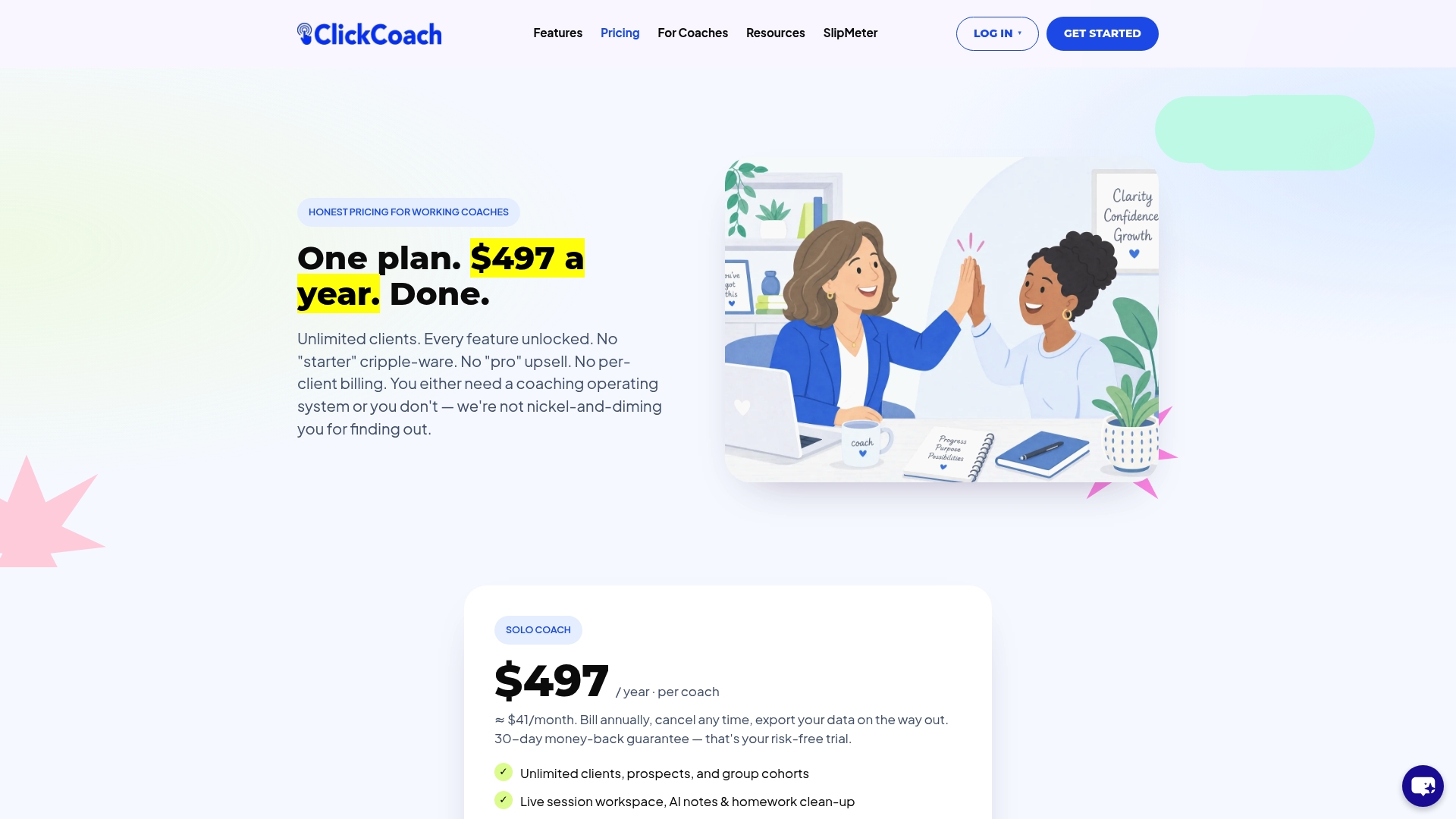
That combination solves the specific problem this article has circled back to repeatedly: coaches losing renewal conversations because the proof of progress lived in three different tools instead of one. The service charges an annual fee per coach, with the same rate applying whether running the practice alone or adding coaches to a growing team. Check current pricing and plan details and see whether it fits your next cohort launch.
Sources
The claims in this article draw on cohort learning benchmarks, platform testing roundups, and buyer guidance built specifically for coaches evaluating software in 2026.
- Cohort Learning Platform Checklist: 8 Buying Criteria
- 15 Group Coaching Platforms Tested in 2026
- How to Pick an Online Coaching Platform in 2026 | keedia
FAQ
What Is the Best Coaching Platform for Organizations?
For multi-coach organizations, Profi and ClickCoach both offer team-based structures, with Profi built around collaboration and white-labeling for larger teams and ClickCoach offering per-coach pricing with shared client record access. The right choice depends on whether you need enterprise-level collaboration tools or a simpler unified workspace for a small coaching team.
What Is the 70/30 Rule in Coaching?
The 70/30 rule generally refers to coaching conversations being mostly client talking and reflecting, with the coach speaking or guiding the rest. It’s a rough guideline for staying client-centered rather than a strict measurable standard, and different coaching methodologies apply it somewhat differently.
Can ChatGPT Be My Life Coach?
ChatGPT can offer general reflection prompts and information, but it lacks accountability, personalized progress tracking, and the professional judgment a trained coach provides. Tools like ClickCoach use AI to help coaches draft homework and follow-up notes faster, but the coach remains the one interpreting client context and steering the relationship.
What Are the 5 C’s of Coaching?
Definitions of the “5 C’s” vary across coaching frameworks, and there’s no single universally agreed list. Rather than cite an unverified acronym, focus on what consistently drives outcomes: clear goals, consistent check-ins, and visible progress tracking between sessions.
How Much Does ClickCoach Cost?
ClickCoach costs $497 per year per coach, whether you’re on the solo coach plan or the multi-coach company plan. Partner and white-label pricing is available on request through the ClickCoach pricing page.