

An all-in-one coaching practice management platform is the best choice for most business coaches because it unifies client records, session management, billing, and coaching workflows into a single workspace. That kind of unification cuts administrative time and helps clients follow through between sessions, which is where most coaching relationships either build momentum or quietly stall.
TL;DR:
- All-in-one coaching platforms are ideal for solo coaches and multi-coach practices because they reduce administrative workload and ensure consistent client tracking.
- Essential features include unified client records, session scheduling, homework templates, billing, and client portals, with automation and data portability as valuable add-ons.
- AI is useful primarily for drafting summaries and suggesting actions but still requires coach oversight to ensure accuracy and data security.
- Implementation typically takes one to three months for solos, with a gradual rollout of workflows to maximize adoption and measurable client engagement.
- Prioritize cybersecurity by enabling multi-factor authentication, using password managers, and ensuring data exportability to protect sensitive coaching data.
Table of Contents
- Which coaches should choose an all-in-one platform
- Essential feature checklist for coaching CRMs
- Practical uses and limits of AI in coaching CRMs
- Typical pricing shapes and a realistic implementation timeline
- Security and privacy checklist for coaching data
- A step-by-step rollout checklist and metrics to watch first
- Customer support quality and availability for coaching professionals
- What successful CRM adoption looks like for coaching practices
- Practitioner perspective: trade-offs and adoption tips
- How ClickCoach maps to this checklist
- Sources
- FAQ
Which coaches should choose an all-in-one platform
The right CRM depends on how you run your practice today, not just how many clients you serve. A solo coach juggling scheduling, invoicing, and session notes in three different apps has different needs than a coaching firm managing five practitioners and shared client accounts.
Solo coaches benefit most from an all-in-one platform because every hour spent reconciling data between a calendar app, a payment processor, and a notes document is an hour not spent coaching. When you’re the only person running the business, fewer logins and less manual data entry translate directly into more billable capacity.
Multi-coach practices need something more: shared visibility into client progress, consistent session templates across coaches, and a way for a practice owner to see engagement patterns without sitting in on every session. A general CRM built for sales teams rarely handles this well because it wasn’t designed around session cadence, homework assignments, or coaching outcomes.
Coaching firms scaling toward a team model face a third challenge: onboarding new coaches quickly while keeping quality consistent. Here, the platform itself becomes part of your operating system, not just a record-keeping tool.
That said, an all-in-one platform isn’t automatically right for everyone. Here’s a quick way to think about the alternatives:
- Entry-level CRMs built for general small business use can work if you have very simple needs and don’t require session notes, homework tracking, or client portals.
- Project or task apps can handle homework tracking loosely but were never designed for client confidentiality, billing, or coaching-specific reporting.
- Agency or enterprise CRMs offer deep customization but often require technical setup time that most independent coaches don’t have and don’t need.
If your practice involves recurring sessions, measurable client goals, and any form of billing or contracts, a coaching-focused all-in-one platform will almost always save more time than it costs to learn. If you run a very small side practice with occasional clients and no recurring billing, a simpler tool stack may be enough until you grow.
Essential feature checklist for coaching CRMs
Not every feature matters equally. Some are foundational; others are nice conveniences you can live without at first. Here’s a priority order based on what actually affects client outcomes and your time.
- Client records and session history. Every session, note, and goal should live under one client profile so you’re never reconstructing context before a call.
- Session scheduling and calendar sync. Two-way sync with your existing calendar avoids double-booking and manual rescheduling emails.
- Homework and action-plan templates with progress tracking. Structured templates you can reuse across clients save setup time and make accountability visible over time.
- Billing, subscriptions, and e-sign contracts. Built-in invoicing and digital signatures remove the need for separate payment and paperwork tools.
- Client portal and client-facing deliverables. A branded space where clients can see their own goals and homework builds trust and reduces “what am I supposed to be doing” emails.
- Automations and integrations. Automatic reminders, follow-ups, and connections to email marketing or payment processors cut repetitive manual work.
- Data export and portability. You should always be able to get your client data out in a usable format, in case your needs change later.
Client records and session history matter most because coaching is a relationship built on continuity. If you can’t quickly recall what a client committed to last session, the coaching itself suffers. Billing and e-sign features matter almost as much for a different reason: unpaid invoices and unsigned agreements are two of the most common sources of friction in a coaching business, and both are easy to eliminate with the right setup.
Client portals deserve particular attention because they shift accountability outward. When clients can log into their own portal and see their goals, homework, and progress laid out, they take more ownership of the work between sessions. A client portal that’s actually used, rather than one client forget exists, depends on how simple and visually clear it is.
Pro Tip: Before comparing platforms feature by feature, list the five administrative tasks that eat the most time in your week. That list will tell you more about what to prioritize than any feature checklist.
Practical uses and limits of AI in coaching CRMs
AI has become a genuine time-saver in coaching software, but it’s worth being clear about what it does well and where it still needs a human hand on the wheel.
Where AI helps most right now:
- Drafting session summaries so you’re not typing notes from memory after every call.
- Suggesting homework or action items based on what was discussed in a session.
- Logging routine CRM updates like scheduling changes or follow-up reminders.
- Flagging clients who haven’t engaged with their portal or completed homework recently.
AI agents built into CRM-style platforms still require human oversight. Research evaluating AI agent performance on CRM-like tasks found that these agents assist with routine work but do not reliably complete realistic tasks without a person checking the output. That matches what most coaches should expect: AI can draft a homework assignment or summarize a session, but the coach still needs to review it before it reaches a client.
This coach-in-the-loop pattern is the safest way to use AI in your practice. A useful prompt structure is to have the AI draft a summary of the session’s key themes and proposed next steps, then you edit before sending. The tool saves the first draft’s worth of time; you keep the judgment.
One more consideration: any AI feature that reads or processes client conversations touches sensitive data. Before enabling an AI assistant in your coaching accountability workflow, check how the platform handles data used to generate those drafts and whether it’s stored or shared beyond your account.
Typical pricing shapes and a realistic implementation timeline
Coaching CRM pricing generally falls into a few patterns: per-coach monthly or annual subscriptions, tiered plans based on client volume, or flat annual licenses that include full platform access. Annual plans typically cost less per month than paying monthly, but they ask for more commitment upfront, so it’s worth trying a platform during a trial period before committing to a year.
Setup time varies by how much you’re migrating from existing tools, but a realistic timeline for a solo coach looks like this:
- Week 1: Trial and evaluation. Test core workflows, scheduling, and templates with one or two real clients before committing.
- Weeks 2 to 3: Setup and configuration. Build your client fields, session note templates, and billing settings.
- Weeks 3 to 4: Data migration. Move existing client records, notes, and contracts into the new system.
- Weeks 4 to 6: Template creation. Build reusable templates for session notes, homework, and client onboarding.
- Days 30 to 90: Full adoption. Run every active client through the new system and start tracking admin time saved.
Multi-coach practices should expect this timeline to stretch, since you’re coordinating templates and permissions across more than one calendar and client base. Budget extra time for training each coach on the shared workflow so client experience stays consistent no matter who’s running the session.
Security and privacy checklist for coaching data
Coaching conversations often touch sensitive personal and business information, which makes basic cybersecurity hygiene non-negotiable, not optional. You don’t need an IT department to get the fundamentals right.
- Enable phishing-resistant multi-factor authentication on your CRM account and any connected email or payment tools.
- Use a password manager to generate and store strong, unique passphrases instead of reusing passwords across platforms.
- Set up regular backups of client data and confirm you can actually export it if you ever need to switch platforms.
- Apply least-privilege access for any team members, giving each coach or assistant only the permissions their role requires.
- Use single sign-on where available to reduce the number of separate credentials your team has to manage.
Small businesses that adopt basic cybersecurity practices reduce their exposure meaningfully. NIST’s small business cybersecurity guidance recommends phishing-resistant MFA, strong unique passphrases, regular backups, and outsourcing specialized cybersecurity tasks when a firm lacks in-house expertise, all of which apply directly to a solo or small coaching practice handling client data.
Beyond your own habits, review what your CRM vendor commits to contractually. Look for clear language on incident notification timelines, how your data may be used, and how long client records are retained after you cancel. The NIST Cybersecurity Framework 2.0 organizes these responsibilities into six functions, Govern, Identify, Protect, Detect, Respond, and Recover, which gives small firms a simple structure for deciding what to ask a vendor before signing.
A step-by-step rollout checklist and metrics to watch first
A CRM only pays off if you actually use it consistently, and consistency comes from a clear rollout plan rather than trying to do everything at once.
- Map your current workflows before you touch any software. Write down how you currently handle scheduling, notes, billing, and homework so you know what needs to transfer.
- Choose your first three templates. Start with a session note template, a homework template, and a renewal or check-in template rather than building everything at once.
- Migrate active clients first. Bring in your current caseload before adding prospects or past clients to keep the transition manageable.
- Run one full client cycle inside the new system. Complete at least one full session-to-homework-to-follow-up loop before judging whether the setup works.
- Review admin time saved after 30 days. Compare how long weekly admin tasks take now versus before the switch.
- Check client engagement with the portal after 60 days. Look at whether clients are actually logging in and completing homework, not just whether the feature exists.
- Evaluate renewal conversations at 90 days. Use the progress history you’ve built to make renewal discussions concrete instead of anecdotal.
Pro Tip: Build your session note and homework templates before you migrate a single client. Retrofitting templates onto existing records takes far longer than starting clean.
The session notes template is worth getting right early, since it becomes the backbone of every other workflow, from progress tracking to renewal conversations. Once that template is solid, homework and check-in templates tend to follow the same structure with minor adjustments.

Customer support quality and availability for coaching professionals
Support quality matters more for coaches than for many other small business owners, because a scheduling glitch or a broken client portal link can happen minutes before a session starts. When evaluating a platform, ask directly what support channels are available and what response times look like during business hours versus evenings and weekends, since many coaches run sessions outside a typical nine-to-five.
Look for platforms that offer clear documentation and a responsive support channel rather than a support ticket queue with vague turnaround promises. A coaching-specific platform has an advantage here: its support team is more likely to understand what a “client portal” or “session note template” actually needs to do, compared to general-purpose CRM support staff who may not know coaching workflows at all.
Before committing to an annual plan, it’s reasonable to test support responsiveness during your trial period. Send a real question and see how quickly and how usefully it gets answered. That single interaction often tells you more about what ongoing support will feel like than any marketing page.
What successful CRM adoption looks like for coaching practices
Rather than pointing to any single story, it’s more useful to describe the pattern that shows up when a coaching practice successfully adopts a CRM. The common thread is sequencing: coaches who succeed start with one workflow, usually session notes or scheduling, get it running smoothly, and only then add billing, portals, and automation on top.
The coaches who struggle tend to try migrating everything at once, including years of historical client data, while also learning a new interface and running live sessions in the same week. That combination creates enough friction that many give up within the first month and revert to their old scattered tools.
A realistic marker of success looks like this: within 60 to 90 days, a coach spends noticeably less time on scheduling and invoicing, has a consistent template for every session, and can show a client a visual record of their progress during a renewal conversation. That last piece, having concrete progress evidence rather than a general sense that things are going well, is often what separates a coach who renews clients smoothly from one who has to make the case from memory each time.

Practitioner perspective: trade-offs and adoption tips
Every coach I’ve talked with who switched to a unified platform hit the same early obstacle: the temptation to migrate every old note and file before doing a single new session in the system. That instinct is understandable but counterproductive. The coaches who adopt fastest start with new clients or the next scheduled session, not the archive.
Momentum after launch comes from small, visible wins. The first time a client logs into their portal and completes homework without being reminded, that’s the signal the system is working, not the initial setup itself.
Operationally, success looks quiet rather than dramatic: fewer emails asking “when’s our next session,” fewer forgotten invoices, and a renewal conversation backed by an actual record instead of a gut feeling. That’s the real return on switching, even when it doesn’t show up as a headline number.
— Mitch Russo
How ClickCoach maps to this checklist
If you’ve read this far, you already have the framework for evaluating any coaching CRM: client records, session workflows, billing, portals, and security, all working together rather than bolted on. ClickCoach was built around that exact checklist.
- Session management and client records live in one workspace, so notes, goals, and history stay attached to each client automatically.
- Client portals are branded to your practice, giving clients a space to see homework and progress without a separate login for every tool.
- Billing and e-sign contracts are built in, removing the need for a separate invoicing or agreement tool.
- AI-assisted drafting helps clean up session notes and suggest homework, with the coach reviewing before anything reaches a client.
- Progress tracking gives you the visual record that makes renewal conversations concrete instead of anecdotal.
This setup fits a solo coach who wants fewer logins and less admin, and it scales to a multi-coach company that needs shared templates and visibility across practitioners. A partner or white-label option is also available for firms that want to offer the platform under their own brand.
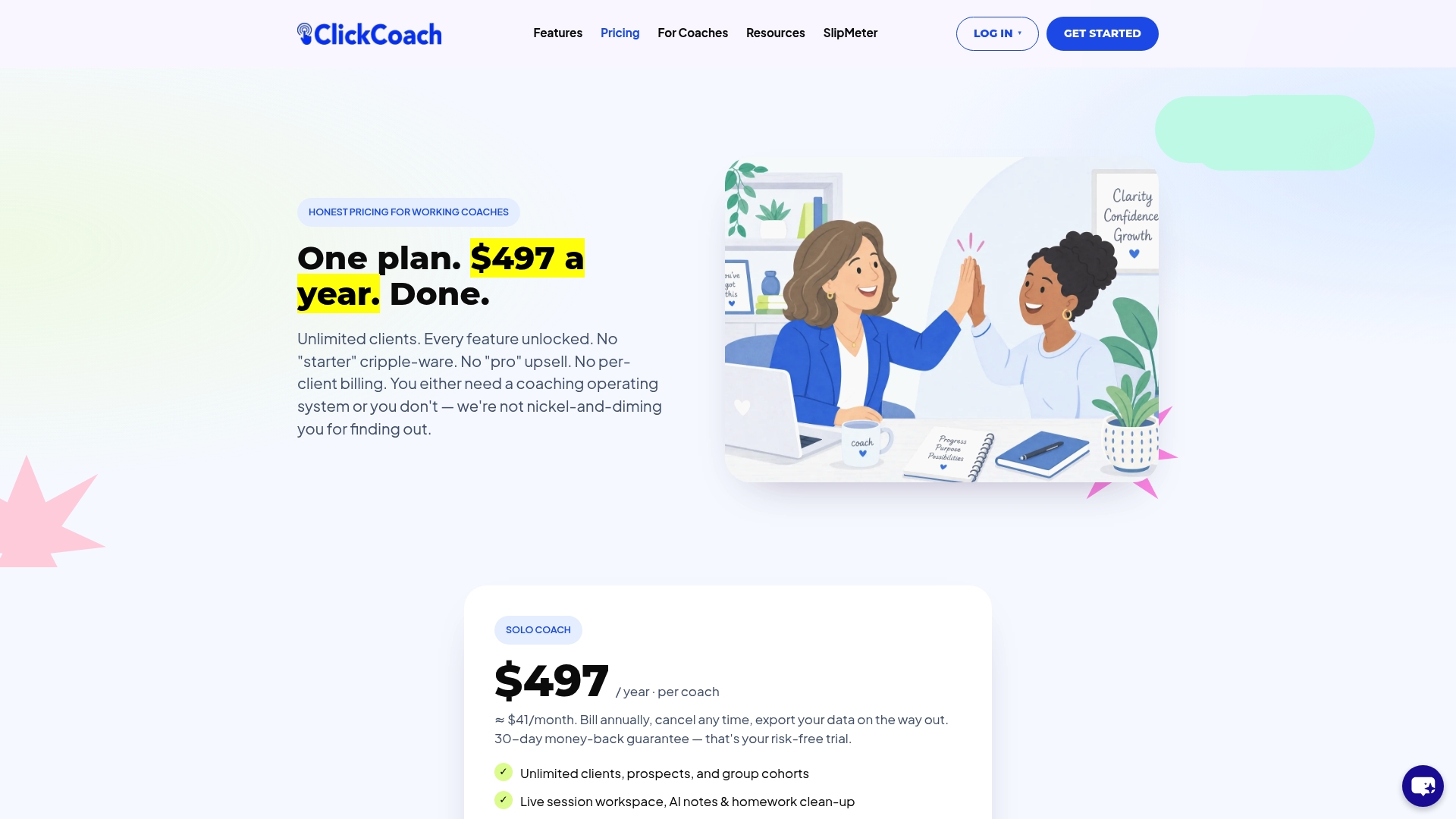
ClickCoach is priced at $497 per year per coach for both the Solo coach and Multi-coach company plans, with full platform access included and a 30-day money-back guarantee if it doesn’t fit your practice. If you’re ready to see whether it matches the workflow you just mapped out, you can check the plan details and get started.
Sources
- NAACL 2025 paper on AI agent performance
- NIST CSWP 50: Small Business Cybersecurity: Non-Employer Firms (initial public draft)
FAQ
What is the 70/30 rule in coaching?
Definitions of that rule vary by coaching methodology, and there is no single authoritative source defining it universally.
What are the top 3 CRM platforms for coaches?
Rather than a fixed ranking, the right choice depends on whether you need a coaching-specific platform with session notes and client portals, a general small business CRM, or an enterprise-grade system built for larger sales teams. Coaches with recurring sessions, homework tracking, and billing needs typically get the most value from a coaching-focused all-in-one platform like ClickCoach rather than a general-purpose CRM.
Will CRM be replaced by AI?
AI is being built into CRM platforms to automate routine tasks like drafting notes and logging updates, but research on AI agents performing CRM-like tasks found they still need human oversight and do not reliably complete realistic tasks autonomously. CRM systems are more likely to keep evolving with AI-assisted features than to be replaced by AI entirely.
What is the best business coaching software?
The best software depends on your practice size and workflow, but coaches generally get the most value from an all-in-one platform that combines client records, session notes, billing, and client portals rather than juggling separate tools. ClickCoach is built specifically around these coaching workflows, with plans starting at $497 per year per coach and a 30-day money-back guarantee.
How do I choose a CRM if I’m just starting my coaching practice?
Start by listing the administrative tasks that currently take the most time, such as scheduling, invoicing, or writing session notes, and look for a platform that handles those as built-in features rather than add-ons. A short trial period with one or two real clients will tell you more about fit than any feature comparison chart.