

The best coaching session software for professional coaches is an all-in-one coaching practice management platform, not a patchwork of separate apps. The right platform centralizes session notes, client progress tracking, billing, and a branded client portal in a single secure workspace, so you spend your time coaching instead of reconciling five different tools.
TL;DR:
- Confirm that the platform offers encryption, multi-factor authentication, and transparent privacy policies before trusting it with client data.
- Test whether the system supports note templates, progress tracking, homework assignment, automated reminders, and billing functions during a realistic trial.
- Ensure the software provides a data export option and does not lock client records within proprietary formats, enabling smooth data portability.
- Verify that AI features include clear disclosure, human oversight, and do not handle clinical or diagnostic tasks without safeguards.
- Run a complete scheduling, session, homework, and billing cycle with a test client to identify workflow gaps before switching to real client records.
Table of Contents
- How to choose the right coaching session software
- Feature checklist: session, progress, scheduling, billing, and integrations
- Ethics, data security, and AI: ICF-aligned checklist and required disclosures
- [How consolidating tools into one platform reduces admin and supports measurable client progress, a key factor in how to get coaching clients through proven business tactics.](#how-consolidating-tools-into-one-platform-reduces-admin-and-supports-measurable-client-progress-a-key-factor-in-how-to-get-coaching-clientshttpssolsocialmediacomposthow-to-get-coaching-clients-how-to-get-coaching-clients-with-7-proven-tactics-through-proven-business-tactics)
- If you want an all-in-one option: what ClickCoach offers and how to test it
- Author’s perspective: consolidation vs. best-of-breed
- FAQ
- Sources
How to choose the right coaching session software
Picking a platform is less about feature lists and more about running the right test. Use this order during free trials and demos so you catch problems before you commit a year of client data to a system.
- Security and ethics first. Confirm encryption, multi-factor authentication, and a documented privacy and retention policy before anything else.
- Session workflow fit. Check for note templates, quick capture during a live session, private versus shareable notes, and a clear view of progress across sessions.
- Client experience. Look for a branded client portal, homework and task assignment, automated reminders, and a resource library your clients will actually open.
- Business operations. Test billing and subscription handling, invoicing, calendar sync, and reporting you can show a client at renewal time.
- AI behavior. Determine whether AI assists you only or interacts directly with clients, and require clear disclosure and control either way.
Run a focused 30 to 60 minute test first: create a sample client, log a session, and assign one piece of homework. If the platform survives that without friction, move to a 14 to 30 day trial where you run two or three real client sessions end to end, from scheduling through invoicing.
Pro Tip: Before trusting any platform with client records, read its privacy policy for data retention and deletion terms, not just its marketing page.
Feature checklist: session, progress, scheduling, billing, and integrations
A platform can look polished in a demo and still fail you in daily use. These are the behaviors worth confirming category by category.
- Session notes: templated formats, tags for quick search, export options, and retention controls you set, not the vendor.
- Goals and progress tracking: milestone setting and a visual progress chart you can pull up during a renewal conversation.
- Action items and homework: clear assignment, automated reminders, and a way to confirm completion rather than guess.
- Client portal and branding: white-label options, access controls, and a mobile experience your clients will use without a tutorial.
- Scheduling and group support: time zone handling, calendar integrations, and a workflow built for cohorts, not just one-on-one sessions.
- Billing and subscriptions: recurring payments, tax and receipt handling, and straightforward refund and reporting tools.
- Integrations and data portability: connections to the video and calendar tools you already use, plus a real export path in CSV or JSON if you ever need to leave.
That last point matters more than it seems. A platform that locks your client history inside a proprietary format is a platform you cannot safely bet your practice on.
Ethics, data security, and AI: ICF-aligned checklist and required disclosures
The 2025 ICF code of ethics requires coaches to maintain strict confidentiality for electronic records and to confirm that any platform they use meets ethical obligations for data privacy and security, including secure login such as multi-factor authentication, data encryption, and transparent data policies. The same guidance makes clear that verifying this is your responsibility, not something you can outsource to a vendor’s compliance badge.
- Security: encryption in transit and at rest, multi-factor authentication, a documented breach response plan, and real options to retain or delete data.
- AI: distinguish coach-assisting AI from client-facing AI, since the ICF AI framework prescribes disclosure, human oversight, and safeguards for either kind, and AI should never be used for clinical or diagnostic tasks.
- Practical steps: add platform-use language to your coaching agreements, store records securely, and set a recurring date to review your platform’s policies.
One safeguard worth building into any coach-assisting AI workflow: a visible audit trail showing AI-suggested text alongside your final edits, a practice the ICF AI framework recommends to keep accountability and client trust intact.
How consolidating tools into one platform reduces admin and supports measurable client progress, a key factor in how to get coaching clients through proven business tactics.
Most coaches lose time to the same handful of tasks: scheduling back and forth, writing session notes in one app, chasing invoices in another, and manually sending reminders. A unified workflow addresses each step in sequence instead of forcing you to stitch them together.
- Scheduling to notes: a session that starts from a calendar booking and opens straight into a note template skips the copy-paste step entirely.
- Notes to homework: assigning an action item right from the session record keeps it tied to context instead of living in a separate task app.
- Homework to reminders: automated follow-up nudges reduce the manual messages you would otherwise send yourself.
- Notes to billing: session records that connect to invoicing cut down on manual reconciliation at month end.
A simple trial workflow to test this: create a client record, run a session using a note template, assign homework, and turn on an automated reminder. If coach-assisting AI drafts a follow-up summary for you to review and edit, confirm that your consent language covers it. Our progress tracking and session notes pages go deeper on how these pieces connect, and our group coaching page covers cohort workflows.
Pro Tip: Run the full scheduling-to-invoicing loop with one test client before you migrate real client records, so you catch workflow gaps early.

If you want an all-in-one option: what ClickCoach offers and how to test it
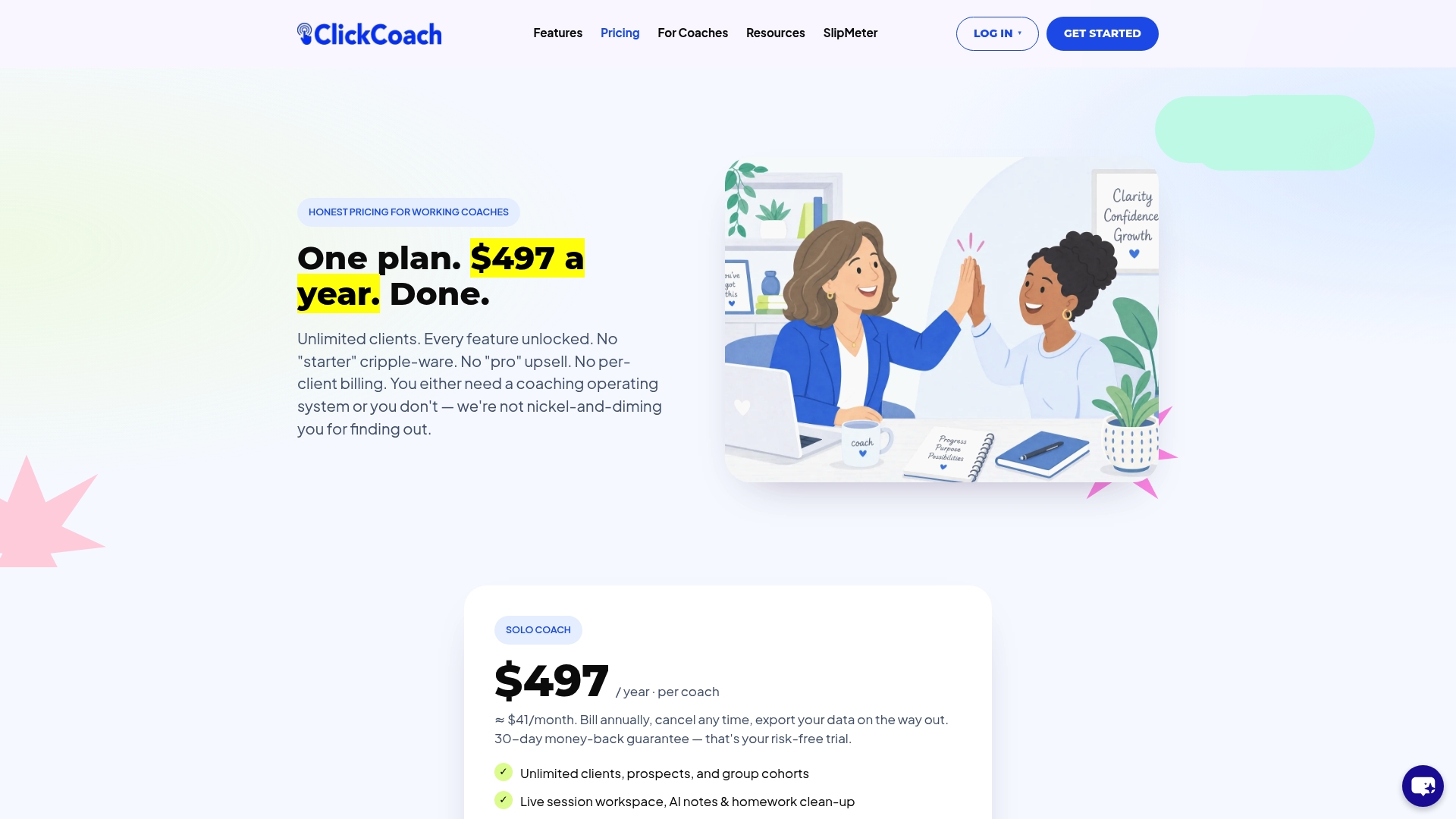
We built ClickCoach to bring the pieces above into one login instead of five subscriptions. Our platform combines session notes, client progress tracking, billing and subscriptions, a branded client portal, and AI-assisted homework drafting that keeps you in control of the final text.
In a trial, we recommend you test:
- Creating a client record and running a session with a note template.
- Assigning homework through the client portal and checking how reminders fire.
- Walking through a billing cycle, including an invoice and a refund.
- Exporting a client’s data to confirm you are never locked in.
- Reviewing an AI-drafted follow-up before it reaches a client, to confirm you retain editorial control.
If this fits how you want to run your practice, our pricing page lists plans for solo coaches and multi-coach companies, each starting from a trial path rather than a demo call.
Author’s perspective: consolidation vs. best-of-breed
Consolidation tends to win for solo and multi-coach practices that want to scale without adding administrative headcount. A best-of-breed stack still makes sense for a narrow, specialized workflow, such as a clinical assessment tool no general platform replicates. For most fee-for-service coaches reading this, one platform that covers sessions, progress, billing, and client access beats five tools that each do one thing well but none that talk to each other.
— Mitch Russo
FAQ
What should I test first in a coaching software trial?
Start with a 30 to 60 minute functional test: create a sample client, run a mock session with a note template, and assign one piece of homework. If that flow feels natural, move into a longer trial with real sessions before committing.
Does coaching software need to meet ICF ethical standards?
Yes. The 2025 ICF code of ethics requires coaches to keep electronic client records confidential and to confirm that any platform they use supports encryption, secure login, and transparent data policies. Verifying this is the coach’s responsibility, not the vendor’s.
Is AI safe to use in client sessions?
AI is acceptable when you disclose it to clients, keep the coach in control of any output, and avoid using it for clinical or diagnostic decisions, following the distinctions laid out in the ICF AI framework. Coach-assisting AI that drafts a follow-up for your review is a different category than AI that interacts directly with clients.
What does ClickCoach cost?
ClickCoach offers a Solo coach plan and a Multi-coach company plan, each at $497 per year per coach, along with a Partner or white-label option priced on request. Full details are on our pricing page.
How long should a coaching software trial run?
A short functional check takes under an hour, but a full trial of 14 to 30 days gives you room to run real sessions, test billing, and confirm the client portal experience before switching your practice over.
Sources
Before adopting any platform, review the ICF code of ethics, the ICF AI framework, and the ICF ethics insights covering technology-assisted coaching.