

The best coaching pipeline software for professional coaches is an all-in-one practice management platform that combines a client pipeline, session management, progress tracking, billing, and a branded client portal in one workspace. We recommend ClickCoach as a direct option built around that exact combination, because it fits a range of coaching practices without forcing you to stitch together separate tools. The right platform cuts administrative hours and gives you proof of client progress you can point to at renewal time.
TL;DR:
- Before signing, test contact import and export, consent flow, progress reports, and role permissions; demos can miss duplicate records and exposure of private notes.
- Require written answers on encryption, retention, deletion, access controls, incident response, and AI training opt out; coaches remain responsible for consent and confidentiality.
- Use a one to two week trial, a two to four week pilot with three to five clients, then a four to eight week rollout.
- ClickCoach charges $497 annually per coach for Solo and team plans, offers a 30 day money back guarantee, and quotes partner pricing on request.
- Prioritize recurring assessments and client visible progress charts, then confirm pipeline stages, templates, and mobile portal match your coaching workflow.
Table of Contents
- How to evaluate coaching pipeline software
- What each core feature actually does for your practice
- Security and ethics checks every coach should run
- How to pilot and onboard without losing momentum
- Mobile access and compatibility
- Customizing your pipeline and workflows
- Support and training from your software vendor
- Scaling from solo practice to a coaching business
- User experience and interface quality
- What actually matters when you choose coaching software
- ClickCoach: matching the checklist to a direct option
- FAQ
- Sources
How to evaluate coaching pipeline software
Picking a platform gets easier when you grade it against a fixed list instead of comparing feature pages one tab at a time. Start with the capabilities that touch your daily workflow, then move to the security and ethics questions that protect your clients and your practice.
- Pipeline and CRM fit: Does it map your actual stages, from inquiry to discovery call to signed client, without forcing you into a sales-team template?
- Session tools: Can you build reusable session templates, capture notes quickly, and assign action items before the call ends?
- Progress tracking: Does it support recurring assessments and visual charts you can show a client at renewal?
- Billing: Does it handle invoicing and subscription billing inside the same login, or do you still need a separate payment processor?
- Client portal: Will your clients actually log in to see homework, resources, and progress, or does the interface feel like one more app to ignore?
- Integrations and reporting: Does it sync with your calendar and email tools, and can you export data if you ever switch platforms?
- Team features: If you run a multi-coach practice, can you assign roles, share notes securely, and track workload across coaches?
- Security and AI ethics: Does the vendor document encryption, data retention, deletion policies, and an opt-out for AI model training?
Before you commit, run a short trial that tests the boring, but critical mechanics: import a batch of contacts, export them again, walk through the client consent flow, pull a sample progress report, and confirm that a junior coach’s login can’t see another coach’s private notes. These tests catch problems that a sales demo never shows you.
Weigh the tradeoff between one platform and a stack of best-of-breed tools honestly. A single system usually wins on admin time saved and on how easy it is to show a client their own progress over months, even when an individual point solution looks shinier on its own.
Pro Tip: Time your own admin hours for one week before you switch tools, so you have a real baseline to compare against after onboarding.
What each core feature actually does for your practice
Feature lists are easy to skim and hard to evaluate, so it helps to connect each one to an outcome you can measure.
- Centralized client record and pipeline: A single timeline that follows a contact from first inquiry through active client status speeds up onboarding because you are not re-entering the same information in a spreadsheet and an email thread.
- Session management: Templates, structured notes, and action items turn every session into a repeatable process instead of a blank page, which keeps quality consistent across a full caseload.
- Progress tracking and recurring assessments: Regular check-ins produce charts you can bring into a renewal conversation as evidence of change, rather than relying on memory or anecdote.
- Homework, action plans, and AI-assisted drafting: Automated follow-up drafts save drafting time between sessions, and accountability tools that track whether homework actually gets completed give you a concrete signal about client engagement, as long as you stay in control of what goes out under your name.
- Billing and subscription management: Invoicing built into the same workspace where you track sessions reduces the back-and-forth that causes late payments and client churn.
- Client portal: A branded portal where clients can see their own homework and resources raises the odds they actually engage between sessions instead of waiting for your next reminder email.
- Team features for multi-coach practices: Defined user roles and shared note access let an owner oversee quality across several coaches without reading every transcript personally.
Progress data deserves particular attention because it is what separates a coaching relationship from a vague sense that things are going well. A progress tracking system that produces a chart over several months gives both you and the client something concrete to look at, which matters most at the exact moment a renewal decision is being made.
Security and ethics checks every coach should run
Treat your platform’s security and AI policies as purchase criteria, not fine print you skim after signing. The International Coaching Federation makes clear that coaches, not vendors, carry the responsibility for ensuring the technology they use meets ethical standards, which means you need to review a platform’s privacy and confidentiality policies yourself and document client consent before you rely on it, according to ICF guidance on technology and platforms.
Before you sign a contract, request written answers on these points:
- Encryption for data at rest and in transit.
- Role-based access controls and audit logs for who viewed or edited a client record.
- A documented data retention and secure deletion policy covering the full client data lifecycle.
- A written incident response plan for a breach or outage.
- An explicit opt-out so your client content is never used to train a public AI model, a safeguard ICF’s practical AI guidance recommends alongside transparency and informed consent.
The Federal Trade Commission’s Safeguards Rule requires covered businesses to maintain a written information security program, run risk assessments, and monitor service providers, with safeguards scaled to the size and sensitivity of the customer information involved, according to the FTC’s Safeguards Rule guidance. Appointing one person in your practice, even if that is just you, to own security oversight and report on it periodically gives you a defensible answer if a client or regulator ever asks how client data is protected.
Add a short data-privacy clause to your coaching agreement that names your retention period and your opt-out stance on AI training, so clients see the policy in writing rather than hearing it only if they ask.

How to pilot and onboard without losing momentum
Roll out new software in stages rather than flipping a switch for your entire caseload on day one. Start with a trial to confirm the basics work, move to a pilot with a handful of real clients, then expand to a full rollout once you trust the workflow.
- Trial (roughly one to two weeks): Configure privacy settings, build your first session template, and connect your calendar.
- Pilot (roughly two to four weeks): Run three to five real clients through the full cycle, from intake to a session to a homework assignment, and note where the workflow breaks down.
- Full rollout (roughly four to eight weeks): Migrate remaining clients, train any additional coaches on your team, and retire the old tools once data has moved cleanly.
A practical onboarding schedule that is built around measurable return on investment starts by cutting repetitive admin work such as session notes and invoicing, then tracks a baseline of hours spent so the improvement is visible within the first eight weeks, based on patterns reported in coach reviews of all-in-one platforms. Track admin hours saved, session prep time, homework completion rates, and portal logins as your early signals that the switch is paying off.
Watch for common migration pitfalls: duplicate contact records when importing from two sources, calendar sync conflicts that double-book a session, and file attachments that do not transfer with the client record they belong to.
Pro Tip: Keep your old system running in read-only mode for one full billing cycle after migration, so you have a fallback if a client record goes missing.
Mobile access and compatibility
Coaching happens between sessions as much as during them, so a platform that only works at a desktop misses half the job. Look for a genuine mobile experience, whether that means a dedicated app or a browser interface that resizes cleanly on a phone, because you will often want to check a client’s homework status or jot a quick session note from your phone right after a call.
The features that matter most on mobile are usually the simplest ones: reading a client’s last note before a call, marking homework complete, and checking tomorrow’s schedule. A platform that buries these behind a clunky mobile interface defeats the purpose of having one, no matter how strong the desktop version looks.
Compatibility also means checking whether the mobile experience works the same way on the operating systems your clients and team actually use. A client portal that renders well on one phone brand but breaks on another creates exactly the kind of friction that keeps people from logging in at all. Ask any vendor you are evaluating which devices and browsers they actively support, and test the portal yourself from a client’s point of view before you commit.
Customizing your pipeline and workflows
A generic sales pipeline template rarely matches how coaching actually works. Your stages probably look more like inquiry, discovery call, proposal sent, onboarding, active client, and alumni, and a platform that forces a rigid sales-team structure on top of that creates friction you will fight every week.

Look for the ability to rename stages, add custom fields relevant to your niche such as certification level or program type, and build separate pipelines if you run more than one kind of coaching engagement, such as one-on-one executive coaching alongside a group program. The ability to customize session templates matters just as much: an executive coach and a wellness coach ask different questions and track different outcomes, so a platform that locks you into one fixed note format will not serve either one well over time.
Flexibility has a limit worth respecting. A platform with too many configuration options can become its own time sink, so weigh how much customization you genuinely need against how much setup time you are willing to spend before your first paying client ever sees it.
Support and training from your software vendor
The quality of support you get after you sign matters as much as the feature list that convinced you to sign in the first place. Ask directly what support channels are available, what the typical response time looks like, and whether help is included in your subscription or billed separately.
Training resources deserve the same scrutiny. A knowledge base, onboarding guides, and video walkthroughs let you and any coaches on your team get comfortable with a new system without waiting on a support ticket for basic questions. If you run a multi-coach practice, ask whether the vendor offers any structured onboarding for new team members, since that is where inconsistent setup tends to start.
Response time matters most in the first few weeks, when you are still building templates and migrating client records and a stalled support ticket can stall your entire rollout. Ask a vendor directly, before you sign, how a typical support request gets handled and how long a response usually takes.
Scaling from solo practice to a coaching business
What a solo coach needs from software looks different from what a coaching firm with several coaches on staff needs, even when both are managing similar client relationships. A solo practitioner mostly needs speed: fast session notes, simple billing, and a portal that does not require client hand-holding to use.
A multi-coach practice adds a layer of complexity: role-based permissions so one coach cannot see another’s private client notes, a way to assign new leads to the right coach, and reporting that lets an owner see caseload and outcomes across the whole team without reading every session note personally. Group coaching tools that support cohort-based programs become relevant here too, since a firm running group programs alongside one-on-one work needs a system that handles both without separate logins.
The practical test is whether a platform grows with you without forcing a disruptive migration later. Ask whether adding a second coach is a simple seat addition or a structural change, and whether your historical client data and progress charts carry over cleanly when your practice grows from one coach to several.
User experience and interface quality
A platform with every feature on this checklist still fails if using it every day feels like a chore. Interface quality shows up in small things: how many clicks it takes to log a session note, whether your dashboard surfaces the information you actually need first, and whether the client-facing portal looks professional enough that you are comfortable sending clients a link to it.
Test the interface from both sides before you commit. Log in as the coach and complete a full session workflow from scheduling through notes to homework assignment, then log in as a client would and see how the portal feels to someone who did not design it and has no patience for a confusing layout.
Design quality also affects adoption on your team. A multi-coach practice loses the benefit of a shared system if some coaches avoid it because it is slow or confusing, and reverting to personal spreadsheets undoes the consistency you bought the software to create in the first place.
What actually matters when you choose coaching software
Most buying advice for coaches focuses on feature counts: how many templates, how many integrations, how many automations. That framing gets the priority backward. The more useful question is whether a platform gives you evidence of client progress and keeps your data handling defensible under ICF ethical standards, because those two things protect your business in ways a longer feature list never will.
Security and AI transparency should function as gating criteria, not afterthoughts you check once you already like a platform. A vendor that cannot clearly answer how long it retains client data, or whether client content trains an AI model, has already told you something important about how seriously it takes coaching confidentiality.
The reader’s real priority should be smaller and more concrete than a feature audit: pick the system that makes your next renewal conversation easier because you can show a client, in a chart, where they started and where they are now. Everything else on a typical comparison list is secondary to that one test.
— Mitch Russo
ClickCoach: matching the checklist to a direct option
Everything on the checklist above points toward one kind of platform: a single workspace that holds client records, session notes, goals, homework, progress tracking, billing, and a branded portal together instead of spread across five subscriptions. ClickCoach builds around that exact combination, with AI features that draft homework and follow-up actions while leaving you in control of what goes out under your name.
We built it to fit a few specific situations:
- Solo coaches who want one login instead of a patchwork of scheduling, invoicing, and note-taking apps.
- Multi-coach practices that need role-based access and shared visibility across a team.
- Partner and white-label practices that want the same infrastructure under their own brand.
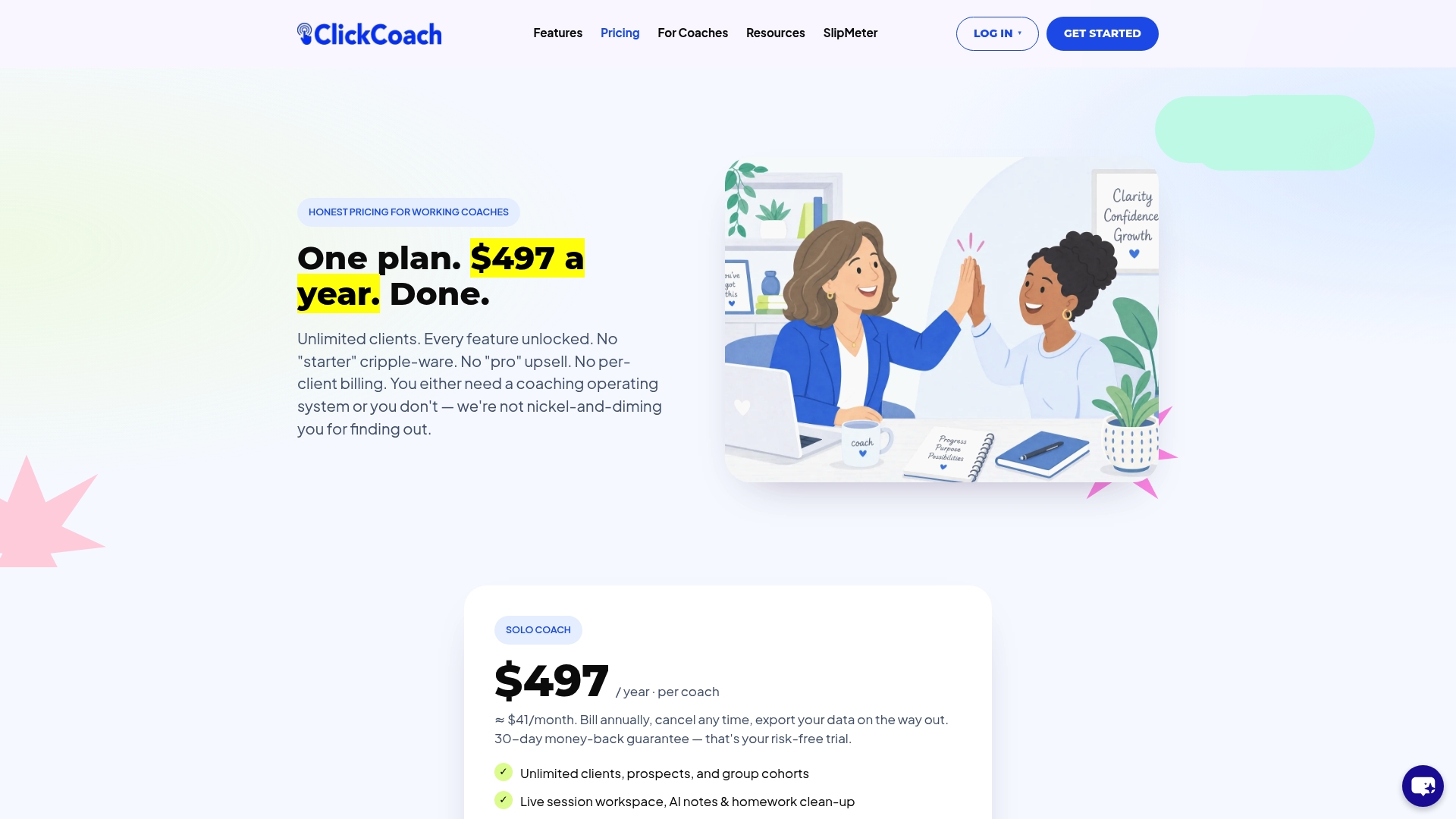
If you are evaluating ClickCoach, run the same checklist from earlier in this guide: test the pipeline stages against your real intake process, check the session notes workflow, confirm the AI opt-out setting, and pull a sample progress report before you decide anything. Pricing covers a Solo coach plan and a Multi-coach company plan, each $497 per year per coach, with a Partner or white-label option available on request, detailed on the ClickCoach pricing page. A 30-day money-back guarantee gives you room to run a real pilot with actual clients before the decision is final. If your current bottleneck is client acquisition rather than practice management, a lead generation resource for coaches covers that separate problem well.
Start your evaluation on the pricing page or go directly to join ClickCoach once you are ready to move your practice into one workspace.
FAQ
What makes coaching pipeline software different from a generic CRM?
A generic sales CRM tracks deals and contacts but has no concept of session notes, homework, or recurring progress assessments. Coaching pipeline software adds those practice-specific workflows, along with a client portal and billing built for ongoing coaching relationships rather than one-time sales.
How much does coaching practice management software typically cost?
Pricing varies by vendor and by whether you need a solo or multi-coach plan. ClickCoach, for example, prices its Solo coach and Multi-coach company plans at $497 per year per coach, listed on its pricing page, with a Partner or white-label option available on request.
Do coaches have ethical obligations around AI features in their software?
Yes. ICF guidance recommends transparency about how AI is used, explicit client consent, and an opt-out so client content is not used to train AI models, treating these as coach responsibilities rather than vendor defaults, according to ICF’s practical guide to AI and coaching.
What security measures should a coach confirm before signing up for software?
At minimum, confirm encryption for data at rest and in transit, a documented data retention and deletion policy, role-based access controls, and an incident response plan. The FTC’s Safeguards Rule outlines the broader framework that covered businesses, including service providers handling client data, are expected to follow, detailed in its Safeguards Rule guidance.
How long does it typically take to onboard a new coaching platform?
A staged rollout commonly runs a one to two week trial, followed by a two to four week pilot with a small group of real clients, then a four to eight week full rollout for the rest of your caseload. Timelines shift depending on how many coaches and legacy records you need to migrate.