

For most professional coaching practices that need a full client journey covering scheduling, secure notes, homework, billing, and group tools, the best approach is an all-in-one coaching practice management platform. The reason is simple: it brings sessions, progress tracking, billing, and client portals into one workspace instead of five. Your next step is to run the demo checklist below before you commit to anything.
TL;DR:
- A coaching platform must support the full client journey from intake to renewal, not just feature lists like calendar or video.
- Vendors should demonstrate live demos for both individual clients and cohorts, focusing on security, session management, and billing workflows.
- The platform should prioritize security features such as multifactor authentication, regular backups, and controlled data access, as recommended by NIST.
- A realistic implementation takes at least one month, with initial core setup, goal workflows, and security reviewed progressively through 30, 60, and 90-day milestones.
- Success depends on how well the software consolidates workflows into one workspace, supporting a secure, seamless client experience rather than just offering many features.
Table of Contents
- Must-have features for coaching engagement software
- [How to evaluate software in a demo: a coach-first client-journey checklist can be guided by frameworks like How to Run a Chatbot Vendor Evaluation That Actually Works to structure your demo checklist effectively.](#how-to-evaluate-software-in-a-demo-a-coach-first-client-journey-checklist-can-be-guided-by-frameworks-like-how-to-run-a-chatbot-vendor-evaluation-that-actually-workshttpsmonobotailibraryblogchatbot-vendor-evaluation-to-structure-your-demo-checklist-effectively)
- Realistic coach-to-client journey demonstrated with ClickCoach
- Our honest take on evaluating coaching software
- How to buy and get started with ClickCoach
- Quick implementation checklist: first 30, 60, and 90 days
- FAQ
- Sources
- Primary sources and standards referenced in this article
Must-have features for coaching engagement software
Before you compare vendors, know what you are actually buying. A coaching platform earns its subscription fee by removing friction at every stage of the client relationship, not by adding a longer feature list.
- Scheduling and session workflows: booking, calendar sync, automated reminders, recurring sessions, and a clear way to handle no-shows.
- Session management: secure notes, reusable templates, private coach-only fields, and time-stamped progress markers tied to each session.
- Goals, action plans, and homework: tasks you can assign, a view the client can check without emailing you, and outcomes you can measure over time.
- Branded client portal: a single place to deliver resources, collect homework submissions, and show progress dashboards the client actually opens.
- Billing and subscriptions: invoicing, recurring payments, and a straightforward refund process.
- Group and multi-coach administration: cohort enrollments, role-based permissions, and reporting that works across several coaches.
- Integrations and data portability: calendar and video syncing, payment processors, and the ability to export your own data.
- Security and data controls: multifactor authentication, access restrictions, backups, and clear retention and deletion rules.
The ICF’s platform standards frame this the same way: evaluate capability, safety, governance, and service quality together, not feature by feature. A platform that nails scheduling but handles notes poorly still leaves you exposed.
Pro Tip: Ask any vendor to show you a cancelled or refunded session end to end. It reveals more about the billing workflow than any pricing page.
How to evaluate software in a demo: a coach-first client-journey checklist can be guided by frameworks like How to Run a Chatbot Vendor Evaluation That Actually Works to structure your demo checklist effectively.
Feature lists are easy to fake in a sales call. A real client journey is not. Ask any vendor to run two live demos: one for a single client and one for a small cohort, both covering intake through first session, homework, progress review, and renewal.
- Watch how the agreement and intake form are stored, and ask who can access them later.
- Check whether session notes stay private to the coach or are visible to the client by default.
- Ask how homework gets assigned, submitted, and marked complete without a separate app.
- Confirm multifactor authentication is available and ask how often backups run.
- Ask for a sample renewal report that shows a client’s progress across months, not just the last session.
The ICF Code of Ethics (2025) requires coaches to co-create agreements and keep client records secure, so your recordkeeping questions in the demo are not optional extras. They are how you confirm the tool supports your professional obligations.
Grading your demo: score each vendor on ease of use, time to record a session, how visibly clients engage with portal features, and how clean the billing flow looks when something goes wrong.
NIST’s small-business cybersecurity guidance recommends multifactor authentication, restricted access to sensitive data, regular updates, and tested backups as baseline checks for any vendor a small firm relies on. Those four items belong on every demo scorecard.
Realistic coach-to-client journey demonstrated with ClickCoach
Here is how that journey looks inside a platform built for it. A new client fills out an intake form, which lands directly in their client record. After the first session, we draft session notes with AI-assisted follow-up suggestions, though the coach reviews and edits every draft before it is saved. Nothing goes to a client unreviewed.
From there, action plans and homework get assigned and tracked against the same client record. The client opens their branded portal to see assignments, submit homework, and check a progress chart that updates automatically. By the time renewal comes around, that chart is the proof point for the conversation, not a memory of how things went.
What this changes day to day:
- Less time spent switching between a calendar app, a notes document, a billing tool, and a separate client dashboard.
- Clearer accountability between sessions, since homework and goals live where the client can see them.
- Billing consolidated into the same workspace as the client’s progress history.
Pro Tip: During a trial, run one real client through intake, a session, and a homework assignment before judging the platform on anything else. The middle of the journey, not the sign-up screen, is where most tools show their limits.
Our honest take on evaluating coaching software
Most buying guides rank coaching software by counting features: calendar sync, video built in, number of integrations. That approach rewards the vendor with the longest spec sheet, not the one that actually supports a paying client relationship.

The better test is whether a platform holds up across a full client journey: intake, notes, homework, progress, and renewal, under the same security and recordkeeping expectations the ICF’s standards lay out. A tool with great scheduling and weak note security is not a safer bet just because it has more integrations.
We also think security gets treated as an afterthought by too many coaches, when it should be a first question. Multifactor authentication and tested backups are not technical details. They are the difference between a practice that recovers from a vendor problem and one that does not. Prioritize the client journey and the security basics first. Everything else is a convenience feature, not a dealbreaker.
— Mitch Russo
How to buy and get started with ClickCoach
Matching the plan to how you actually practice matters more than comparing line items. We offer three plan kinds on our pricing page:
- Solo coach: fits an independent practice running one-to-one sessions and managing their own billing.
- Multi-coach company (497 USD per year per coach): built for practices with several coaches who need shared reporting and permissions.
- Partner / white-label: suited to firms that want to offer the platform under their own brand; pricing is available on request.
Use a trial the same way you ran your demo checklist: push one real client through intake, a session, homework, and a progress check before judging the fit. A realistic onboarding pace looks like getting your first client journey live in week one, your templates and billing set up by week two, and your full roster migrated within the first month.
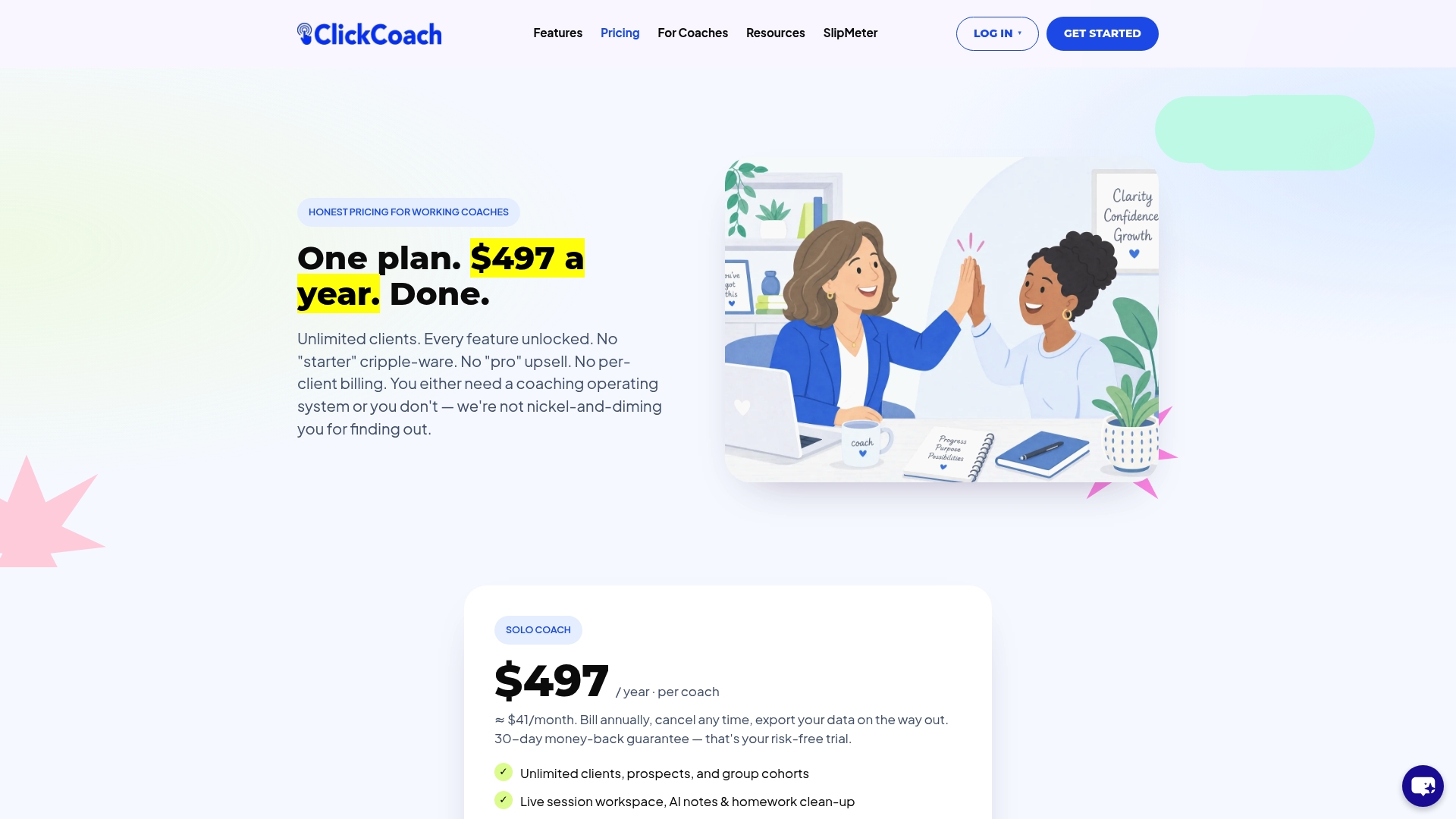
If you run a solo practice or manage a small team of coaches, start with our coaching business management platform and see how the full client journey holds together before you decide on a plan.
Quick implementation checklist: first 30, 60, and 90 days
Rolling out new software works best as a staged plan, not a weekend project.
- Days 1 to 30: migrate core client records, build your session note templates, turn on payment collection, and run your first full client journeys. Owner: the coach, with help from an admin if your practice has one.
- Days 31 to 60: configure goal and action plan workflows, stock your client portal with resources, and set up a basic retention report. Owner: the coach or practice manager, roughly a few hours a week.
- Days 61 to 90: finalize permissions for any multi-coach team, automate recurring billing, and review your security settings and backup schedule. Owner: whoever manages operations, with a security review suited to a solo or small firm per NIST’s small-business guidance.
Pro Tip: Do not wait until day 90 to check your backups. Confirm the export function works in week one, while switching costs are still low if something is missing.
FAQ
What should I look for first in coaching engagement software?
Start with how the platform handles a full client journey: intake, session notes, homework, progress tracking, and billing, rather than counting individual features. The ICF’s platform standards recommend judging capability, safety, governance, and service quality together.
How is coaching practice management software different from a coaching directory?
A practice management platform like ClickCoach handles the operational side of running sessions, tracking progress, and billing clients you already have. A directory, by contrast, helps prospective clients find a coach and plays no role in session delivery or client records.
What security features should a small coaching practice require?
At minimum, require multifactor authentication, restricted access to sensitive client data, regular software updates, and backups that are actually tested, not just scheduled. NIST’s small-business cybersecurity guidance outlines these as baseline controls for firms without dedicated IT staff.
Does coaching software work for group or cohort coaching, not just one-to-one?
Yes, though the feature set differs: look for cohort enrollment, role-based permissions for multiple coaches, and reporting that rolls up across a group rather than one client at a time. Our group coaching tools are built specifically for that multi-coach, multi-client structure.
How long does it take to get value from a new coaching platform?
A reasonable pace is a working client journey live within the first 30 days, core workflows like goals and portals configured by day 60, and full security and billing automation finalized by day 90. The exact timeline depends on how many client records and coaches you are migrating.
Sources
- Standards for Evaluating & Implementing a Coaching Platform
- ICF Code of Ethics (2025)
- NIST small-business cybersecurity guidance
- Best Coaching Software 2026 | Capterra