

ClickCoach is the recommended option when your primary job is to run and scale a coaching practice while using AI to draft homework, automate follow-up, and measure client progress. If your job is daily nudges for a large team or rehearsing a single high-stakes conversation, a different category fits better, and we explain why below. Either way, the evaluation criteria and evidence in this guide will help you choose with confidence.
TL;DR:
- Choose AI only coaching for in flow manager nudges, roleplay for one high stakes conversation, and practice management for client records, billing, and progress tracking.
- A 2026 randomized trial of 114 participants found larger effects from human coaching on goal attainment, wellbeing, and self confidence.
- Set a 30 to 60 day pilot, test exports, permissions, and integrations, and track homework completion and goal progress rather than login counts.
- ClickCoach prices both coach plans at $497 per coach annually and offers a 30 day money back guarantee; confirm export access and permissions before signing.
Table of Contents
- Which type of AI coaching tool fits your job to be done
- How AI coaching tools actually differ once you look under the hood
- What to check before you commit to a vendor
- Matching the tool to your specific role
- What the research says about AI coaching versus human coaching
- How to run a focused evaluation and pilot
- Getting a new AI coaching tool up and running
- Support and training you should expect from a vendor
- What I’ve learned watching coaches adopt AI tools
- Where ClickCoach fits if you’re running a coaching practice
- FAQ
- Sources
Which type of AI coaching tool fits your job to be done
Before comparing specific products, it helps to know which category you actually need. Most buyers land in one of four groups, and picking the wrong one wastes a trial period and a budget cycle.
- Practice-management platforms: best for running a coaching business end to end, with AI layered onto admin tasks like homework drafts and follow-up notes.
- AI-only continuous coaches: best for managers who want in-flow, daily nudges and self-directed development delivered at scale across a workforce.
- Roleplay and rehearsal platforms: best for practicing one specific high-stakes conversation, such as a sales pitch, a negotiation, or a job interview.
- Communication coaches: best for refining delivery, tone, and presentation skills rather than coaching on goals or strategy.
If you are a solo or multi-coach practice owner trying to replace spreadsheets, scattered notes, and a separate billing tool, you want a practice-management platform. If you are an HR or learning leader trying to put light-touch coaching in front of hundreds of managers, you want an AI-only continuous coach. If your goal is narrow rehearsal before one meeting, a roleplay tool does that one job well and nothing more. Knowing which bucket you’re in before you book a demo saves you from comparing tools that were never built to solve the same problem.
How AI coaching tools actually differ once you look under the hood
The surface pitch for most AI coaching tools sounds similar: smarter coaching, less friction. The differences show up in deployment, interaction pattern, and how much control you keep over client data.
- AI-only coaches run as a standalone chat or voice interface, often delivered through a web app or messaging integration, where the person being coached talks directly to the model with no human coach in the loop.
- Hybrid tools pair a human coach with AI support for scheduling, note summarization, or homework drafts, keeping the coach as the primary relationship while AI handles repetitive tasks.
- Roleplay and rehearsal engines simulate a specific scenario, such as a performance review or a sales call, and score the user’s responses against a rubric.
- Practice-management platforms center on the coach’s workflow: client records, session notes, goals, progress tracking, and billing, with AI assisting inside that structure rather than replacing it.
Integration pattern matters as much as the model itself. Tools embedded in the systems people already use, like a calendar, Slack, or Teams, tend to see steadier use than tools that require opening a separate app for every interaction. A standalone platform can still work well for coaches, since client sessions are already a scheduled, dedicated activity rather than something that needs to happen “in the flow of work.”
Privacy and admin controls diverge sharply by category. AI-only tools built for enterprise rollouts usually include admin dashboards, data retention settings, and aggregate reporting for HR. Practice-management platforms built for individual coaches tend to focus controls on the coach-client relationship: who can see session notes, how client data is exported, and what a client can access through their own portal.
Pro Tip: Ask any vendor to show you their data export process during the demo, not just describe it. If they can’t show it live, treat that as a real limitation.
What to check before you commit to a vendor
A good demo isn’t about watching a slideshow. It’s about testing the specific tasks you’ll actually do every week.
- Conversation realism and feedback quality: for roleplay tools, ask for a sample transcript and scoring rubric, not just a live demo script.
- Progress measurement: check whether the tool supports structured goal frameworks and dashboards you can show a client as renewal proof, similar to the accountability tracking features built into practice-management platforms.
- Integrations and workflow fit: confirm calendar sync, messaging integrations, billing, and whether clients get their own portal.
- Privacy and data controls: ask directly about deletion policies, export formats, consent flows, and who holds admin permissions.
- Admin and team features: for multi-coach practices, test whether an owner can see across coaches’ caseloads without compromising individual client confidentiality.
- Pricing model: expect either a flat per-seat annual fee or a custom enterprise quote, and ask what happens to your data if you cancel.
A 2025 workplace study found that users rated human coaches higher than a commercially available AI coaching agent on insights, goal attainment, working alliance, and commitment, though trust and confidentiality scores were similar between the two. That gap matters directly to your evaluation: a tool’s conversation quality and reporting need to earn trust on their own, because the AI layer alone doesn’t close the gap with human coaching on most outcome measures.
Matching the tool to your specific role
The right tool depends heavily on who is doing the coaching and who is being coached. A feature that matters enormously to one buyer is irrelevant to another.
- Personal life coaching: look for journaling support, strong privacy defaults, habit nudges, and a reflection tool available outside scheduled sessions.
- Career coaching: prioritize mock interview practice, resume and LinkedIn draft assistance, and a structured job-search workflow you can track over weeks.
- Manager and team development: focus on in-flow nudges delivered inside existing communication tools, manager-level dashboards, and aggregate metrics rather than individual transcripts.
- Professional coaches running a practice: the priority shifts to practice management: branded client portals, organized session notes, billing, and progress charts you can show a client at renewal time.
That last group is where a platform like ClickCoach is purpose-built, bringing client records, goals, and billing into one coaching business management workspace rather than asking a coach to stitch together a CRM, a notes app, and a payment processor. A coach juggling twenty active clients across three tools loses hours every week to re-entering the same information, and that time comes directly out of either billable hours or personal time.
If your work centers on executive-level transformation, leadership identity shifts, or helping a professional through a major career transition, that kind of deep, sustained engagement is better served by a structured coaching relationship than by a self-serve AI chatbot. Programs like the 90-day AI leadership coaching track for executives combine human coaching with AI-assisted tools for exactly this kind of identity-level work, which sits closer to hybrid coaching than to either pure AI-only or pure practice-management categories.
What the research says about AI coaching versus human coaching

The evidence so far points in a consistent direction: AI coaching tools are strongest as an addition to human coaching, not a replacement for it, at least for outcomes that depend on trust and relationship depth.
A 2025 quasi-experimental workplace study comparing human coaches against a commercially available AI coaching agent called Alpina found statistically significant differences favoring human coaches on several engagement factors, with trust and confidentiality scoring similarly between the two. A separate 2026 randomized controlled experiment with 114 participants, comparing accredited human coaches against automated AI coaches using validated psychometric measures, found that human coaching produced larger effect sizes for goal attainment, wellbeing, and self-efficacy.
AI coaching is most valuable when it augments human workflows, automating follow-ups, drafting homework, and scaling low-stakes practice, rather than substituting for relational, high-trust coaching.
The practical takeaway: use AI tools for rehearsal, reminders, and scale, and keep a human coach in the loop for the kind of change work that depends on trust built over time. On the governance side, the NIST AI Risk Management Framework outlines four functions, Govern, Map, Measure, and Manage, and recommends rigorous testing and privacy-by-design practices for any organization deploying AI systems that handle sensitive personal data, which coaching conversations certainly are.
How to run a focused evaluation and pilot
A structured pilot beats a gut decision every time, and it doesn’t need to take more than a few weeks to produce a clear answer.
- Run a live roleplay or conversation test during the demo rather than relying on a canned script.
- Ask for a sample data export to confirm you can actually get your client records out if you switch tools later.
- Review admin settings to see who can access client notes and whether permissions are granular enough for a multi-coach team.
- Test the calendar and billing integrations with your actual tools, not the vendor’s demo environment.
- Request a sample report or dashboard to see whether progress tracking produces something you’d actually show a client.
- Clarify data ownership and deletion terms in writing before you sign anything.
- Set a 30 to 60 day pilot window with a small group of clients or team members before committing to a full rollout.
During the pilot, measure engagement, completion of assigned homework or lessons, and actual goal progress rather than just login counts, since those three numbers tell you whether the tool is changing behavior or just adding another notification.
| Red flag | Why it matters |
|---|---|
| Opaque or quote-only pricing with no self-serve option | Makes it hard to compare true cost across vendors |
| No admin or permission controls | Risks client confidentiality in multi-coach settings |
| No clear data export path | Locks you into the platform if you want to leave |
| No visible testing or governance documentation | Signals the vendor hasn’t addressed privacy risk directly |
Getting a new AI coaching tool up and running
Rolling out a new coaching tool goes smoothly when you treat it as a short project rather than a flip of a switch. Start by migrating existing client records and session history before inviting clients into any new portal, so nothing gets lost in the transition.
Most practice-management platforms offer guided setup for importing contacts, building your first goal templates, and connecting billing. Set aside a dedicated week to build out your session note templates and homework formats before your first live session on the new system, rather than trying to configure things on the fly between client calls.
For multi-coach practices, onboarding needs a second layer: deciding who has admin access, how new coaches get added, and what client data transfers if a coach leaves the practice. Walk through this with your team before launch day, not after a problem surfaces.
Clients generally need less onboarding than coaches expect. A clear welcome message explaining how to log into their portal, where to find homework, and how to message you between sessions covers most of what they need. Keep that message short, since a long onboarding email tends to get skimmed rather than read.
Budget two to three weeks total for a clean transition: one week for data migration and template setup, one week for a soft launch with a handful of clients, and a final week to fix anything that didn’t translate well before rolling out to your full caseload.

Support and training you should expect from a vendor
Reasonable support access matters more once you’re mid-pilot and something isn’t working the way you expected. Before you commit, confirm what channels are available: email support, live chat, or a dedicated account contact, and what response times look like for each.
Documentation quality varies widely across vendors. Look for a searchable knowledge base covering common setup tasks, not just a single onboarding PDF. Video walkthroughs for core workflows, like setting up a client portal or building a progress dashboard, save real time compared to text-only guides.
Ask whether live onboarding calls are included or billed separately, particularly if you’re setting up a multi-coach practice with several admins who each need a walkthrough. A platform that offers a structured onboarding call tends to get teams live faster than one that points you to a help center and leaves you to figure out the rest.
Ongoing training resources matter too, especially as a vendor adds features. Check whether the vendor publishes release notes or runs occasional webinars on new functionality, since a tool that evolves without clear communication forces you to discover changes by accident during a live client session, which is the worst possible time to find a new button you didn’t expect.
What I’ve learned watching coaches adopt AI tools
AI earns its keep in a coaching practice by handling the parts of the job that drain time without building the relationship: drafting homework, summarizing a session, flagging a missed check-in. Used that way, it gives a coach back hours for the actual coaching conversation.
The risk shows up when AI starts to replace judgment rather than support it. A homework draft should be a starting point the coach edits before it reaches a client, not an auto-sent message. Clients notice when a response feels generic, and that erodes the trust a coaching relationship depends on.
One shift I’d encourage any coach to make: review every AI-drafted note before it goes out, every time, no exceptions. It takes a minute and it keeps the human relationship, not the software, at the center of the work.
— Mitch Russo
Where ClickCoach fits if you’re running a coaching practice
If your job is to run a coaching business rather than just deliver sessions, ClickCoach brings the pieces most practices juggle separately into one workspace: client records, session notes, goals, action plans, homework, progress tracking, billing, and branded client portals, with AI helping draft homework and follow-up actions while you stay in control of what goes out.
- Solo coaches get client management, billing, and branded portals without stitching together separate apps.
- Multi-coach practices get admin visibility across coaches while keeping individual client relationships intact.
- Practices scaling into a brand can explore the partner and white-label option built for that stage.
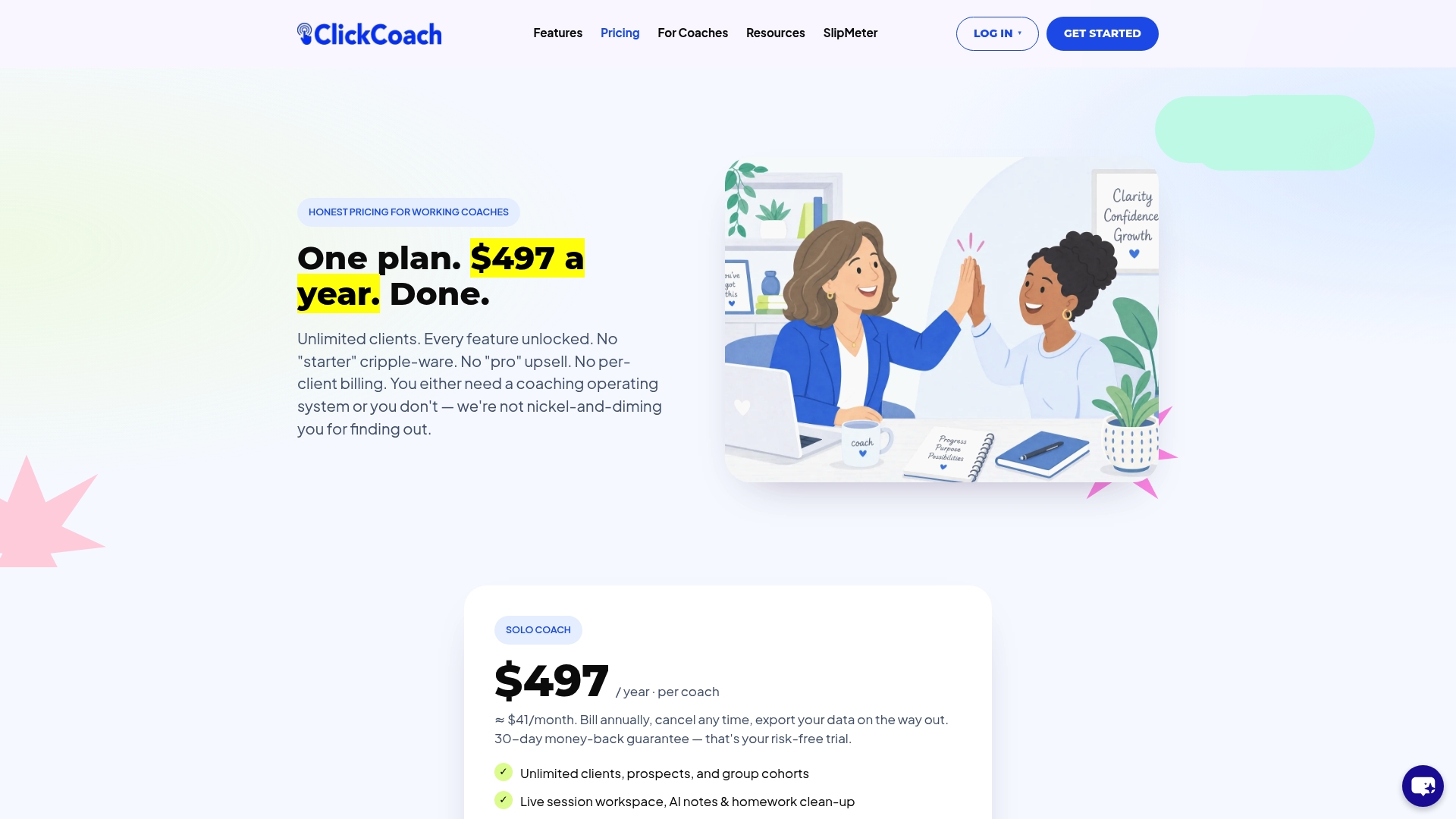
Run it through the same checklist covered earlier: test the homework draft quality, check your export options, and confirm the admin permissions fit your team before you commit. Pricing is straightforward: both the Solo coach and Multi-coach company plans run $497 USD per year per coach, backed by a 30-day money-back guarantee if the fit isn’t right.
See the full feature set on the coaching platform page, or go straight to pricing to start a trial.
FAQ
Which AI tool is best for coaching?
The best choice depends on the job: a practice-management platform fits coaches running a full business, while an AI-only tool fits large-scale manager nudges and a roleplay tool fits single-scenario rehearsal. For coaches managing client records, billing, and progress tracking in one workspace, ClickCoach is built specifically for that job.
Which AI is the best for career coaching?
For career coaching, look for a tool built around mock interview practice, resume and LinkedIn drafting, and a structured job-search workflow rather than a general-purpose chatbot. Roleplay and rehearsal platforms tend to fit this use case better than AI-only continuous coaches, which are built more for ongoing manager development.
Can ChatGPT be my life coach?
A general AI assistant can support reflection, journaling prompts, and brainstorming, but research comparing human and AI coaching found human coaches rated higher on insights, goal attainment, and working alliance than a commercially available AI coaching agent. For sustained personal change, a structured coaching relationship, with or without AI support tools layered in, tends to outperform an unstructured chatbot conversation.
What are the top AI tools for coaching?
The top tools fall into a few distinct categories rather than one ranked list: practice-management platforms for running a coaching business, AI-only continuous coaches for in-flow manager nudges, and roleplay engines for rehearsing specific conversations. The right pick depends on whether you’re coaching clients, managing a team, or running a practice, since each category solves a different problem.